Have you ever felt so overwhelmed by stress, frustration, or sadness that it became difficult to think clearly or control your reactions? You might have heard someone describe that experience as being dysregulated. But is the correct word dysregulated or disregulated, and what does it actually mean?
Although both spellings appear in online searches and everyday conversations, dysregulated is the established term used in psychology, medicine, and scientific writing. It generally describes a situation in which a system struggles to regulate itself properly. When discussing emotions, for example, it can mean having difficulty managing emotional responses, returning to a calm state, or responding proportionately to a stressful situation.
Understanding the difference between these terms can help you use the right word, recognize emotional regulation difficulties, and better understand what people mean when they talk about feeling overwhelmed.
Dysregulated or Disregulated: Which Is Correct?
Dysregulated is the standard and preferred spelling. It is widely used in psychological research, healthcare, and discussions about emotional well-being.
The word combines the prefix dys-, which commonly indicates something impaired, abnormal, or difficult, with regulated, meaning controlled or adjusted according to a particular process.
Disregulated occasionally appears in informal writing, search queries, and spelling variations. However, it is not the usual choice in contemporary clinical and scientific terminology.
Here is a simple comparison:
| Word |
Meaning and usage |
| Dysregulated |
The established term for a system that has difficulty regulating itself. |
| Disregulated |
A less-standard spelling that is generally best avoided in formal writing. |
| Regulated |
Controlled, managed, or maintained within an appropriate range. |
| Dysregulation |
The noun describing impaired or disrupted regulation. |
Example: “After a stressful day, she felt emotionally dysregulated and needed time to calm down.”
For articles, academic assignments, professional communication, and health-related content, choose dysregulated unless you are quoting a source that uses another spelling.
What Does Dysregulated Mean?
Dysregulated means that a process or system is having difficulty maintaining its normal balance or responding appropriately to changing conditions.
The word is not limited to emotions. It can describe different systems in the human body, including those involved in sleep, hormones, metabolism, and stress responses.
In everyday conversation, however, the term most often appears in discussions about emotional regulation and the nervous system.
What Does Emotionally Dysregulated Mean?
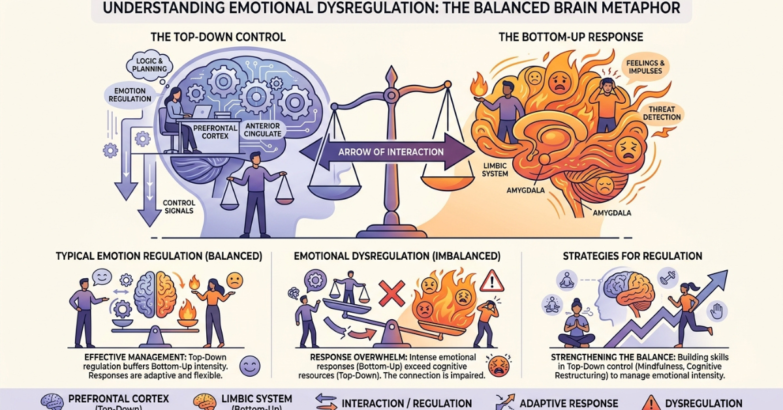
Emotional dysregulation refers to difficulty managing the intensity, duration, or expression of emotions. A person may experience feelings that become so strong that it is hard to think clearly, communicate calmly, or choose an appropriate response.
For example, imagine receiving critical feedback at work. One person might feel disappointed, consider the feedback, and move on. Another might experience intense anxiety or anger, struggle to concentrate, and remain upset long after the conversation ends.
That difference does not automatically mean the second person has a mental health condition. Emotional responses are influenced by many factors, including stress, sleep, personal experiences, environment, and available coping skills.
What Does Nervous System Dysregulation Mean?
The nervous system helps the body respond to challenges, recognize safety, and return toward a resting state after periods of activation.
When people use the phrase nervous system dysregulation, they may be referring to difficulties with stress responses, arousal, relaxation, or other aspects of nervous system functioning. The exact meaning depends on the context.
For instance, someone who feels persistently on edge after a stressful experience might describe themselves as being in a dysregulated state. However, this phrase alone does not establish that their nervous system has a specific medical problem.
Common Signs of Emotional Dysregulation
Emotional dysregulation can look different from one person to another. Some people express distress openly, while others withdraw, become quiet, or struggle to explain what they are feeling.
Common signs may include:
- Intense emotional reactions: Feeling unusually angry, anxious, sad, or frustrated in response to everyday challenges.
- Difficulty calming down: Remaining upset long after a stressful event has passed.
- Impulsive behavior: Saying or doing something in the heat of the moment and regretting it later.
- Frequent mood changes: Experiencing shifts in mood that feel difficult to manage.
- Emotional shutdown: Feeling numb, disconnected, or unable to communicate when overwhelmed.
- Low frustration tolerance: Finding minor inconveniences surprisingly difficult to handle.
- Relationship difficulties: Struggling to resolve disagreements because emotions become too intense.
Experiencing one or more of these signs occasionally does not necessarily indicate a disorder. What matters is the frequency, intensity, duration, and impact on everyday life.
What Causes Emotional Dysregulation?
There is no single explanation for why someone may struggle to manage emotions. Emotional regulation develops over time and can be affected by biological, psychological, and environmental factors.
1. Stress and Burnout
Long working hours, financial worries, family responsibilities, and ongoing uncertainty can make emotional regulation more difficult. When someone is already exhausted, even a relatively small problem may feel overwhelming.
2. Lack of Sleep
Sleep affects mood, concentration, patience, and decision-making. Poor sleep can make it harder to cope with frustration and recover from stressful experiences.
3. Childhood Experiences and Trauma
Growing up in an unpredictable, unsafe, or highly stressful environment may affect how a person learns to recognize and manage emotions. Trauma experienced during childhood or adulthood can also contribute to difficulties with emotional regulation.
These experiences do not affect everyone in the same way, and a difficult childhood does not automatically lead to emotional dysregulation.
4. Mental Health and Neurodevelopmental Conditions
Emotional regulation difficulties may occur alongside conditions such as attention-deficit/hyperactivity disorder (ADHD), anxiety disorders, depression, post-traumatic stress disorder (PTSD), and certain mood or personality disorders.
However, emotional dysregulation is a symptom or feature, not a diagnosis on its own. A qualified healthcare professional can help determine whether an underlying condition is involved. <Cite refs={[“turn229943search1″,”turn229943search0”]}/>
5. Physical Health and Other Factors
Hormonal changes, certain neurological conditions, medication effects, and other health concerns may influence mood or emotional responses. If emotional changes begin suddenly, become severe, or occur alongside other physical symptoms, consider speaking with a healthcare professional.
How to Manage Emotional Dysregulation
The goal of emotional regulation is not to eliminate difficult emotions. Anger, sadness, fear, and disappointment are normal parts of life. The aim is to understand those emotions and respond in ways that protect your well-being and relationships.
Here are several practical strategies that may help.
1. Recognize What You Are Feeling
Before trying to change your reaction, give yourself a moment to identify the emotion.
Instead of thinking, “Everything is going wrong,” try to be more specific: “I’m feeling disappointed because I expected a different outcome.”
Naming an emotion can help you understand what is happening and decide what to do next.
2. Pause Before Reacting
When emotions become intense, avoid rushing into an argument, sending an angry message, or making an important decision.
Try this simple routine:
- Stop what you are doing for a moment.
- Take a few slow, comfortable breaths.
- Notice the physical sensations you are experiencing.
- Give yourself time before responding.
- Choose a response that fits the situation rather than reacting automatically.
Even a short pause can create space for a more thoughtful decision.
3. Identify Your Triggers
A trigger is a situation, experience, or reminder that brings up a strong emotional response.
For example, you may notice that criticism, unexpected changes, feeling ignored, or being rushed makes it harder to stay calm.
Keeping a simple journal can help you identify patterns. Record what happened, how you felt, what you did, and what helped you recover.
4. Take Care of Your Physical Needs
Emotional well-being is closely connected to everyday habits. Try to maintain a reasonably consistent sleep schedule, eat regularly, get appropriate physical activity, and make time for rest.
These habits are not a substitute for professional care when it is needed, but they can support your ability to cope with stress.
5. Practice Healthy Communication
When you feel overwhelmed, explain what you need without blaming the other person.
For example, instead of saying, “You always make me angry,” try saying, “I’m feeling overwhelmed right now, and I need a little time before we continue this conversation.”
This approach can reduce conflict and help others understand your experience.
6. Consider Professional Support
If emotional difficulties repeatedly affect your relationships, work, education, or daily routines, consider speaking with a mental health professional.
Depending on your needs, support may include cognitive behavioral therapy (CBT), dialectical behavior therapy (DBT), or other approaches that teach emotional awareness, distress tolerance, and coping skills. Treatment should be tailored to the individual rather than chosen solely because a particular symptom is present. <Cite refs={[“turn229943search1″,”turn229943search2”]}/>
Dysregulated vs. Regulated: Understanding the Difference
The distinction becomes easier to understand when you compare how someone might respond to the same stressful situation.
| Situation |
Regulated response |
Dysregulated response |
| Receiving criticism |
Listening, reflecting, and asking questions |
Becoming overwhelmed or reacting impulsively |
| Having an argument |
Taking a break and returning to the discussion |
Shouting, withdrawing completely, or struggling to stop arguing |
| Facing an unexpected change |
Feeling disappointed and adjusting plans |
Experiencing intense distress that is difficult to manage |
| Making a mistake |
Acknowledging the mistake and learning from it |
Becoming consumed by frustration or self-criticism |
These are illustrative examples, not rigid categories. A person who is usually emotionally regulated can still have an intense reaction under pressure, and a person who struggles with regulation can respond calmly in many situations.
Emotional regulation is a skill that varies with circumstances. It does not mean remaining calm every second of the day.
Dysregulated in a Sentence: Examples of Correct Usage
If you are unsure how to use the word, these examples show how it fits into everyday and professional writing.
- “After several nights of poor sleep, I felt emotionally dysregulated at work.”
- “The child became dysregulated when the classroom routine suddenly changed.”
- “She took a short break to help herself feel calmer and more focused.”
- “Chronic stress may affect the body’s ability to regulate certain physiological processes.”
- “The therapist helped him develop strategies for managing intense emotional reactions.”
- “Researchers investigated dysregulated immune responses in patients with the condition.”
- “When I feel overwhelmed, I try to recognize my emotions before responding.”
Notice that the word can describe emotional experiences, behavior, or biological processes. Its precise meaning depends on the context.
Frequently Asked Questions
1. Is it dysregulated or disregulated?
Dysregulated is the standard spelling used in psychology, medicine, and scientific writing. Disregulated appears occasionally but is generally considered nonstandard in these contexts.
2. What does dysregulated mean in simple terms?
It means having difficulty keeping a process or response within its usual or appropriate range. When referring to emotions, it means struggling to manage feelings or reactions effectively.
3. Is dysregulation the same as being upset?
No. Being upset is a normal emotional response. Dysregulation generally refers to difficulty managing or recovering from emotional responses, particularly when the difficulty is intense, persistent, or disruptive.
4. What does it mean when a child is dysregulated?
It usually means the child is having difficulty managing emotions or behavior in that moment. The child might cry, yell, become frustrated, withdraw, or struggle to follow instructions. Fatigue, hunger, overstimulation, stress, and developmental factors may contribute.
Children often need adult support to develop emotional regulation skills. Repeated or severe difficulties may warrant discussion with a pediatrician or qualified child mental health professional.
5. Can adults experience emotional dysregulation?
Yes. Adults can experience difficulties managing strong emotions, especially during periods of stress, exhaustion, trauma, or illness. Emotional regulation skills can also be developed and strengthened throughout adulthood.
6. Is emotional dysregulation a mental illness?
Not by itself. Emotional dysregulation is a descriptive term for difficulties managing emotions and may occur with several mental health or neurological conditions. Its presence alone does not establish a diagnosis.
7. How long does a dysregulated state last?
There is no fixed duration. A person may recover from a brief episode within minutes, while other situations can involve distress that lasts much longer. The duration depends on the individual, the circumstances, and the factors contributing to the reaction.
If distress is persistent or interferes with everyday functioning, professional guidance may be helpful.
8. How can you calm down when you feel dysregulated?
Try slowing your breathing, reducing unnecessary stimulation, taking a short break, identifying the emotion you are experiencing, or speaking with someone you trust. Choose a strategy that feels safe and appropriate for your circumstances.
If one technique does not help immediately, that does not mean you have failed. Different strategies work for different people.
9. What is the difference between dysregulation and deregulation?
Dysregulation means impaired or disrupted regulation of a system. Deregulation generally means removing or relaxing rules, controls, or restrictions, often in economic or institutional settings. The words have different meanings and should not be used interchangeably.
10. What is the opposite of dysregulated?
Depending on the context, useful opposites include regulated, well-regulated, or effectively regulated. When discussing emotions, emotionally regulated describes being able to recognize and manage feelings in a way that supports appropriate responses.
Conclusion
When deciding between dysregulated or disregulated, the best choice is dysregulated. It is the established spelling used to describe impaired regulation in emotional, psychological, medical, and scientific contexts.
Emotional dysregulation can involve difficulty managing strong feelings, calming down after stressful experiences, or responding thoughtfully under pressure. It can be influenced by sleep, stress, personal experiences, and underlying health conditions, but it does not automatically indicate a mental health disorder.
The good news is that emotional regulation skills can improve with practice, appropriate coping strategies, and professional support when necessary.
If you are writing about this topic for a blog, school assignment, or educational resource, use dysregulated for accuracy. If you are experiencing persistent emotional difficulties yourself, consider seeking guidance from a qualified professional who can help you understand what is happening and identify suitable next steps.