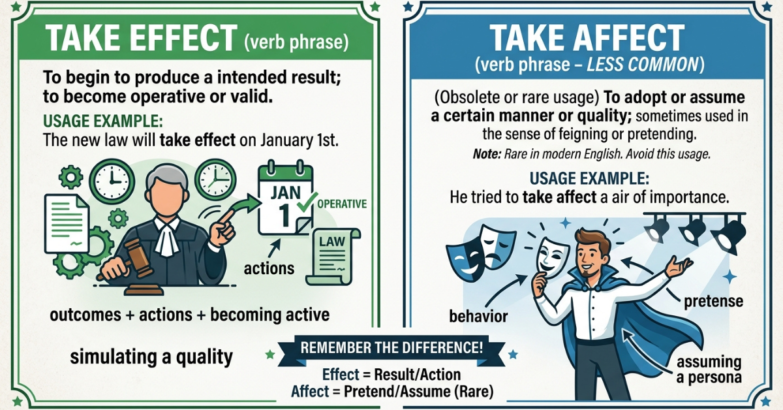
Have you ever paused while writing an email, assignment, or important announcement because you weren’t sure whether to write take effect or take affect? You’re not alone. These expressions look almost identical, but only one is correct in standard English for expressing that something begins to happen or becomes active.
The correct phrase is take effect. It means that a rule, decision, law, policy, treatment, or change begins to operate or produce a result. Although affect is a common English word, using it in this particular expression is generally a grammatical mistake.
In this guide, we’ll explain why take effect is correct, how effect and affect differ, and how to use both words confidently in everyday writing.
Take Effect or Take Affect: Which One Is Correct?
The correct expression is take effect, not take affect.
The distinction becomes easier to understand when you look at the role each word plays in a sentence.
- Take effect: Means to become active, begin operating, or start producing a result.
- Affect: Usually functions as a verb meaning to influence or change something.
For example:
- Correct: The new company policy will take effect on Monday.
- Incorrect: The new company policy will take affect on Monday.
In the correct sentence, the policy begins to apply on Monday. The word effect is a noun referring to the result or operation of a change.
A useful way to remember this is that rules, policies, and agreements generally take effect when they become active.
What Does “Take Effect” Mean?
The phrase take effect means to begin functioning, become applicable, or start having an impact. It is commonly used when discussing laws, regulations, workplace policies, medication, insurance coverage, and planned changes.
The exact meaning depends on the context, but the basic idea remains the same: something has reached the point where it starts operating or producing a result.
Examples of Take Effect in Sentences
Here are several examples showing how to use the phrase correctly.
In everyday situations:
- The new school timetable will take effect next week.
- The discount takes effect when you enter the promotional code.
- The changes to the website will take effect after the next update.
In business and employment:
- The revised salary structure will take effect on January 1.
- The company’s new attendance policy takes effect tomorrow.
- The updated contract terms will take effect once both parties approve them.
In law and government:
- The new regulation will take effect after its official implementation date.
- The tax changes are scheduled to take effect next year.
- The amendment took effect following the required approval process.
In healthcare:
- The medication may take effect within the timeframe specified by your healthcare professional.
- The treatment began to take effect after several sessions.
Notice that take effect can appear in the present, past, or future tense. The form changes according to the sentence, but the expression remains the same.
What Is the Difference Between Effect and Affect?
The confusion often comes from the fact that effect and affect are pronounced similarly and have related meanings. However, they usually serve different grammatical purposes.
| Word |
Usual role |
Meaning |
Example |
| Effect |
Noun |
A result or consequence |
The new rule had a positive effect. |
| Affect |
Verb |
To influence or change something |
The new rule may affect employees. |
| Take effect |
Verb phrase |
To become active or begin producing a result |
The new rule takes effect tomorrow. |
The most useful distinction is simple: affect usually describes an action, while effect usually describes a result.
For example, a change in working hours may affect employees. When that change officially begins to apply, it takes effect. Once it is in operation, it may have an effect on productivity.
These three expressions are related, but they are not interchangeable.
When Should You Use “Affect”?
Use affect when you mean to influence, alter, or make a difference to something.
Examples include:
- Lack of sleep can affect your concentration.
- Heavy rain affected traffic across the city.
- The price increase may affect customer demand.
- A new marketing strategy could affect sales performance.
In each example, affect describes something influencing another thing.
When Should You Use “Effect”?
Use effect as a noun when referring to a result, consequence, or outcome.
Examples include:
- The new policy had an immediate effect on productivity.
- Exercise can have a positive effect on your mood.
- The medicine produced the expected effect.
- The changes had little effect on customer satisfaction.
Remember that effect can also be a verb in formal contexts, meaning to bring something about. For example, “The organization hopes to effect meaningful change.” However, this less common usage does not make take affect correct.
How to Remember the Correct Phrase
If you regularly confuse these words, a few simple memory tricks can help.
1. Remember the Rule: “Take Effect”
Whenever you mean that something becomes active or starts operating, use take effect.
Think of a new law, policy, or agreement becoming officially applicable. It takes effect on a particular date.
2. Use the Result Test
Ask yourself whether you are talking about a result or an action.
- If you mean a result, effect is usually the right noun.
- If you mean to influence something, affect is usually the right verb.
- If something is beginning to operate, use take effect.
For example:
“The new schedule will ___ employee productivity.”
Here, affect is correct because the schedule will influence productivity.
“The new schedule will ___ on Monday.”
Here, take effect is correct because Monday is when the schedule begins to apply.
3. Read the Sentence Aloud
Reading your sentence aloud can help you identify whether the expression fits naturally. Although effect and affect often sound similar, checking the intended meaning is more reliable than relying on pronunciation alone.
Common Mistakes to Avoid
Even experienced writers sometimes confuse these words, particularly when writing quickly. The following mistakes are easy to correct.
Mistake 1: Using “take affect” for a start date
Incorrect: The new regulations will take affect in December.
Correct: The new regulations will take effect in December.
Mistake 2: Using “effect” when you mean “influence”
Incorrect: The weather may effect our travel plans.
Correct: The weather may affect our travel plans.
The first sentence could be grammatical in a different context if effect means to bring something about, but it does not express the intended meaning of influencing travel plans.
Mistake 3: Confusing “in effect” with “take effect”
These expressions are related but have different uses.
- Take effect: The new rules will take effect tomorrow.
- In effect: The new rules are currently in effect.
The first describes when the rules begin operating. The second describes their active status.
Mistake 4: Assuming “effect” always refers to something positive
An effect can be positive, negative, or neutral. For instance, a new policy may have a positive effect on productivity or a negative effect on employee morale.
Take Effect vs. Come Into Effect vs. Go Into Effect
You may also encounter the expressions come into effect and go into effect. All three are accepted in standard English and often communicate the same basic idea.
| Expression |
Meaning |
Example |
| Take effect |
Begin operating or producing results |
The new policy takes effect Monday. |
| Come into effect |
Begin to apply or operate |
The regulation comes into effect next month. |
| Go into effect |
Begin to be implemented or apply |
The agreement goes into effect immediately. |
The difference is largely a matter of phrasing and regional preference. Come into effect and go into effect are particularly common when discussing laws, regulations, and formal agreements.
Choose the expression that sounds natural in your sentence, and keep your wording consistent throughout formal documents.
Frequently Asked Questions
1. Is it “take effect” or “take affect”?
The correct expression is take effect. It means that something begins operating, becomes active, or starts producing a result. Take affect is not the standard expression for this meaning.
2. Why is “take effect” correct?
In this phrase, effect is a noun referring to a result or operation. The verb take combines with the noun to form an expression meaning to begin operating or producing results.
3. Does “take effect” mean the same as “affect”?
No. Take effect means to become active or begin producing a result. Affect generally means to influence or change something.
For example, a policy may affect employees when it takes effect.
4. Is it “the law takes effect” or “the law takes affect”?
“The law takes effect” is correct. It means the law begins to apply or operate on a particular date. The actual start date may depend on the law’s provisions and applicable legal requirements.
5. Can I say “the medicine takes effect”?
Yes. This is a common and grammatically correct expression. It means the medicine begins producing an intended or observable effect. The time required varies depending on the medication, dosage, and individual circumstances.
6. What is the difference between “take effect” and “in effect”?
Take effect describes the point when something begins to operate. In effect describes a state in which something is active or applicable.
For example, “The policy takes effect tomorrow” identifies its start date, while “The policy is in effect” means it is currently active.
7. Is “come into effect” grammatically correct?
Yes. Come into effect is a correct alternative to take effect. Both can describe a law, rule, or policy beginning to apply.
8. What is the past tense of “take effect”?
The past tense is took effect.
For example: “The new policy took effect last month.”
You can also use has taken effect when describing something that became active in the past and remains relevant to the present.
9. Can “effect” be used as a verb?
Yes. Although effect is most often used as a noun, it can also mean to bring about or accomplish something.
For example: “The committee plans to effect major changes.”
This formal use is different from the more common verb affect, which means to influence.
10. How can I avoid confusing effect and affect?
Remember the general rule: affect is usually a verb meaning to influence, while effect is usually a noun meaning a result. When you mean that something becomes active or begins operating, use take effect.
Conclusion
When deciding between these two expressions, the correct choice is take effect. Use it whenever you want to describe a law, policy, agreement, treatment, or other change beginning to operate or produce results.
Keep the basic distinction in mind: affect usually means to influence something, while effect usually refers to a result. Once you understand how these words function in a sentence, choosing the correct expression becomes much easier.
Before publishing your next email, report, assignment, or article, take a moment to check the intended meaning. A small grammatical distinction can make your writing clearer, more professional, and easier to understand. For more practical English explanations, explore related guides on commonly confused words and everyday grammar mistakes.