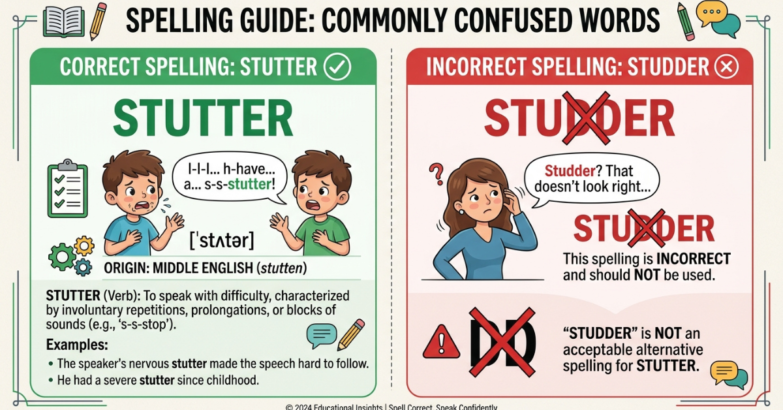
Have you ever wondered whether the correct spelling is studder or stutter? You’re not alone. These two spellings look similar, and because they sound almost identical in everyday conversation, it’s easy to mix them up when writing.
The correct spelling in standard English is stutter. It refers to a speech pattern in which someone repeats sounds or syllables, stretches certain sounds, or experiences difficulty getting a word out. Although studder is a common misspelling, it is not the standard spelling of the word used to describe this speech difficulty.
Understanding the difference is useful not only for improving your spelling but also for learning about stuttering, why it happens, and how it can affect communication. Let’s explore the meaning, pronunciation, causes, and treatment options in a straightforward way.
Studder vs. Stutter: What’s the Difference?
The main difference between these words is their spelling and standard usage.
| Word |
Meaning |
Correct Usage |
| Stutter |
A speech difficulty involving repetitions, prolonged sounds, or blocks |
Correct standard English spelling |
| Studder |
A common misspelling of stutter |
Generally incorrect when referring to a speech disorder |
For example:
- Correct: He sometimes stutters when speaking in front of a large audience.
- Incorrect: He sometimes studders when speaking in front of a large audience.
The confusion is understandable because English spelling doesn’t always reflect pronunciation perfectly. If you’ve typed studder before, the important thing to remember is that the standard spelling is stutter.
What Does Stutter Mean?
To stutter means to experience interruptions in the normal flow of speech. These interruptions can involve repeating parts of words, holding sounds longer than usual, or having moments when a word feels difficult to start.
For example, someone might say:
- “I-I-I want to go.”
- “Sssssometimes it happens.”
- Pause silently before saying a word, even when they know exactly what they want to say.
Stuttering is also known as stammering, particularly in British English and several other varieties of English. Both terms generally describe the same speech condition.
Stuttering is not a reflection of intelligence, knowledge, or a person’s ability to communicate effectively. Someone who stutters may have plenty to say but experience difficulty expressing it fluently.
What Is Stuttering in Speech?
Stuttering is a speech fluency disorder that affects the rhythm and flow of spoken language. It often begins during childhood, particularly while children are developing their language skills, although it can persist into adulthood.
Speech-language professionals commonly describe three main types of stuttering-like disruptions.
1. Repetitions
Repetitions happen when a person repeats a sound, syllable, or short word.
Examples include:
- “B-b-ball”
- “Can-can-can I come?”
- “My-my name is Ali.”
Occasional repetitions can occur in ordinary speech, especially when someone is excited or searching for the right words. Persistent, involuntary repetitions accompanied by other signs may warrant an assessment.
2. Prolongations
A prolongation occurs when someone stretches a sound longer than expected.
For instance, a person might say “mmmmom” while trying to say “mom.” The sound may continue even though the speaker wants to move forward with the word.
3. Speech Blocks
A block occurs when a person struggles to begin or continue a word. They may remain silent for a moment, tense their lips or jaw, or appear to push to get the word out.
Blocks can be particularly frustrating because the speaker may know exactly what they want to say but cannot produce the sound smoothly.
What Causes Stuttering?
There isn’t one single explanation for every case of stuttering. Research suggests that developmental stuttering involves a combination of genetic, neurological, and developmental factors.
Genetic Factors
Stuttering can run in families. A family history of stuttering may increase a child’s likelihood of developing it, although not everyone with a genetic predisposition will stutter.
Brain Development and Speech Processing
Research has identified differences in some brain networks involved in speech production and timing among people who stutter. These findings suggest that stuttering is associated with how the brain coordinates the complex processes required for fluent speech.
They do not mean that a person’s brain is damaged or that their intelligence is affected.
Childhood Language Development
Stuttering frequently begins between the ages of two and six, when children are rapidly learning new words and forming more complex sentences. Speech and language abilities develop at different rates, and some children experience disruptions in fluency during this period.
Many children naturally recover from developmental stuttering, while others continue to stutter as they grow older.
Stress, Anxiety, and Pressure
Stress and anxiety do not generally cause developmental stuttering, but they can make it more noticeable for some people. Speaking during an interview, talking to unfamiliar people, or feeling rushed may increase speech disruptions.
The relationship works both ways: difficult speaking experiences can also contribute to anxiety about future conversations.
Acquired Stuttering
In some cases, stuttering-like symptoms begin later in life. This can occasionally be associated with neurological conditions, certain brain injuries, or other medical factors.
Sudden-onset speech difficulties should not automatically be assumed to be ordinary stuttering. New speech problems, especially when accompanied by facial drooping, weakness, confusion, or difficulty understanding language, require emergency medical assessment.
What Are the Common Signs of Stuttering?
Stuttering can look different from one person to another. Some people experience occasional repetitions, while others have more frequent blocks or prolonged sounds.
Common signs include:
- Repeating sounds, syllables, or words.
- Stretching sounds longer than intended.
- Pausing or getting stuck when starting a word.
- Showing tension in the face, jaw, or neck while speaking.
- Blinking, moving the head, or displaying other physical movements during difficult moments.
- Replacing certain words to avoid anticipated speech difficulties.
- Feeling frustrated, embarrassed, or anxious about speaking.
Not everyone experiences all these signs. Some people have noticeable speech disruptions without physical tension, while others develop strategies to hide their stutter.
A speech-language pathologist can help determine whether the disruptions are consistent with stuttering and whether support would be beneficial.
Can Stuttering Be Treated?
Yes. Speech-language therapy can help people who stutter improve communication, manage difficult speaking situations, and develop techniques suited to their individual needs.
However, treatment does not look the same for everyone. The most appropriate approach depends on a person’s age, speech patterns, goals, and how stuttering affects everyday life.
Speech Therapy for Children
For young children, a speech-language pathologist may work with the child and their family to support comfortable communication. Treatment can include parent guidance, changes to conversational routines, and techniques that help the child communicate without unnecessary pressure.
Early assessment can be particularly helpful when stuttering persists, becomes more frequent, or causes the child distress.
Speech Therapy for Adults
Adults may work on techniques that support speech fluency, reduce physical tension, and improve confidence in different situations. Therapy may also address avoidance behaviors and the emotional impact of stuttering.
Possible approaches include:
- Fluency-shaping techniques: Strategies that modify aspects of speech, such as rate, breathing coordination, and sound production.
- Stuttering-modification techniques: Methods designed to reduce struggle and make moments of stuttering easier to manage.
- Communication confidence work: Support for participating in conversations, presentations, interviews, and social activities.
- Psychological support: Help with anxiety or negative feelings related to speaking when these affect the person’s well-being.
The goal is not necessarily to eliminate every instance of stuttering. Successful treatment may also mean communicating more comfortably, participating more freely, and feeling less restricted by speech difficulties.
Can Stuttering Go Away on Its Own?
Some children recover naturally from developmental stuttering, especially during the early years. Others continue to stutter into adolescence or adulthood.
It is difficult to predict an individual’s outcome based on a single symptom. If a child has been stuttering for several months, shows physical tension, becomes distressed, or has a family history of persistent stuttering, consider consulting a speech-language pathologist rather than relying solely on waiting.
For adults who have stuttered for years, therapy can still provide meaningful benefits even if stuttering does not disappear completely.
How to Support Someone Who Stutters
The way other people respond can make a real difference to someone who experiences speech difficulties. Patience and respectful listening help create a more comfortable environment for communication.
Here are a few simple ways to be supportive:
- Listen without interrupting. Give the person enough time to finish their sentence.
- Avoid completing their words. Even if you think you know what they want to say, let them express themselves.
- Focus on the message. Pay attention to their ideas rather than the way they speak.
- Don’t tell them to hurry up or relax. Such comments can create additional pressure, even when they’re intended to help.
- Maintain natural eye contact. Respond as you normally would during a conversation.
- Treat them with respect. Stuttering is a speech difference, not a measure of intelligence or ability.
These recommendations align with guidance from the NHS on communicating with people who stutter. <Cite refs={[“turn135556search0″,”turn135556search1”]}/>
Is Stuttering the Same as Stammering?
Yes. In most everyday contexts, stuttering and stammering refer to the same speech condition.
The difference is largely regional:
- Stuttering: More commonly used in American English.
- Stammering: More commonly used in British English.
Both describe disruptions in speech fluency, including repetitions, prolonged sounds, and blocks. The preferred term may depend on the country, the individual, or the terminology used by a healthcare professional. <Cite refs={[“turn135556search1″,”turn135556search2”]}/>
Common Myths About Stuttering
Several misconceptions can make life harder for people who stutter. Here are the facts behind some of the most common ones.
| Myth |
Fact |
| Stuttering means someone is nervous. |
Anxiety can affect speech, but developmental stuttering is not simply caused by nervousness. |
| People who stutter aren’t intelligent. |
Stuttering does not indicate a person’s intelligence. |
| Telling someone to slow down will fix it. |
Unsolicited instructions can increase pressure and do not provide a reliable solution. |
| Stuttering only affects children. |
It can persist into adulthood or, less commonly, begin later in life. |
| Everyone eventually stops stuttering. |
Many children recover, but some continue to stutter as adults. |
| Stuttering cannot improve. |
Speech therapy and appropriate support can help people improve communication and manage its impact. |
These distinctions are consistent with information from the US National Institute on Deafness and Other Communication Disorders and the NHS. <Cite refs={[“turn135556search2″,”turn135556search1”]}/>
Frequently Asked Questions
1. Is it studder or stutter?
Stutter is the correct spelling in standard English when referring to disrupted speech fluency. Studder is a common misspelling.
2. What does stutter mean in simple words?
It means having difficulty speaking smoothly because of repeated sounds or syllables, stretched sounds, or moments when words do not come out.
3. Is stuttering a speech disorder?
Yes. Stuttering is a speech fluency disorder that affects the flow and rhythm of speech. Its severity and impact vary from person to person.
4. Why do people stutter?
Developmental stuttering is associated with a combination of genetic, neurological, and developmental factors. Researchers are still studying the precise mechanisms behind it. Stress may make stuttering more noticeable, but it is not generally considered the underlying cause of developmental stuttering. <Cite refs={[“turn135556search2″,”turn135556search1”]}/>
5. Can a child develop stuttering suddenly?
Yes. Stuttering can become noticeable relatively suddenly, even in a child who previously spoke fluently. If you notice persistent speech disruptions or are concerned about your child’s development, consult a speech-language pathologist or healthcare professional.
6. Can adults develop stuttering?
Yes, although new-onset stuttering in adulthood is less common than developmental stuttering in childhood. It can sometimes be associated with neurological conditions, brain injury, or medication-related factors. Sudden speech difficulties require prompt medical evaluation, particularly when accompanied by other neurological symptoms. <Cite refs={[“turn135556search2″,”turn135556search1”]}/>
7. Can stuttering be cured permanently?
There is no single guaranteed treatment that permanently eliminates stuttering for everyone. Some children recover naturally, while speech therapy can help children and adults improve fluency, reduce speaking difficulties, and communicate more confidently.
8. Is stuttering the same as a stammer?
Yes. The terms generally refer to the same condition. Stuttering is more common in American English, whereas stammering is more common in British English.
9. When should someone seek professional help?
Consider consulting a speech-language pathologist if stuttering persists, causes distress, involves physical tension, leads to avoiding conversations, or interferes with school, work, or everyday communication. Sudden-onset speech difficulties need medical assessment.
10. How should you talk to someone who stutters?
Listen patiently, avoid interrupting or finishing their sentences, maintain natural eye contact, and focus on what they are saying. Give them time to communicate without unnecessary pressure.
Conclusion
If you’ve been searching for Studder or Stutter, the answer is straightforward: stutter is the correct spelling in standard English. The word describes interruptions in speech fluency, while studder is a common spelling mistake.
Beyond spelling, understanding stuttering helps us recognize that speech difficulties do not reflect intelligence or a person’s ability to express meaningful ideas. Stuttering can involve repetitions, prolonged sounds, and blocks, and it may be influenced by a combination of genetic and neurological factors.