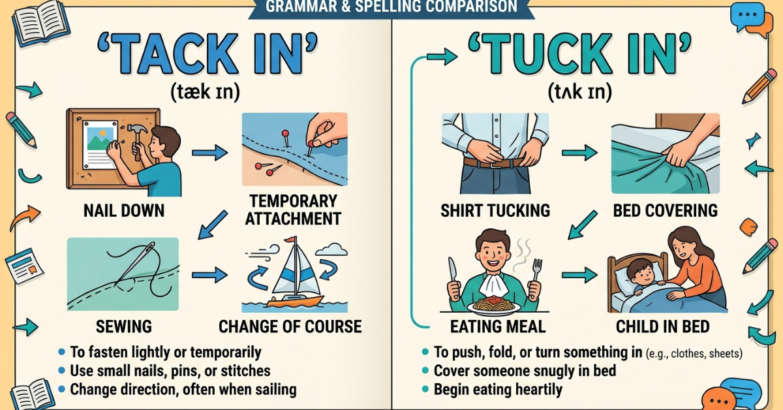
Have you ever paused while writing a sentence and wondered whether the correct phrase is tack in or tuck in? You’re not alone. These expressions sound similar, but they have different meanings, and choosing the right one depends on what you want to say.
In everyday English, “tuck in” is the correct expression when you mean to put something neatly inside, fold it in, or begin eating a meal. “Tack in” can also be correct in specific contexts, particularly when referring to sailing or temporarily fastening fabric, but it is not a general substitute for “tuck in.”
Let’s explore the differences, common uses, examples, and situations in which each expression makes sense.
Is It Tack In or Tuck In?
The correct phrase for most everyday situations is tuck in. It is commonly used when arranging clothing, putting someone to bed, or inviting people to start eating.
For example:
- Correct: Tuck in your shirt before the meeting.
- Correct: The mother tucked her child into bed.
- Correct: Everyone, tuck in while the food is hot.
By contrast, “tack” generally means to attach something temporarily with a small nail or stitch, change direction while sailing, or take a particular course of action.
Therefore, if you are talking about putting a shirt inside your trousers or folding a blanket around someone, “tuck in” is the appropriate choice.
What Does Tuck In Mean?
The phrasal verb “tuck in” has several meanings depending on the context. It is especially common in British English, although it is also widely understood in other varieties of English.
1. To Put Something Neatly Inside
One of the most common meanings is to push, fold, or place something into a particular position so that it looks tidy or stays in place.
Examples:
- Please tuck in the loose corners of the bedsheet.
- He tucked his shirt into his trousers.
- She tucked the letter inside her handbag.
- Tuck the blanket around your shoulders to keep warm.
In these sentences, the phrase describes arranging or securing something neatly.
2. To Put Someone to Bed
“Tuck in” can also mean to prepare someone for sleep by arranging their blankets comfortably.
Examples:
- Dad tucked the children into bed at eight o’clock.
- She tucked her daughter in and turned off the light.
- The nurse tucked the patient in before leaving the room.
This usage is particularly associated with caring for children, although it can be used for adults as well.
3. To Eat With Enjoyment
In informal British English, “tuck in” means to start eating eagerly or enjoy a meal.
Examples:
- Dinner is ready, so everyone can tuck in.
- The children tucked into their pizza as soon as it arrived.
- We were hungry after the long journey and tucked into our lunch.
You may hear someone say, “Tuck in!” when inviting guests to begin eating.
4. To Put Money or Something Away
In some contexts, “tuck away” is used to describe putting something somewhere safe or saving it for later. Although this is a related expression, it is not identical to “tuck in.”
For example:
- She tucked some money away for emergencies.
- He tucked the spare key into a drawer.
The first sentence uses “tuck away,” while the second uses “tuck into” to describe placing an object inside something.
What Does Tack In Mean?
“Tack in” is not the standard phrase for arranging clothes, making a bed, or eating. However, the word “tack” has legitimate meanings in other contexts.
1. Tack in Sewing and Fabric Work
A tack can be a temporary stitch used to hold fabric in position before permanent sewing. In specialized sewing instructions, tacking fabric into place may be described using related constructions.
For example:
- The tailor used temporary stitches to hold the lining in place.
- Tack the fabric at the edges before sewing the final seam.
In ordinary instructions, “tack the fabric in place” is more natural than using “tack in” by itself.
2. Tack in Sailing
In sailing, a tack refers to a boat’s direction relative to the wind, and tacking describes turning the boat’s bow through the wind to change direction.
For example:
- The sailor changed tack to move toward the harbor.
- The crew tacked across the bay to make progress against the wind.
These are specialized uses and do not mean folding or inserting something.
3. Tack as a Change in Approach
“Tack” can also refer to a method, strategy, or course of action.
For example:
- The manager took a different tack during negotiations.
- We should try a new tack if the current approach fails.
Again, this meaning is unrelated to tucking something into place.
Tack vs. Tuck: Key Differences
Although the words sound alike, their meanings and common uses differ.
| Word |
Main meaning |
Example |
| Tuck |
Fold or place something neatly |
Tuck your shirt in. |
| Tack |
Attach temporarily |
Tack the fabric in place. |
| Tuck in |
Put inside, prepare for bed, or begin eating |
Tuck into your dinner. |
| Tack |
Change direction or approach |
The team took a different tack. |
The easiest way to remember the distinction is to associate tuck with folding, fitting, and eating, and tack with fastening, sailing, and strategy.
Is It Tuck In or Tuck Into?
Both expressions are correct, but they are used in slightly different grammatical patterns.
Tuck In
“Tuck in” can be used without naming an object after the verb, or it can refer to putting something into a position.
Examples:
- Tuck in your shirt.
- The children are ready to tuck in for the night.
- The food is ready. Tuck in!
Tuck Into
“Tuck into” is commonly used when specifying what someone is eating or what something is being placed inside.
Examples:
- We tucked into a delicious breakfast.
- She tucked the documents into her bag.
- He tucked into a large slice of cake.
The correct choice depends on the sentence. When talking about eating, “tuck into a meal” is especially common in British English. When talking about clothing, “tuck your shirt in” is a natural construction.
Common Mistakes to Avoid
Here are some frequent errors and their corrected versions.
Mistake 1: “Tack your shirt in.”
Correct: “Tuck your shirt in.”
Use “tuck” when placing the fabric of a shirt inside trousers or a skirt.
Mistake 2: “Let’s tack into dinner.”
Correct: “Let’s tuck into dinner.”
The expression refers to beginning a meal enthusiastically.
Mistake 3: “She tacked the child into bed.”
Correct: “She tucked the child into bed.”
Use “tucked” when describing making someone comfortable for sleep.
Mistake 4: Assuming “tack” is always wrong.
“Tack” is a valid English word. It simply has different meanings, including fastening something temporarily and changing direction while sailing.
How to Remember the Correct Phrase
If you frequently confuse these expressions, try these simple memory tips:
- Tuck means fold: Think about tucking a shirt into trousers or tucking a blanket around someone.
- Tuck means eat: Remember the expression “tuck into a meal.”
- Tack means attach: Think about a tack or temporary stitch holding something in place.
- Tack can mean direction: In sailing and business discussions, a tack can describe a change of course or strategy.
When in doubt, ask yourself what action you are describing. If it involves folding, inserting, sleeping, or eating, “tuck” is usually the word you need.
Frequently Asked Questions
Is “tack in” grammatically correct?
It can be correct in specific contexts, such as specialized instructions involving tacking or fastening fabric, but it is not the standard expression for putting clothes inside trousers or arranging bedding. In those situations, use “tuck in.”
Is it “tack your shirt in” or “tuck your shirt in”?
The correct expression is “tuck your shirt in.” It means to place the bottom of the shirt inside your trousers, skirt, or another garment.
What does “tuck in” mean in British English?
In British English, “tuck in” can mean to begin eating eagerly. It can also refer to putting something neatly inside or preparing someone for bed.
Is “tuck into” correct English?
Yes. “Tuck into” is a common expression, particularly in British English, when describing someone enjoying a meal. For example, “They tucked into their lunch.”
Can I say “tuck in” when talking about food?
Yes. You can say “Tuck in!” to invite people to start eating. You can also say “We tucked into our dinner” to describe eating enthusiastically.
What is the difference between “tack” and “tuck”?
“Tuck” generally means to fold, insert, or arrange something neatly. “Tack” can mean to attach something temporarily, change direction while sailing, or adopt a particular strategy.
Is it “tuck someone in” or “tuck someone into bed”?
Both are correct. “Tuck someone in” is a shorter expression, while “tuck someone into bed” specifies where the person is being settled.
Conclusion
When deciding between “tack in” and “tuck in,” the key is understanding the intended meaning. “Tuck in” is the right choice for clothing, bedding, and inviting someone to eat, while “tack” belongs to different contexts, including temporary fastening, sailing, and changes in strategy.
Remember the simple rule: you tuck a shirt into your trousers, tuck a child into bed, and tuck into a meal. With these examples in mind, choosing the correct expression becomes much easier.
For more practical English explanations, explore related articles about commonly confused words, everyday phrases, and grammar mistakes to strengthen your vocabulary and communicate more confidently.