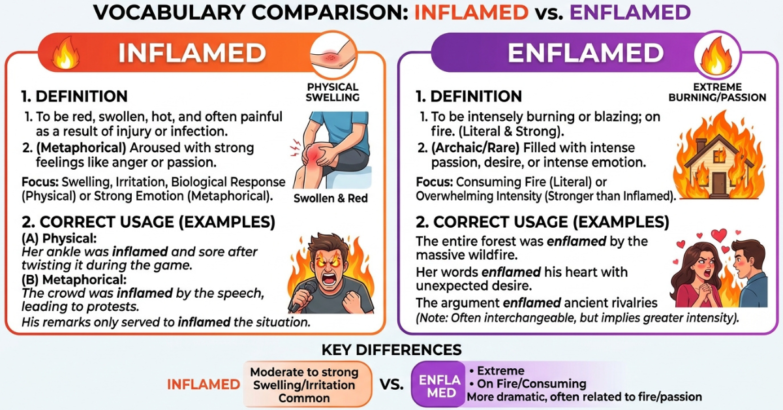
Have you ever paused while writing a sentence and wondered whether to use inflamed or enflamed? The two words look almost identical, and both are associated with the idea of something becoming more intense. However, their meanings, usage, and familiarity in modern English are not quite the same.
When comparing inflamed vs enflamed, the most important thing to know is that inflamed is the standard, widely accepted spelling in contemporary English. It can describe a physical condition, such as an irritated or swollen area of skin, as well as an emotional state, such as anger or resentment. Enflamed is a much less common variant, generally associated with literary or historical usage.
Understanding the distinction will help you choose the right word for everyday conversations, professional writing, academic work, and creative storytelling.
What Does Inflamed Mean?
Inflamed is the past tense and past participle of the verb inflame. It means to cause inflammation, make something more intense, or provoke a strong emotional response.
The word has several common meanings depending on the context.
1. Inflamed in a Medical Context
In medicine, inflamed describes tissue that has developed inflammation in response to injury, infection, irritation, or another trigger.
Common signs of inflammation include:
- Redness
- Swelling
- Warmth
- Pain or tenderness
- Reduced function in the affected area
For example:
- The insect bite left her skin red and inflamed.
- The doctor examined his inflamed gums.
- The injury caused the tissue around the joint to become inflamed.
Inflammation is part of the body’s immune response. It does not always mean an infection is present; inflammation can also occur because of an injury, an autoimmune condition, or irritation.
2. Inflamed in an Emotional Context
The word can also describe emotions that have become more intense, particularly anger, resentment, or hostility.
Examples include:
- The heated argument inflamed tensions between the two colleagues.
- His careless remarks inflamed an already sensitive situation.
- The controversial decision inflamed public anger.
In these sentences, inflamed does not refer to a physical condition. Instead, it suggests that an existing emotion or conflict has become stronger.
3. Inflamed in a Figurative Sense
Writers sometimes use inflamed to describe situations in which feelings, reactions, or conflicts become more intense.
For instance, a political debate may inflame public opinion, while a provocative headline may inflame fears about an issue.
This figurative meaning is common in journalism, literature, and everyday communication.
What Does Enflamed Mean?
Enflamed is a less common variant of inflamed. It has appeared in English writing, particularly in older or literary contexts, and generally conveys the idea of something being set alight or becoming intensely excited, passionate, or agitated.
The prefix en- can mean to cause something to enter a particular state. However, the existence of this spelling does not mean it is the preferred form in modern English.
Consider these examples:
- The poet described an enflamed passion that consumed the character.
- The historical passage portrayed an enflamed city during the conflict.
These examples illustrate how a writer might use the less familiar spelling for a particular literary effect. In contemporary prose, however, inflamed would usually be the more natural choice.
If you encounter enflamed in an older book, poem, or historical document, it is not necessarily a typographical error. Its suitability depends on the period, context, and author’s intended style.
For modern writing, the simplest approach is to use inflamed unless you have a specific reason to preserve the alternative spelling.
Inflamed vs Enflamed: Key Differences
Although the words are related, they differ considerably in frequency and practical usefulness.
| Feature |
Inflamed |
Enflamed |
| Modern usage |
Common and standard |
Rare |
| Medical writing |
Widely used |
Generally avoided |
| Emotional meaning |
Common |
Possible, but uncommon |
| Everyday conversation |
Natural and familiar |
May sound unusual |
| Formal writing |
Recommended |
Usually unnecessary |
| Historical or literary writing |
Appropriate |
May appear as a stylistic variant |
The main distinction is not that the words have completely opposite meanings. Rather, inflamed is the established choice for most modern contexts, while enflamed is an uncommon alternative.
If you are writing an email, article, report, medical description, or social media post, choosing inflamed will almost always be the clearer option.
Inflamed vs Enflamed Examples in Sentences
Looking at complete sentences is one of the easiest ways to understand which spelling fits a particular situation.
Examples Using Inflamed
- Medical: The dentist treated the patient’s inflamed gums.
- Emotional: His accusations inflamed the disagreement.
- Political: The announcement inflamed public criticism.
- Physical: The skin around the wound appeared red and inflamed.
- Figurative: The sensational report inflamed fears throughout the community.
In each example, the word communicates an increase in irritation, inflammation, anger, or intensity.
Examples Using Enflamed
- The novelist described an enflamed desire for revenge.
- The old text referred to an enflamed spirit filled with passion.
- The author used the term enflamed to create a dramatic, archaic tone.
These sentences demonstrate a possible literary use, but they should not be taken to mean that enflamed is the preferred spelling in contemporary English.
Which Sentence Is Better?
Consider the following pairs:
Less suitable for modern prose: The patient’s throat was enflamed.
Preferred: The patient’s throat was inflamed.
Another example:
Less natural: The politician’s comments enflamed public anger.
Preferred: The politician’s comments inflamed public anger.
The preferred versions sound more natural because inflamed is the established form in modern English.
Is Inflamed the Correct Spelling?
Yes. Inflamed is the standard spelling used in contemporary English for both medical and figurative meanings.
It is the form you will generally encounter in dictionaries, medical information, news reporting, academic writing, and everyday communication.
The word comes from the verb inflame, which has its roots in Latin inflammare, meaning to set on fire or kindle. Over time, the word developed both literal and figurative meanings.
The spelling enflamed has also appeared in English, but it is uncommon today. Its existence does not make it the better choice for general writing.
To avoid confusion, remember these related forms:
- Inflame: The base verb, meaning to cause inflammation or intensify a feeling.
- Inflamed: The past tense or past participle of inflame.
- Inflaming: The present participle or gerund of inflame.
- Inflammation: The noun describing the process or condition of becoming inflamed.
- Inflammatory: An adjective describing something that causes inflammation or provokes strong reactions.
For example, you might write, “The inflammatory comments inflamed the audience.” Here, inflammatory describes the comments, while inflamed describes their effect.
Common Mistakes to Avoid
Even though the spelling difference seems small, using the wrong form can make a sentence sound awkward or less professional.
1. Using Enflamed in Medical Writing
When describing swollen, irritated, or inflamed tissue, use inflamed.
Incorrect or unusual: The doctor examined the enflamed tonsils.
Preferred: The doctor examined the inflamed tonsils.
2. Assuming Both Spellings Are Equally Common
Both forms have existed in English, but that does not make them equally suitable for everyday use. Inflamed is much more familiar and is the safer choice for a broad audience.
3. Confusing Inflamed With Infected
An inflamed area is not necessarily infected. Inflammation is a biological response, while infection involves harmful microorganisms entering and multiplying in the body.
For example, a minor injury can cause inflammation without an infection. Conversely, an infection may trigger inflammation as the immune system responds.
4. Overusing Figurative Language
Although inflamed works well when describing anger or tension, it may sound dramatic when a simpler word would communicate the idea more clearly.
Instead of saying, “The discussion inflamed his disappointment,” you might write, “The discussion increased his disappointment.”
Choose the wording that best suits your intended tone.
How to Remember the Correct Spelling
If you regularly confuse these words, a simple memory trick can help.
Think of the familiar word inflammation. The adjective inflamed shares the same recognizable beginning and is used to describe the condition associated with inflammation.
You can also remember this practical rule:
When in doubt, use inflamed.
It works for medical descriptions, emotional reactions, public disputes, and most figurative expressions.
If you are reading a historical or literary text, you can retain enflamed when quoting the original wording or when deliberately adopting an older style.
Frequently Asked Questions
1. Is it inflamed or enflamed?
Inflamed is the standard and more widely used spelling in modern English. Enflamed is a rare variant that may appear in older or literary writing.
2. Are inflamed and enflamed synonyms?
They are closely related in meaning, but they are not equally common in modern usage. Both can convey an idea of increased intensity, but inflamed is the preferred form in most contexts.
3. Is enflamed a real word?
Yes. Enflamed has appeared in English usage, including literary and historical contexts. However, it is uncommon in contemporary writing and is generally unnecessary when inflamed communicates the intended meaning.
4. What does inflamed mean medically?
Medically, inflamed means that body tissue is experiencing inflammation. Depending on the cause, signs can include redness, swelling, warmth, pain, and reduced function.
Inflammation may result from an injury, infection, irritation, or an immune system response.
5. Can inflamed describe emotions?
Yes. The word can describe anger, resentment, hostility, or other reactions that have become more intense.
For example, “The accusation inflamed tensions between the two groups” means the accusation made an existing disagreement more intense.
6. What is the difference between inflamed and infected?
Inflamed describes an inflammatory response in the body. Infected means that disease-causing microorganisms have invaded and multiplied in the body.
The two conditions can occur together, but they are not interchangeable terms.
7. Should I use enflamed in formal writing?
Generally, no. Unless you are quoting a source or deliberately using an older literary style, inflamed is the clearer and more conventional choice for formal writing.
8. What are the past tense and past participle of inflame?
Both are inflamed.
Examples:
- Past tense: The comment inflamed the debate.
- Past participle: The debate had become inflamed by the accusations.
The word can function as a verb form or as an adjective, depending on the sentence.
Conclusion
When deciding between inflamed and enflamed, the difference comes down mainly to modern usage and familiarity. Although both forms have appeared in English, inflamed is the standard spelling you should choose in almost every everyday, professional, or medical context.
It can describe physical inflammation, heightened emotions, or conflicts that have become more intense. Enflamed, meanwhile, is best understood as a rare alternative that may suit certain historical or literary contexts.
The next time you are unsure which spelling to use, remember the familiar word inflammation and choose inflamed. It is the simplest way to keep your writing clear, natural, and correct.