Have you ever wondered whether the correct spelling is knaw or gnaw? These two words may look similar, especially when you’re typing quickly or trying to remember a word you’ve heard in conversation. However, only one is the standard spelling in modern English.
Gnaw is the correct spelling, while knaw is generally considered a misspelling. The word gnaw describes the act of repeatedly biting, chewing, or wearing something down with the teeth. It can also describe a persistent feeling, such as hunger, worry, or guilt that gradually eats away at someone.
In this guide, we’ll explore the meaning of gnaw, its pronunciation, common examples, and a few simple tricks to help you remember the correct spelling.
Knaw or Gnaw: Which One Is Correct?
The correct spelling is gnaw. Although the word begins with the letters gn, the first letter is silent when you pronounce it.
The spelling knaw is not accepted as the standard form of this English word. People sometimes use it by mistake because the letter combination kn also appears in words with a silent first letter, such as know, knee, and knock.
Here’s a quick comparison:
| Word |
Is it correct? |
Meaning |
| Gnaw |
Yes |
To bite, chew, or wear something away gradually |
| Knaw |
No, not in standard English |
Usually a misspelling of gnaw |
If you’re writing an essay, school assignment, email, article, or social media post, always use gnaw when you mean to chew or bite something persistently.
What Does Gnaw Mean?
The verb gnaw means to bite or chew something repeatedly, often using the front teeth. It is commonly associated with animals such as mice, rats, rabbits, squirrels, and beavers, which chew on food or other materials.
However, the word isn’t limited to physical chewing. English speakers also use it figuratively to describe an uncomfortable feeling that continues to bother someone.
1. The Literal Meaning of Gnaw
In its literal sense, gnawing involves repeated biting or chewing, sometimes gradually wearing away a material.
Examples include:
- The mouse began to gnaw on a piece of cheese.
- The rabbit gnawed on a wooden toy.
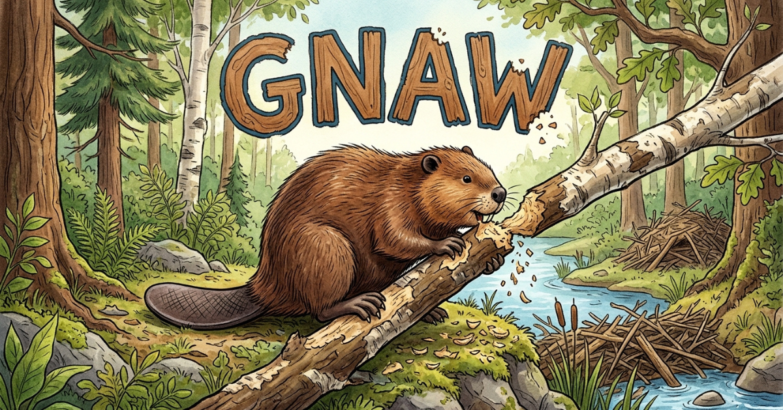
- The beaver gnawed through the tree trunk.
- The puppy tried to gnaw on its chew toy.
In each example, something is being bitten or chewed repeatedly.
2. The Figurative Meaning of Gnaw
The word can also describe feelings that persist in the mind or body. These feelings may be difficult to ignore, even when someone tries to focus on something else.
For example:
- Hunger began to gnaw at him during the long journey.
- A feeling of guilt continued to gnaw at her.
- Doubts about the decision started to gnaw at his confidence.
- The uncertainty gnawed away at her peace of mind.
In these sentences, nobody is physically chewing anything. Instead, the word conveys a feeling that gradually becomes more difficult to ignore.
How Do You Pronounce Gnaw?
The word gnaw is pronounced “naw,” rhyming with saw, law, and raw.
The initial g is silent, so you do not pronounce it as “g-naw.”
This silent-letter pattern can seem unusual, but English contains several words with silent initial letters. For example:
- Gnaw: pronounced naw
- Gnat: pronounced nat
- Gnome: pronounced nome
- Know: pronounced no
- Knee: pronounced nee
A useful way to remember the pronunciation is to say gnaw aloud as if the word began with the letter N.
Why Do People Confuse Knaw and Gnaw?
There are several reasons people mix up these spellings.
Similar silent-letter patterns
English has words beginning with silent G and silent K. Because both patterns exist, it is understandable that someone might mistakenly write knaw instead of gnaw.
For instance, the words know and gnaw both begin with a silent letter, but their spellings are different.
Learning the word through speech
Someone who learns a word by hearing it rather than reading it may not know which letters appear at the beginning. Since the G in gnaw is silent, the word sounds as though it begins with N.
Typing mistakes and autocorrect
Fast typing, unfamiliar vocabulary, and spelling mistakes can also cause confusion. A spell-checker may flag knaw and suggest gnaw, depending on the software and context.
The simplest solution is to remember the standard spelling and check unfamiliar words before publishing or submitting your writing.
Synonyms of Gnaw
Depending on the context, several words can replace gnaw. The best choice depends on whether you’re describing physical chewing or a persistent feeling.
Synonyms for physical gnawing
- Chew
- Bite
- Nibble
- Grind
- Chomp
These words have slightly different meanings. For example, nibble usually suggests small, gentle bites, while gnaw often implies repeated or persistent chewing.
Synonyms for figurative gnawing
- Bother
- Torment
- Worry
- Trouble
- Eat away at
For example, instead of writing, “The thought continued to gnaw at him,” you could write, “The thought continued to bother him.”
However, gnaw often communicates a stronger sense of persistence than simpler alternatives.
Common Expressions Using Gnaw
The word appears in several common English expressions.
Gnaw at someone: To cause persistent worry, guilt, or discomfort.
Example: The mistake continued to gnaw at her.
Gnaw away at something: To gradually weaken or consume something, literally or figuratively.
Example: Constant criticism can gnaw away at a person’s confidence.
Gnaw on something: To chew something repeatedly.
Example: The dog likes to gnaw on its favorite toy.
A gnawing hunger: A strong, persistent feeling of hunger.
Example: After hours without food, he felt a gnawing hunger.
These expressions are useful in everyday conversation, storytelling, and descriptive writing.
How to Remember the Correct Spelling
If you frequently confuse these words, try these simple techniques.
- Connect gnaw with animals. Think of a mouse gnawing on food or a beaver chewing a tree.
- Remember the silent G. The word sounds like naw, but it starts with G.
- Compare it with gnat. Both words begin with a silent G.
- Use it in a sentence. Writing “The rabbit likes to gnaw on carrots” can help reinforce the spelling.
- Use a spell-checker. If you’re unsure, check a trusted dictionary or spelling tool.
With a little practice, the correct spelling should become easier to remember.
Frequently Asked Questions
Is knaw a real word?
In standard modern English, knaw is generally treated as a misspelling of gnaw. Unless you’re referring to a proper name or a specialized use, choose gnaw.
Is gnaw or knaw the correct spelling?
Gnaw is correct. It means to chew or bite something repeatedly or to experience a persistent feeling that bothers you.
What does gnaw mean in simple words?
Gnaw means to keep biting or chewing something. It can also mean that a feeling, such as worry or guilt, continues to bother someone.
Is the G silent in gnaw?
Yes. The G is silent, and the word is pronounced naw.
What is an example of gnaw in a sentence?
“The mouse began to gnaw on the cardboard box.”
Another example is, “A sense of regret continued to gnaw at him.”
What is the difference between gnaw and chew?
Both words can describe biting food or another object. However, gnaw often suggests repeated, persistent biting that gradually wears something down, while chew is a broader term for working something between the teeth.
What is the past tense of gnaw?
The simple past tense is gnawed. For example, “The dog gnawed on its toy yesterday.”
The past participle is also gnawed, as in “The wooden chair had been gnawed by the puppy.”
Can gnaw describe emotions?
Yes. The word is often used figuratively to describe persistent feelings such as guilt, anxiety, hunger, or doubt.
For example, “The unanswered question continued to gnaw at her.”
Conclusion
When deciding between knaw or gnaw, remember that gnaw is the correct spelling in standard English. It describes repeated biting or chewing and can also express persistent feelings that gradually become difficult to ignore.
Although the silent G makes the word slightly confusing, remembering its pronunciation and connecting it with familiar words such as gnat can help you spell it correctly.
The next time you’re writing about an animal chewing on something or a worry that refuses to go away, use gnaw. For more helpful English spelling guides, word meanings, and grammar tips, explore related articles to continue building your vocabulary.