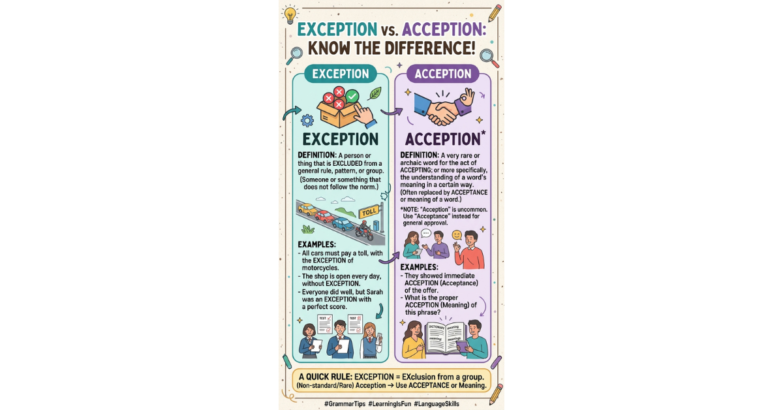
Have you ever wondered whether to write exception or acception? These two words look similar, but there is an important difference: exception is a correct and commonly used English word, while acception is an extremely rare, obsolete term that most people do not need in everyday writing.
Understanding the difference can help you avoid spelling mistakes in emails, school assignments, professional documents, and everyday conversations. In this guide, we’ll explain both terms, explore their meanings, provide practical examples, and answer common questions about their correct usage.
Exception vs Acception: What’s the Difference?
The main difference comes down to meaning and modern usage. Although both words are associated with the verb accept or related word forms, they do not serve the same purpose in contemporary English.
| Word |
Meaning |
Modern Usage |
| Exception |
Someone or something excluded from a general rule |
Common and correct |
| Acception |
A rare historical term referring to the acceptance or interpretation of something |
Obsolete or extremely uncommon |
In most situations, exception is the word you should use when referring to a rule, a special case, or something that does not follow the usual pattern.
For example, if a school allows one student to miss a requirement that applies to everyone else, that student may receive an exception.
What Does Exception Mean?
An exception is a person, thing, or situation that does not follow a general rule or is excluded from what normally applies.
The word is commonly used in education, business, law, everyday conversation, and professional communication.
Examples of Exception in a Sentence
Here are some examples showing how to use the word correctly:
- Everyone must attend the meeting, with the exception of employees on approved leave.
- This store accepts returns within 30 days, without exception.
- My brother is the only exception to our family’s usual tradition.
- The teacher made an exception for a student who was ill.
- All applicants must meet the requirements, except in exceptional circumstances.
These examples show that an exception creates a special case within a general rule.
Common Expressions Using Exception
You will frequently encounter the word in these phrases:
1. With the exception of: Used to identify someone or something excluded from a group.
Example: With the exception of Sarah, everyone completed the assignment.
2. Without exception: Means that a rule applies to everyone or everything.
Example: All visitors must register at reception without exception.
3. Make an exception: Means to allow something that would not normally be permitted.
Example: The manager decided to make an exception and approve the request.
4. Take exception to: Means to feel offended or object to something.
Example: He took exception to the comment because he considered it disrespectful.
What Does Acception Mean?
Acception is a rare historical English word that has appeared in older texts with meanings related to acceptance, the reception of something, or the way a word or expression is understood.
However, it is not a standard choice in modern everyday English. Most contemporary dictionaries and writing guides direct readers toward more familiar terms, such as acceptance, interpretation, or meaning, depending on the intended context.
For example, if you want to describe someone’s willingness to receive an offer, use acceptance. If you mean the way a word is understood, use meaning or interpretation.
Examples of Better Word Choices
Instead of using the uncommon word acception, choose the word that expresses your intended meaning:
- Unnatural: Her acception of the offer surprised everyone.
- Natural: Her acceptance of the offer surprised everyone.
Another example:
- Unclear: The acception of this word varies by context.
- Clear: The meaning of this word varies by context.
These alternatives sound natural and are much easier for modern readers to understand.
Why Do People Confuse Exception and Acception?
The confusion is understandable because the words share several letters and have similar endings. However, their spelling, meaning, and grammatical usage are different.
Here are three common reasons for the mix-up.
1. Similar Spelling
Both words contain the sequence ception, which can make them look interchangeable at first glance. But similar spelling does not mean that two words have the same meaning.
2. The Verb Accept
The word accept means to receive or agree to something. Its noun form is acceptance, not acception, in standard modern English.
For example:
- I accept your invitation.
- Thank you for your acceptance of the invitation.
3. The Meaning of Exception
An exception refers to something that falls outside a general rule. Because the word is sometimes used when discussing permission or approval, people may mistakenly associate it with accepting something.
Remember that accepting something and making an exception are two different actions.
Exception vs Acceptance: Another Important Difference
It is also helpful to understand the difference between exception and acceptance, since these are both common words.
| Word |
Definition |
Example |
| Exception |
A case that differs from a general rule |
The manager made an exception to the policy. |
| Acceptance |
The act of receiving, agreeing to, or recognizing something |
She confirmed her acceptance of the job offer. |
| Accept |
To receive or agree to something |
I accept your invitation. |
The easiest way to remember the distinction is to connect each word with its purpose:
- Exception: A special case or departure from a rule.
- Acceptance: Agreement, approval, or the act of receiving something.
- Accept: The action of receiving or agreeing.
How to Remember the Correct Spelling
If you regularly confuse these words, a simple memory trick can help.
Think of the word except when you see exception. Both relate to something being left out or treated differently.
For example, consider this sentence:
Everyone received a certificate except Ali, who was the exception to the rule.
The connection between except and exception makes the meaning easier to remember.
For acceptance, think of accepting an invitation, an offer, or an opportunity. This helps distinguish it from an exception.
When proofreading your writing, ask yourself one simple question: Am I talking about a special case, or am I talking about agreeing to or receiving something?
If you mean a special case, use exception. If you mean agreement or receiving something, use acceptance or accept, depending on the sentence.
Frequently Asked Questions
Is acception a real word?
Yes, acception has existed as a historical English word, but it is extremely rare in contemporary usage. In most modern writing, acceptance, meaning, or interpretation is the more appropriate choice.
Which spelling is correct: exception or acception?
Both forms have historical linguistic backgrounds, but they are not interchangeable. Exception is the standard modern word for a special case or something excluded from a general rule.
What is the difference between exception and acceptance?
An exception is a special case that differs from a general rule. Acceptance means receiving, agreeing to, or approving something.
For example, a manager might make an exception to a company policy while also confirming acceptance of an employee’s proposal.
Is acception a synonym for acceptance?
Historically, acception has been used in senses related to acceptance or interpretation. However, it is not a standard modern synonym in everyday English. Use acceptance when referring to agreement or the act of receiving something.
How do you use exception in a sentence?
You can use exception to describe something that does not follow a general rule.
Example: “All students must submit their assignments by Friday, with the exception of those who have received an extension.”
What is the opposite of exception?
There is no single opposite that works in every context. Depending on the sentence, possible alternatives include rule, general case, or standard practice.
For example, if a policy has no exceptions, it applies uniformly to everyone.
Why is exception spelled with an X instead of an A?
The spelling comes from the word’s historical development through Latin and French. It is related to the Latin exceptio, meaning an exclusion or exception. Its spelling is not derived from the modern verb accept.
Can I use acception in formal writing?
It is generally best to avoid acception in contemporary formal writing unless you are discussing historical English or quoting an older source. Use a more familiar and precise word, such as acceptance, meaning, or interpretation.
Conclusion
When comparing exception and acception, the most important thing to remember is that they are not interchangeable. Exception is the standard modern English word for a special case, an exclusion, or a departure from a general rule. Acception, by contrast, is a rare historical term that is generally unnecessary in everyday communication.
If you are writing an email, preparing an assignment, or creating professional content, choose exception when you mean a special case and acceptance when you mean agreement or receiving something.
Understanding these distinctions will make your writing clearer, more accurate, and easier to read. For more practical English explanations, explore related guides on commonly confused words, spelling differences, and everyday grammar.