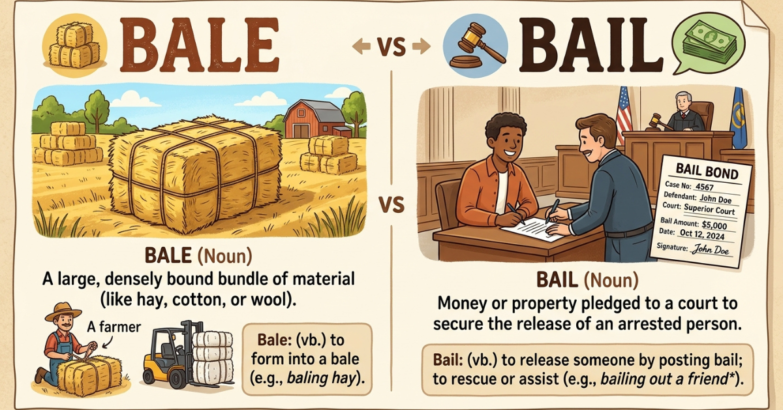
English has plenty of words that sound alike but mean entirely different things. Bale and bail are a perfect example. They differ by just one letter, yet using the wrong one can change the meaning of a sentence completely.
Understanding bale vs bail comes down to knowing the context. Bale usually refers to a large, tightly bound bundle of material, such as hay, cotton, or recycled paper. Bail, on the other hand, is most commonly associated with releasing someone from custody while their case is pending, although it also has other meanings.
Let’s explore the definitions, examples, common expressions, and simple tricks that will help you remember which word to use.
What Does Bale Mean?
The word bale is a noun and, less commonly, a verb. As a noun, it describes a large bundle of material that has been compressed and tied, wrapped, or otherwise secured for storage or transportation.
Bales are commonly used in agriculture, manufacturing, recycling, and shipping. Compressing materials into bundles makes them easier to handle and transport.
Examples of Bale in a Sentence
Here are a few everyday examples:
- The farmer loaded a bale of hay onto the truck.
- The warehouse received several bales of cotton.
- The recycling facility compressed old cardboard into large bales.
- She purchased a bale of straw for her garden.
In each example, bale refers to a physical bundle of material.
What Does Bale Mean as a Verb?
As a verb, to bale means to compress material into a bundle and secure it.
For example:
- The workers bale the hay after harvesting the field.
- The recycling machine bales plastic bottles for shipment.
This use is especially common in farming and recycling operations.
Common Types of Bales
The word appears in several industries, including:
- Hay bales: Bundles of dried grass or other forage used to feed livestock.
- Cotton bales: Compressed cotton prepared for storage, sale, or textile manufacturing.
- Straw bales: Bundles used in agriculture, gardening, and some construction methods.
- Recycling bales: Compressed paper, cardboard, plastics, or metals prepared for processing.
These examples all share the same basic idea: material grouped together into a compact bundle.
What Does Bail Mean?
Bail has several meanings, but its most familiar use relates to the legal system. In criminal proceedings, bail generally refers to the release of an accused person from custody while their case is pending, subject to applicable legal requirements and conditions.
Depending on the jurisdiction, release may involve a financial payment, a guarantee, or other conditions imposed by a court.
For example:
- The judge granted bail to the accused.
- Her family arranged for her release on bail.
- The court denied bail because of concerns about flight risk.
The precise rules governing bail differ between countries and legal systems.
What Does Bail Mean as a Verb?
As a verb, to bail someone out often means to help secure their release from custody, sometimes by providing money or a guarantee.
For example:
- His brother helped bail him out of jail.
- They contacted a lawyer to arrange bail.
The expression also has a broader, informal meaning: helping someone out of a difficult situation.
For instance, “My friend bailed me out when I ran out of money” means the friend provided assistance during a financial problem.
Other Meanings of Bail
The word has several additional uses worth knowing.
1. To leave a situation
In informal English, bail can mean to leave or withdraw from a situation, especially unexpectedly.
Example: “We decided to bail on the party because it started raining.”
2. To remove water from a boat
The verb bail can also mean removing water from a boat or another container using a bucket or similar tool. This action is also commonly spelled bale in this particular sense, so the spelling can depend on the intended meaning and usage.
Example: “They used a bucket to bail water out of the boat.”
3. A handle or fastening
In some contexts, bail is a noun referring to a movable handle, loop, or metal support, such as the handle on a bucket or a fitting on a piece of equipment.
Bale vs Bail: Key Differences
Although the two words sound alike, their meanings and typical uses are different.
| Feature |
Bale |
Bail |
| Main meaning |
A compact bundle of material |
Conditional release from custody |
| Common word type |
Noun and verb |
Noun and verb |
| Common contexts |
Farming, recycling, shipping |
Law, everyday conversation |
| Example |
A bale of cotton |
The judge granted bail |
| Related expression |
Hay bale |
Bail someone out |
The easiest distinction to remember is that bale usually relates to bundled material, while bail often relates to legal release or leaving a situation.
Bale vs Bail: How to Use Each Word Correctly
Choosing the correct spelling becomes much easier when you pay attention to the surrounding words.
Use Bale When Talking About Bundles
Choose bale when discussing compressed or tied materials.
Correct: The farmer stacked three bales of hay in the barn.
Incorrect: The farmer stacked three bails of hay in the barn.
The first sentence uses the standard spelling for bundles of hay.
Use Bail When Talking About Legal Release
Choose bail when referring to release from custody under legal conditions.
Correct: The court approved his bail.
Incorrect: The court approved his bale.
The second spelling would not convey the intended legal meaning.
Use Bail in Informal Expressions
When someone leaves an event or withdraws from a plan, bail is generally the appropriate spelling.
Examples:
- She decided to bail on the meeting.
- I had to bail because I wasn’t feeling well.
- He helped his friend bail out of a financial problem.
These expressions have nothing to do with bundles of material.
Common Phrases With Bale and Bail
Learning common expressions is a practical way to remember the difference.
Common Phrases With Bale
- Bale of hay: A compact bundle of dried grass.
- Bale of cotton: Compressed cotton prepared for storage or transportation.
- Bale of straw: A bundle of straw used for farming or other purposes.
- Bale press: Equipment used to compress material into bales.
- Baling wire: Wire used to secure certain types of bales.
Common Phrases With Bail
- Bail money: Money associated with securing someone’s release, where applicable.
- Grant bail: To authorize release under the relevant legal system.
- Bail out of jail: To help secure someone’s release from custody.
- Jump bail: To fail to comply with bail obligations, often by missing a required court appearance.
- Bail on someone: To abandon someone or fail to follow through on a commitment.
- Bail out a business: To provide financial assistance to a struggling company.
One important point: expressions such as jump bail and bail out of jail are legal or colloquial expressions, not references to physical bundles.
Easy Tricks to Remember the Difference
If you frequently confuse these words, try these simple memory aids.
1. Associate bale with bundles.
Both bale and bundle begin with the letter B. Think of a bale of hay, cotton, or cardboard.
2. Associate bail with jail.
Both words contain the letters “ail.” The familiar expression “bail out of jail” makes the spelling easier to remember.
3. Look at the context.
Ask yourself what the sentence describes:
- Is it a physical bundle? Use bale.
- Is it legal release, withdrawing from a plan, or helping someone out? Use bail.
4. Memorize two short examples.
- The farmer moved a bale of hay.
- The judge granted bail.
These examples cover the most common distinction between the words.
Frequently Asked Questions
1. What is the main difference between bale and bail?
Bale generally means a large, compressed bundle of material, such as hay or cotton. Bail commonly refers to release from custody under legal conditions and can also mean leaving a situation or helping someone out of trouble.
2. Is a bale of hay or a bail of hay correct?
A bale of hay is correct. The word describes dried grass compressed into a bundle for storage, transportation, or livestock feed.
3. Does bail always refer to jail?
No. Although bail is commonly associated with the legal system, the word can also mean leaving a situation unexpectedly, helping someone through a difficult situation, or removing water from a boat.
4. What does it mean to bail on someone?
To bail on someone means to abandon them, withdraw from an arrangement, or fail to follow through on a commitment. For example, “He bailed on our plans at the last minute.”
5. Can bale be used as a verb?
Yes. To bale means to compress material into a bundle and secure it. For example, farmers bale hay after harvesting it.
6. Is it bail out or bale out?
It depends on the meaning. Bail out is the usual spelling when referring to financial assistance, legal release, or withdrawing from a situation. Bale out is also used in the sense of removing water from a boat, although bail out is common for that meaning too.
7. Are bale and bail pronounced the same way?
Yes. In standard English, bale and bail are homophones, meaning they are pronounced alike but have different spellings and meanings.
8. How do you remember when to use bale or bail?
Remember these two associations: bale = bundle and bail = jail. When you understand the context, selecting the correct word becomes much easier.
Conclusion
The difference between bale and bail is simple once you understand how each word is used. Bale usually refers to a compressed bundle of material, while bail is commonly associated with legal release, withdrawing from a commitment, or helping someone out of a difficult situation.
When deciding which spelling to use, focus on the meaning of the sentence rather than how the word sounds. Remembering a bale of hay and bail from jail is an easy way to avoid confusion.
Want to improve your everyday English vocabulary? Explore more word comparisons, spelling guides, and commonly confused words to write with greater confidence.