Have you ever written an email, finished an assignment, or prepared a report and wondered whether the correct word is verbiage or verbage? You’re not alone. These two spellings look almost identical, and it’s easy to see why people mix them up.
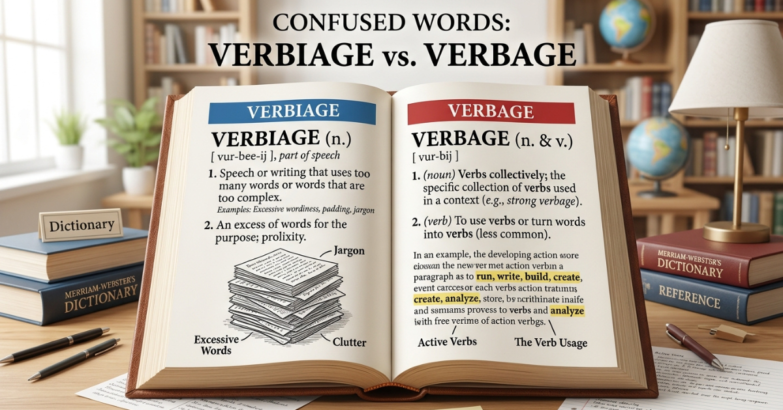
When comparing Verbiage vs Verbage, the important thing to remember is that verbiage is the standard, accepted spelling in modern English. It refers to the words used to express an idea, message, or piece of information. Verbage, on the other hand, is generally considered a misspelling, although it occasionally appears in informal writing.
Understanding the difference can help you communicate more clearly, improve your writing, and avoid unnecessary spelling mistakes in professional and academic settings.
What Does Verbiage Mean?
Verbiage is a noun that refers to the words used to express something. Depending on the context, it can describe the wording of a document, the language used in a conversation, or an excessive amount of words that make a message difficult to understand.
The word has two common shades of meaning:
- Neutral meaning: The specific wording or language used to communicate an idea.
- Negative meaning: Excessive, complicated, or unnecessary wording that makes a message longer than it needs to be.
For example, a lawyer might review the verbiage in a contract to ensure that every clause is clear. In another situation, a manager might criticize a report for containing too much verbiage.
Both uses are correct. The intended meaning depends on the context.
Examples of Verbiage in Sentences
Here are several examples showing how to use the word naturally:
- The verbiage in the agreement needs to be revised before we sign it.
- The instructions contain unnecessary verbiage that confuses new users.
- Please review the website’s verbiage before publishing the new page.
- The professor encouraged students to avoid excessive verbiage in their essays.
- The marketing team simplified the product description to make its verbiage more accessible.
In each sentence, verbiage refers to wording or the language used to communicate information.
What Does Verbage Mean?
Verbage is a nonstandard spelling that people sometimes use instead of verbiage. It may appear in emails, online discussions, workplace documents, and casual conversations.
Although readers can usually understand what someone means by verbage, standard dictionaries generally recognize verbiage as the correct form for the intended meaning.
The confusion is understandable. English contains many words with similar endings, and people sometimes shorten or simplify unfamiliar spellings when writing quickly. However, familiarity does not make verbage the preferred spelling.
Examples of Incorrect Verbage Usage
Consider these sentences:
- Incorrect: The contract contains confusing verbage.
- Correct: The contract contains confusing verbiage.
- Incorrect: Please update the verbage on our homepage.
- Correct: Please update the verbiage on our homepage.
- Incorrect: The report has too much verbage.
- Correct: The report has too much verbiage.
If you’re writing an academic paper, business proposal, email, website, or formal document, choose verbiage.
Verbiage vs. Verbage: Key Differences
The main difference between these terms is their spelling and acceptance in standard English, rather than their meaning.
| Feature |
Verbiage |
Verbage |
| Spelling |
Standard and correct |
Generally nonstandard |
| Dictionary usage |
Established English noun |
Usually treated as a misspelling |
| Meaning |
Wording or language used to express something |
Usually intended to mean verbiage |
| Formal writing |
Recommended |
Avoid |
| Professional communication |
Appropriate |
May appear careless |
| Example |
The verbiage needs editing. |
The verbage needs editing. |
The simplest rule is to use verbiage whenever you mean the wording or language of a message.
Why Do People Confuse Verbiage and Verbage?
There are several reasons this spelling mistake occurs so frequently.
1. The Words Sound Similar
Both spellings look similar, and in everyday speech, people may not notice the difference. When someone hears the word without seeing it written, they might naturally spell it as verbage.
2. English Spelling Can Be Unpredictable
English includes words with unusual spellings, silent letters, and endings that don’t always follow consistent patterns. As a result, people sometimes apply familiar spelling patterns to words they don’t use often.
3. Informal Writing Encourages Shortcuts
Social media posts, text messages, and quick workplace conversations often receive less proofreading than formal documents. When a nonstandard spelling appears repeatedly, it can start to look correct even when it isn’t.
4. Autocorrect Doesn’t Catch Every Mistake
Depending on the device or software, a spelling checker may not flag every nonstandard word. Writers should therefore proofread important documents rather than relying entirely on automated corrections.
How to Use Verbiage Correctly
Using the word correctly is straightforward once you understand what it describes.
Use Verbiage When Referring to Wording
When discussing the language in a document, message, agreement, or advertisement, verbiage is the appropriate choice.
Example: “The legal team approved the revised verbiage in the service agreement.”
Use Verbiage When Describing Wordiness
The word can also refer to unnecessarily complicated or excessive language.
Example: “The article would be easier to read if we removed some of the verbiage.”
Consider Simpler Alternatives
Although verbiage is correct, it isn’t always the clearest word for every situation. Depending on your sentence, you might prefer:
- Wording: The exact words used in a message.
- Language: The words and expressions used to communicate.
- Text: Written content in a document or on a page.
- Phrasing: The way an idea is expressed through words.
- Wordiness: The use of more words than necessary.
- Terminology: Specialized words used in a particular subject or profession.
For example, “Please improve the wording on the homepage” may sound more natural than “Please improve the verbiage on the homepage.”
Choosing a simpler alternative can make your writing more direct and reader-friendly.
Is Verbiage Always a Negative Word?
No. This is an important distinction because many people assume that verbiage always means unnecessary or meaningless words.
In reality, the word can be neutral or negative depending on how it is used.
Neutral usage:
“The verbiage in the privacy policy was updated to reflect the new requirements.”
Here, the word simply refers to the wording of the policy.
Negative usage:
“The presentation contained so much verbiage that the main point was difficult to understand.”
In this example, it suggests excessive or unnecessarily complicated language.
If you want to avoid ambiguity, use wording when you simply mean the words in a document and wordiness when you specifically mean too many words.
Verbiage vs. Wording: Is There a Difference?
Although verbiage and wording can overlap in meaning, they aren’t always interchangeable in tone.
Wording is a straightforward, neutral term. It usually refers to the particular words chosen to express a message.
Verbiage is somewhat more formal and can sometimes suggest lengthy, complicated, or excessive language. However, it can also be used neutrally, especially when discussing contracts, policies, and official documents.
Compare these examples:
- “The wording of the email is polite and professional.”
- “The verbiage of the contract needs legal review.”
Both sentences are correct, but the second uses a more formal term suited to a document-focused context.
Tips to Remember the Correct Spelling
If you frequently mix up the two spellings, these simple techniques can help.
- Remember the ending: The standard word ends in -iage, making it verbiage.
- Associate it with words: Think of verbiage as the words used to communicate an idea.
- Proofread formal documents: Pay particular attention to contracts, website copy, reports, and professional emails.
- Use a spelling checker: A reliable grammar tool can help identify errors, although you should still review its suggestions.
- Choose simpler language when appropriate: If you’re unsure whether verbiage fits the sentence, try wording or text instead.
The goal isn’t simply to use sophisticated vocabulary. It’s to choose words that communicate your meaning accurately.
Frequently Asked Questions
1. Is verbiage or verbage correct?
Verbiage is the standard spelling in modern English. Verbage is generally considered a misspelling when used to mean wording or language.
2. What does verbiage mean in simple words?
Verbiage means the words used to express an idea or communicate information. It can refer to the wording of a document or, in some contexts, an excessive amount of words.
3. Is verbage a real word?
Verbage appears in informal writing, but it is not the standard spelling for the intended meaning. In edited and professional English, use verbiage.
4. How do you pronounce verbiage?
Verbiage is commonly pronounced VUR-bee-ij. Pronunciation can vary slightly by accent, but the middle syllable sounds like “bee.”
5. Can verbiage have a negative meaning?
Yes. Although it can neutrally describe wording, it is also frequently used to criticize language that is unnecessarily long, complicated, or repetitive.
6. What is another word for verbiage?
Depending on the context, alternatives include wording, language, phrasing, text, and wordiness. Use wordiness when you specifically want to emphasize excessive language.
7. Should I use verbiage in professional writing?
Yes, when it accurately expresses your intended meaning. It is appropriate in professional documents, contracts, reports, and business communication. However, simpler words such as wording may be more effective when clarity is the priority.
8. What is the plural of verbiage?
Verbiage is generally used as an uncountable noun, so it usually does not need a plural form. Writers typically say “different types of verbiage” rather than “verbiages.”
Conclusion
When comparing Verbiage vs Verbage, the choice is simple: verbiage is the standard spelling, while verbage is generally considered incorrect in edited English.
Verbiage refers to the words used to communicate an idea, whether you’re discussing the wording of a legal agreement, the language in a business email, or unnecessary text in an article. Its meaning can be neutral or critical depending on the context.
The next time you write a report, revise website content, or prepare a professional email, remember to use verbiage when the word fits your sentence. And when a simpler alternative communicates your meaning more clearly, don’t hesitate to use wording or text instead.
Clear writing isn’t about using the most complicated words. It’s about choosing the right ones.