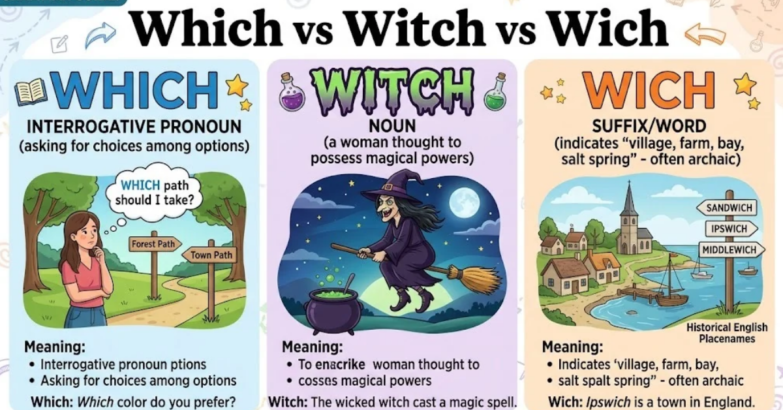
Have you ever stopped while writing a sentence and wondered whether to use which, witch, or wich? These three words can easily cause confusion because they sound almost identical when spoken. However, their meanings and spellings are very different.
Understanding which vs witch vs wich is important if you want to improve your spelling, grammar, and everyday communication. One word is used to ask questions and provide additional information, another refers to someone associated with magic, and the third is generally an incorrect spelling of the other two.
In this guide, we’ll explain what each word means, when to use it, provide practical sentence examples, and share simple tricks to help you remember the correct spelling.
Which vs Witch vs Wich: What’s the Difference?
The main difference between which, witch, and wich comes down to their meanings and grammatical uses.
- Which: A pronoun or determiner used to ask questions or identify something from a group of options.
- Witch: A noun referring to a person associated with witchcraft or magical practices.
- Wich: Not generally a standard standalone English word. It is usually a misspelling of which or witch, although it appears in some proper names and informal shortened forms.
Here’s a quick comparison:
| Word |
Meaning |
Correct Usage |
| Which |
Used to identify or ask about a choice |
Which shirt do you prefer? |
| Witch |
A person associated with witchcraft |
The witch appeared in the story. |
| Wich |
Usually a spelling mistake |
Incorrect in standard usage |
Although which and witch sound the same in most English accents, they are not interchangeable. The spelling you choose changes the meaning of your sentence completely.
What Does Which Mean?
The word which is used when asking about a particular person, thing, or choice from a known or limited group. It can function as an interrogative pronoun, an interrogative determiner, or a relative pronoun.
You will commonly find it in questions, comparisons, and sentences that provide additional information about something.
Examples of Which in Sentences
Here are some everyday examples:
- Which movie do you want to watch tonight?
- Which restaurant serves the best pizza?
- Which of these bags belongs to you?
- I don’t know which road leads to the airport.
- She bought a new phone, which was more expensive than her previous one.
In each example, which helps identify a particular option or introduces additional information.
When Should You Use Which?
Use which in the following situations:
1. When asking someone to make a choice
- Which color do you like better?
- Which subject is your favorite?
2. When referring to a specific option
- I couldn’t decide which dress to buy.
- Tell me which route is faster.
3. When adding extra information
- He missed the train, which made him late for work.
- I visited London, which is known for its historic landmarks.
Which vs That: Is There a Difference?
Another common grammar question involves which and that. Both words can introduce relative clauses, but they often serve different purposes.
In traditional American English grammar:
- Which generally introduces nonrestrictive clauses that add extra information. These clauses are usually separated by commas.
- That generally introduces restrictive clauses that identify exactly which person or thing is being discussed.
Examples:
- “My laptop, which I bought last year, still works perfectly.”
- “The laptop that I bought last year still works perfectly.”
In the first sentence, the information between the commas is additional. In the second, the clause identifies the particular laptop being discussed.
Usage conventions can vary, especially between American and British English, but this distinction is a helpful general rule.
What Does Witch Mean?
A witch is a noun traditionally used to describe a person believed to practice witchcraft or use supernatural powers.
Witches appear in folklore, mythology, literature, movies, and Halloween traditions. Depending on the cultural context, the word can carry different meanings and associations.
In traditional European fairy tales, witches are often portrayed as magical characters who cast spells, create potions, or ride broomsticks. Modern literature and popular culture also portray witches as positive, independent, or misunderstood characters.
Examples of Witch in Sentences
Here are some examples showing how to use witch correctly:
- The witch lived in a small cottage near the forest.
- Children dressed as witches for Halloween.
- The movie tells the story of a young witch learning magic.
- The old fairy tale features a witch who casts powerful spells.
- She wore a black witch costume to the Halloween party.
Notice that witch refers to a person or character associated with witchcraft. It does not have the same grammatical purpose as which.
What Is a Witch in Different Contexts?
The meaning of witch can depend on how and where it is used.
1. Folklore and fairy tales: Witches are often magical characters who use spells, potions, or supernatural abilities.
2. Halloween and entertainment: The word commonly describes a costume or fictional character associated with pointy hats, broomsticks, and magical objects.
3. Historical and cultural contexts: Witchcraft has been understood differently across societies and historical periods. In some modern spiritual traditions, people identify with witchcraft as a religious or spiritual practice.
Therefore, the word should not automatically be associated with evil or negative behavior.
Is Wich a Real Word?
In standard modern English, wich is generally not accepted as a standalone alternative to which or witch.
Most people who type wich are trying to write one of the other two words but accidentally leave out a letter. For example:
- Incorrect: Wich dress should I wear?
- Correct: Which dress should I wear?
- Incorrect: The wich cast a spell.
- Correct: The witch cast a spell.
However, there are some exceptions worth knowing.
Why Does Wich Appear in English?
The spelling wich can appear in specific names, historical place names, and informal shortened forms.
For example:
- Sandwich: The word contains the letters “wich” at the end, but it is a complete and correctly spelled English word.
- Droitwich: A place name in England.
- Ipswich: A town name in England.
- Wich: It may appear as part of surnames, brand names, or other proper nouns.
The important distinction is that these examples do not make wich a correct replacement for which or witch in ordinary sentences.
Which vs Witch vs Wich: Pronunciation Differences
One reason these words are frequently confused is that which and witch are homophones in most English accents.
Homophones are words that sound alike but have different meanings and spellings.
How to Pronounce Which and Witch
Both words are commonly pronounced as /wɪtʃ/ in accents that distinguish the initial sounds of which and witch.
In some regional English accents, particularly certain varieties of Scottish and Irish English, the pronunciation of which may differ from witch.
The word wich, when encountered as a name or spelling, is generally pronounced similarly, but its pronunciation depends on the specific name or context.
Since pronunciation alone may not help you distinguish which from witch, understanding the meaning of the sentence is the best way to choose the correct spelling.
Easy Tricks to Remember Which, Witch, and Wich
If you regularly confuse these words, a few simple memory tricks can make the difference easier to remember.
1. Remember That Which Is About Choices
The word which is commonly used when someone needs to select or identify something.
Think of this example:
“Which phone should I buy?”
Whenever you’re asking about a choice, which is usually the word you need.
2. Associate Witch With Magic
The word witch contains the letter combination “tch,” just like catch and match.
You can also remember the traditional image of a witch wearing a pointed hat and holding a broomstick.
Think:
“Witch = Witchcraft.”
This association makes it easier to remember that witch refers to a person connected with magic or witchcraft.
3. Avoid Using Wich in Ordinary Sentences
If you’re unsure whether to write wich, stop and consider the meaning of your sentence.
- Are you asking about a choice? Write which.
- Are you talking about someone associated with magic? Write witch.
- Are you writing wich by itself? Double-check whether you have missed a letter.
Common Mistakes When Using Which, Witch, and Wich
Even experienced English speakers sometimes confuse words that sound alike. Here are some mistakes worth avoiding.
| Incorrect Sentence |
Correct Sentence |
| Wich one is yours? |
Which one is yours? |
| The wich lives in the forest. |
The witch lives in the forest. |
| I don’t know wich book to read. |
I don’t know which book to read. |
| The wich made a magic potion. |
The witch made a magic potion. |
| Wich color looks better? |
Which color looks better? |
How to Avoid These Spelling Errors
Follow these simple tips:
- Read the entire sentence before choosing a word.
- Identify whether you’re asking a question or referring to a person.
- Remember that which relates to choices and witch relates to witchcraft.
- Use spell-checking tools to catch accidental typing mistakes.
- Practice writing both words in different sentences.
Understanding the context is more effective than relying on pronunciation alone.
Practice: Which, Witch, or Wich?
Want to check whether you’ve understood the difference? Try completing these sentences with the correct word.
- ______ dress should I wear to the party?
- The ______ flew across the sky on her broomstick.
- I can’t decide ______ restaurant to visit.
- The story features a powerful ______ who lives in a castle.
- ______ of these two options is better?
Answers:
- Which
- Witch
- Which
- Witch
- Which
If you answered all five correctly, you’ve understood the basic difference between these commonly confused words.
Frequently Asked Questions (FAQs)
1. Is it which or witch?
Both which and witch are correct English words, but they have different meanings. Which is used to ask questions or identify choices, while witch refers to someone associated with witchcraft.
2. Is wich a correct English word?
Generally, no. Wich is usually a misspelling of which or witch when used in ordinary writing. However, it can appear in proper names and as part of other correctly spelled words.
3. Why do which and witch sound the same?
In most English accents, which and witch are pronounced identically because both have the same vowel and final consonant sounds. They are therefore considered homophones in those accents.
4. How do you remember the difference between which and witch?
Remember that which is associated with choices and questions, while witch is associated with witchcraft and magic. This simple connection makes it easier to select the correct spelling.
5. Is which a question word?
Yes. Which is commonly used as an interrogative pronoun or determiner when asking someone to identify a particular person or thing from a group.
For example: “Which book would you like to read?”
6. What is the plural of witch?
The plural of witch is witches. For example: “The witches gathered in the forest.”
7. Can which and witch be used interchangeably?
No. Although they sound alike in most accents, they have completely different meanings. Using one instead of the other can change the meaning of a sentence or make it grammatically incorrect.
8. Is wich short for sandwich?
In informal contexts, wich may be used as a shortened form of sandwich, particularly in food-related names or branding. However, it is not a standard replacement for sandwich in formal writing.
Conclusion
Understanding which vs witch vs wich becomes much easier once you learn what each spelling represents. Which is used for questions, choices, and additional information, while witch refers to a person associated with witchcraft. Wich is generally a spelling mistake in everyday English, although it can appear in certain names and informal shortened forms.
The easiest way to remember the difference is to connect which with choices and witch with magic. Whenever you encounter wich in a sentence, check whether you actually mean one of these two words.
Keep practicing with everyday examples, and you’ll soon be able to use these commonly confused words correctly and confidently. Explore more commonly confused English words and spelling guides to continue improving your vocabulary and writing skills.