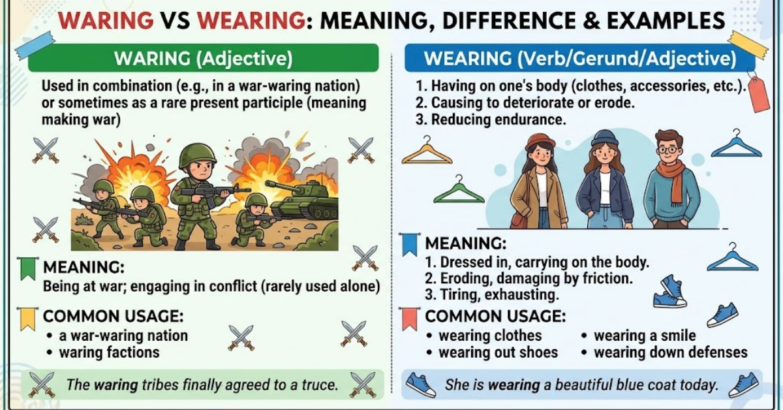
Have you ever wondered whether to write waring or wearing in a sentence? These two words look almost identical, but one small spelling difference changes how they are used. Understanding Waring vs Wearing is important because the words have different meanings, grammatical functions, and applications in everyday English.
The correct choice depends on what you want to communicate. Wearing is the present participle of the verb wear, which means having clothing, accessories, or something else on your body. Waring, on the other hand, is generally a proper name or surname, not a standard alternative spelling of wearing.
In this guide, we’ll explain the difference between these words, explore their meanings, provide practical sentence examples, and share simple ways to remember which one to use.
Waring vs Wearing: Which One Is Correct?
Both Waring and wearing can be correct in English, but they are not interchangeable.
- Wearing: A standard English word used when talking about clothes, accessories, or something being worn.
- Waring: Usually a proper noun, such as a person’s surname or a brand name. It is not the correct spelling when you mean putting on or having something on your body.
For example:
- Correct: “She is wearing a beautiful red dress.”
- Incorrect: “She is waring a beautiful red dress.”
- Correct: “Mr. Waring will attend the meeting tomorrow.”
The important thing to remember is that wearing comes from the verb wear, while Waring is typically used as a name.
What Does Wearing Mean?
Wearing is the present participle and gerund form of the verb wear. It describes the action of having clothing, jewelry, shoes, accessories, or other items on your body.
It can also describe using or displaying something, such as a particular expression or hairstyle.
For example:
- “He is wearing a black jacket.”
- “She loves wearing comfortable shoes.”
- “The little boy is wearing his favorite hat.”
- “I enjoy wearing sunglasses during sunny weather.”
- “He was wearing a big smile throughout the celebration.”
In these examples, wearing describes something a person has on or is displaying.
Different Ways to Use Wearing in a Sentence
The word wearing has several uses depending on the context.
1. Wearing clothes and accessories
This is the most common use of the word.
Examples:
- “She is wearing a blue sweater.”
- “He was wearing leather boots.”
- “I am wearing my new watch.”
2. Wearing an expression
The word can also describe someone’s facial expression.
Examples:
- “She was wearing a happy smile.”
- “He walked into the room wearing a serious expression.”
3. Wearing something as a symbol
Sometimes, wearing refers to displaying an item that represents a cause, group, or belief.
Examples:
- “The students were wearing badges to support the campaign.”
- “Everyone was wearing ribbons for the awareness event.”
4. Wearing someone or something down
In figurative language, wearing down means gradually exhausting someone or weakening something.
Example:
- “The long working hours are wearing him down.”
What Does Waring Mean?
Waring is not a standard spelling of the verb wearing. Instead, it is most commonly encountered as a proper noun, particularly a surname.
It may appear in names of individuals, companies, historical references, and other named entities.
For example:
- “Mr. Waring is the new manager.”
- “The Waring family has lived in this town for generations.”
- “I read an article written by someone named Waring.”
Because it is a proper noun in these examples, it begins with a capital letter.
Is Waring a Real Word?
Yes, Waring is a real word when used as a proper name. However, it is not an accepted alternative spelling of wearing in standard English.
If you want to describe someone having clothes on, use wearing. If you’re referring to a person, family, or organization named Waring, the spelling may be correct.
Waring vs Wearing: Key Differences Explained
The easiest way to understand these words is to compare their meanings, grammatical roles, and usage.
| Feature |
Waring |
Wearing |
| Meaning |
Usually a surname or proper name |
Having clothes or accessories on |
| Part of speech |
Proper noun |
Present participle or gerund |
| Common usage |
Names and titles |
Everyday English |
| Capitalization |
Usually capitalized |
Usually lowercase |
| Example |
“Mr. Waring called.” |
“She is wearing a coat.” |
| Standard clothing-related spelling |
Incorrect |
Correct |
The difference is simple: wearing describes an action or state, while Waring generally identifies a name.
Why Do People Confuse Waring and Wearing?
Although these words have different meanings, people often mix them up because their pronunciation and appearance are similar.
Here are some common reasons behind this spelling mistake.
1. Similar Pronunciation
In ordinary speech, Waring and wearing can sound very similar, particularly when spoken quickly. This makes it easy to confuse them when writing from memory.
2. Missing the Letter E
The word wearing contains the spelling pattern “wear.” When typing quickly, someone might accidentally leave out the letter e and produce waring.
3. Autocorrect and Typing Errors
Spell-checking tools do not always recognize the intended meaning of a sentence. If Waring is recognized as a name, a writing tool may not flag it as incorrect.
For example, a sentence such as “I am waring my new shoes” may need manual correction even if an automated tool overlooks it.
4. Unfamiliarity With the Word Wear
Some writers may know the word wear but forget that its present participle is formed by adding -ing while retaining the e: wearing.
Understanding this spelling rule makes the correct form easier to remember.
How to Remember the Correct Spelling of Wearing
If you regularly confuse Waring and Wearing, a simple spelling trick can help.
Remember the following:
Wear + ing = Wearing
The base verb is wear. When adding -ing, the final e is dropped:
- Wear → Wearing
- Make → Making
- Take → Taking
- Write → Writing
This is a common English spelling pattern involving verbs ending in a silent e.
Another helpful trick is to connect wearing with clothing. Whenever you’re talking about shirts, dresses, shoes, hats, or jewelry, think of the word wear.
For example:
“I am wearing my favorite shirt.”
The connection between the word and its meaning makes it easier to remember.
Common Synonyms for Wearing
Depending on the context, several words can replace wearing. Choosing the right synonym can make your writing more varied and natural.
| Synonym |
Meaning |
Example |
| Dressed in |
Having particular clothes on |
“She was dressed in blue.” |
| Donning |
Putting on clothing or accessories |
“He is donning his jacket.” |
| Sporting |
Wearing something stylishly |
“He was sporting a new watch.” |
| Clad in |
Covered or dressed in something |
“The workers were clad in uniforms.” |
| Adorned with |
Decorated with accessories |
“She was adorned with beautiful jewelry.” |
These alternatives are not interchangeable in every situation. For example, donning usually emphasizes the act of putting something on, while wearing describes having it on.
Examples of Waring vs Wearing in Everyday Sentences
The following examples show how to distinguish the two words in practical situations.
Correct Uses of Wearing
- “She is wearing a beautiful necklace.”
- “Why are you wearing sunglasses indoors?”
- “He was wearing a formal suit at the wedding.”
- “My sister enjoys wearing colorful dresses.”
- “The athlete is wearing his team’s uniform.”
- “I have been wearing these shoes all day.”
Correct Uses of Waring
- “Mr. Waring is responsible for managing the department.”
- “The Waring family attended the annual celebration.”
- “I received a letter from someone named Waring.”
- “The historical document mentions John Waring.”
Incorrect Uses of Waring
Here are some examples of mistakes to avoid:
| Incorrect Sentence |
Correct Sentence |
| She is waring a red dress. |
She is wearing a red dress. |
| He is waring new shoes. |
He is wearing new shoes. |
| I am waring a jacket. |
I am wearing a jacket. |
| They are waring uniforms. |
They are wearing uniforms. |
These examples reinforce the main rule: use wearing when describing clothes or accessories.
Frequently Asked Questions
1. Is it Waring or Wearing?
Both spellings exist, but they have different meanings. Wearing is the correct word when describing clothes or accessories, while Waring is generally a proper name or surname.
2. Is Waring a correct English word?
Yes, Waring is used as a proper noun, particularly as a surname. However, it is not a standard English spelling of wearing.
3. What is the meaning of Wearing?
Wearing means having clothing, shoes, jewelry, or accessories on your body. It can also describe displaying an expression, such as wearing a smile.
4. Why is Wearing spelled with an E?
The word comes from the verb wear. When adding the suffix -ing, the silent e at the end of the base verb is removed, producing wearing.
5. What is the difference between Wear and Wearing?
Wear is the base form of the verb, while wearing is its present participle or gerund form. For example, “I wear glasses” and “I am wearing glasses” are both correct sentences.
6. Is Wearing a verb or an adjective?
Wearing is primarily the present participle or gerund form of the verb wear. It can also function as an adjective in certain contexts, such as “wearing apparel,” although this usage is less common.
7. Can Waring be used in a sentence?
Yes. Waring can be used in a sentence when referring to a person or another entity with that name. For example, “Mr. Waring is joining us for dinner.”
Also Read: Charter Bus Edmonton
Conclusion
When comparing Waring vs Wearing, the correct choice depends on the meaning you want to express. Wearing is the standard English word for having clothes, shoes, jewelry, or accessories on your body. Waring is generally a surname or proper name and should not replace wearing in ordinary sentences.
The easiest way to remember the difference is to start with the base verb: wear + ing = wearing. Whenever you’re describing what someone has on, use wearing.
Paying attention to small spelling differences like this can make a noticeable improvement in your everyday writing. Explore more commonly confused English words to strengthen your vocabulary and communicate with greater confidence.