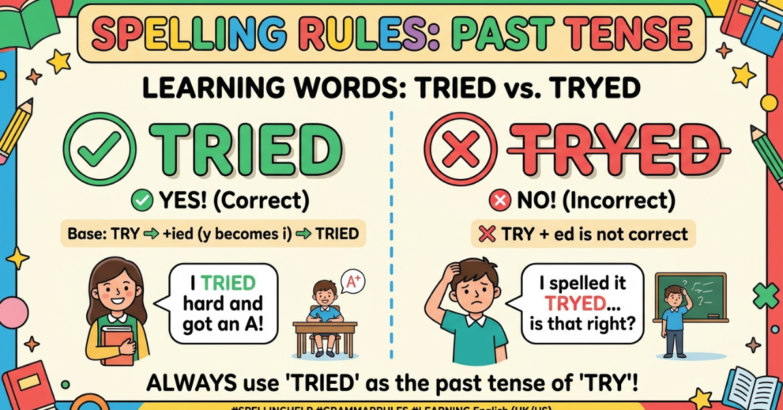
Have you ever written a sentence like “I tryed my best” and wondered whether it was correct? You are not alone. Many English learners and native speakers get confused about tryed or tried, especially when changing a verb into the past tense.
The correct spelling is tried. Although tryed might seem logical because the past tense of many verbs ends in -ed, the verb try follows a specific spelling rule. Understanding this rule will help you avoid similar mistakes with other English words.
In this guide, you will learn the difference between the two spellings, why one is correct, how to use the word in sentences, and which related words follow the same grammar rule.
Tryed or Tried: Which One Is Correct?
Tried is the correct spelling, while tryed is a misspelling in standard modern English.
The word tried is the past tense and past participle of the verb try. It describes an action that someone attempted or made an effort to complete in the past.
Here is a quick comparison:
| Word |
Correct or Incorrect? |
Explanation |
| Tried |
Correct |
Standard past tense and past participle of try |
| Tryed |
Incorrect |
Does not follow the standard English spelling rule |
Examples:
- Correct: I tried to finish my homework before dinner.
- Incorrect: I tryed to finish my homework before dinner.
- Correct: She has tried several ways to solve the problem.
- Incorrect: She has tryed several ways to solve the problem.
If you are writing an email, school assignment, social media post, or professional document, always use tried.
Why Is Tried the Correct Spelling?
The reason comes down to a common English spelling rule involving verbs that end in a consonant followed by the letter y.
When a verb ends in a consonant plus y, you generally change the y to i before adding -ed to form the past tense.
The rule looks like this:
Consonant + y → change y to i + ed
For example:
- Try → Tried
- Cry → Cried
- Study → Studied
- Carry → Carried
- Hurry → Hurried
- Worry → Worried
Notice that the final y changes to i before the ending is added. That is why tryed is incorrect.
What Happens When a Verb Ends in a Vowel Plus Y?
There is an important exception to remember. When a verb ends in a vowel followed by y, you generally keep the y and simply add -ed.
Examples include:
- Play → Played
- Enjoy → Enjoyed
- Stay → Stayed
- Destroy → Destroyed
- Pray → Prayed
The difference is the letter immediately before the y. In try, the letter before y is the consonant r, so the spelling changes to tried. In play, the letter before y is the vowel a, so the spelling remains played.
This simple distinction makes it much easier to remember the correct form.
What Does Tried Mean?
The word tried usually means that someone attempted to do something, made an effort, or tested something to see whether it would work.
It is the past tense of try and can be used in several everyday situations.
1. Tried as an Attempt
Use tried when someone made an effort to accomplish something, whether or not they succeeded.
Examples:
- I tried to call you yesterday.
- He tried to open the locked door.
- We tried to finish the project on time.
- They tried to convince their manager to change the schedule.
In these sentences, the word describes an attempt rather than guaranteeing success.
2. Tried When Testing Something
You can also use tried when talking about testing a product, experience, method, or activity.
Examples:
- I tried a new restaurant last weekend.
- She tried a different approach to studying.
- We tried the new software before purchasing it.
- Have you tried this recipe before?
In this context, the word often means that someone experienced or tested something.
3. Tried as a Past Participle
Tried also works as a past participle, often appearing with helping verbs such as have, has, and had.
Examples:
- I have tried everything I can think of.
- She has tried to contact the company several times.
- They had tried the same method before changing their strategy.
Although the spelling stays the same, the grammatical structure changes depending on how the word is used in a sentence.
Tried vs. Try vs. Tries vs. Trying
These words all come from the same verb, but each has a different grammatical use.
| Word |
Usage |
Example |
| Try |
Base form or present tense |
I try to exercise daily. |
| Tries |
Present tense with he, she, or it |
She tries to help everyone. |
| Tried |
Past tense or past participle |
He tried to fix the computer. |
| Trying |
Present participle or gerund |
They are trying a new strategy. |
Understanding these forms will help you choose the right word when writing or speaking English.
When Should You Use Tried?
Use tried when describing an attempt in the past or when forming a perfect tense with a helping verb.
For example:
- Past simple: I tried to learn French last year.
- Present perfect: I have tried to learn French.
- Past perfect: I had tried several solutions before asking for help.
Remember that tried does not change its spelling according to the subject. You write I tried, she tried, and they tried.
Common Sentences Using Tried
One of the easiest ways to remember a spelling rule is to see it used naturally in everyday language.
Here are some examples you can use as a reference:
Everyday conversation
- I tried calling you, but you did not answer.
- Have you tried turning your phone off and on again?
- I tried my best to help.
School and education
- She tried to answer every question on the test.
- We tried a new study technique before the examination.
- He tried to improve his writing skills.
Work and business
- Our team tried several marketing strategies.
- I tried to complete the report before the meeting.
- The company has tried different approaches to customer service.
Personal experiences
- I tried cooking Italian food for the first time.
- They tried to repair the old bicycle.
- She tried something new and discovered a hobby she loved.
In each example, tried is the correct form.
Is Tryed Ever Correct?
In standard modern English, tryed is not the correct past tense of try. You should use tried in formal writing, everyday communication, academic assignments, and professional documents.
You might occasionally encounter the spelling tryed in old texts, informal online posts, usernames, or deliberately misspelled content. Such appearances do not make it the standard spelling.
If you are unsure which version to use, choose tried.
Easy Ways to Remember the Correct Spelling
If you frequently forget whether to use tryed or tried, a few simple techniques can help.
Remember the Y-to-I Rule
Think of the word study. Its past tense is studied, not studyed. The same rule applies to try, giving you tried.
Learn Similar Word Pairs
Memorize a few examples that follow the same pattern:
- Try → Tried
- Cry → Cried
- Fry → Fried
- Reply → Replied
- Apply → Applied
Once you recognize the pattern, spelling similar verbs becomes much easier.
Read Your Sentence Aloud
Reading a sentence aloud can help you identify awkward grammar, but remember that tryed and tried generally sound the same in ordinary speech. If you are uncertain about the written form, apply the spelling rule rather than relying on pronunciation.
Use a Spell Checker
Most modern word processors and browsers can flag tryed as a spelling error. Spell-checking tools are useful, but learning the rule will help you catch mistakes even when automated suggestions are unavailable.
Tryed or Tried: Practice Quiz
Test your understanding with these five questions. Choose the correct word for each sentence.
1. I _____ to finish the assignment last night.
2. She has _____ several different recipes.
3. He _____ to explain the situation to his teacher.
4. We _____ our best to arrive on time.
5. They had _____ every possible solution before asking for help.
Answers: 1-B, 2-A, 3-B, 4-A, 5-B.
If you selected tried for every sentence, you have understood the main spelling rule.
Frequently Asked Questions
1. Is it tryed or tried?
Tried is correct. It is the past tense and past participle of try. The spelling tryed is incorrect in standard English.
2. Why is tried spelled with an i?
The verb try ends in a consonant followed by y. When forming its past tense, the y changes to i before adding -ed, producing tried.
3. Is tried a real word?
Yes. Tried is a standard English word used to describe an attempt or an action that someone has tested or experienced. It can function as both the simple past tense and the past participle of try.
4. What is the past tense of try?
The past tense of try is tried. For example, “I try to study every day” becomes “I tried to study yesterday.”
5. Is it tryed my best or tried my best?
The correct expression is “tried my best.” For example, “I tried my best to complete the task.” The word tryed is a spelling mistake.
6. What is the difference between tried and trying?
Tried usually refers to an attempt in the past or appears in perfect tenses. Trying describes an ongoing attempt or can function as a noun-like gerund.
Examples:
- I tried to fix the computer yesterday.
- I am trying to fix the computer now.
7. Is tried the same as attempted?
They have similar meanings in many contexts. Both can describe making an effort to do something, although attempted can sound more formal.
For example, “She tried to solve the problem” and “She attempted to solve the problem” communicate a similar idea.
8. How do you spell tried in British and American English?
The spelling is the same in both British and American English: tried. There is no regional spelling difference for this word.
Conclusion
When deciding between tryed or tried, the correct choice is always tried in standard modern English. The word is the past tense and past participle of try, and its spelling follows the rule that changes a consonant-plus-y ending to -ied.
Remember the examples cry → cried, study → studied, and try → tried. With a little practice, you will be able to apply this rule naturally and avoid a common English spelling mistake.
If you enjoy improving your vocabulary and grammar, explore more spelling guides and commonly confused English words to build confidence in your everyday writing.