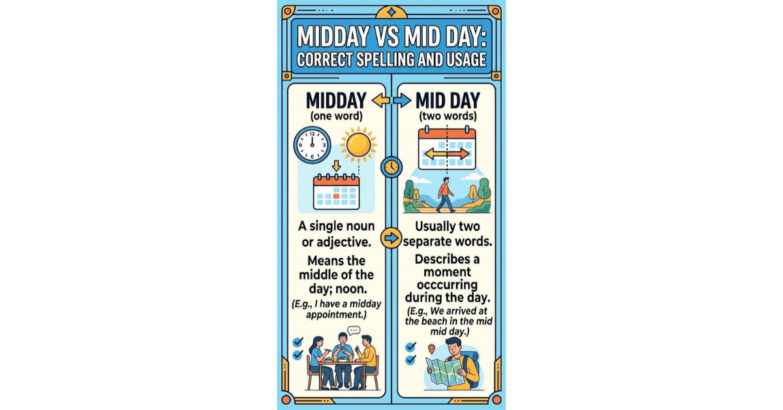
Have you ever wondered whether to write midday or mid day? Although the two forms look almost identical, choosing the right one can make your writing clearer and more professional. If you’re writing an email, preparing an article, or simply checking your English grammar, understanding midday vs mid day will help you avoid a common spelling mistake.
In standard modern English, midday is the preferred spelling when referring to the middle of the day, usually around noon. The two-word form, mid day, is much less common and generally isn’t needed when you’re talking about this time of day.
Let’s explore the difference, examine real-world examples, and learn how to use midday correctly in everyday writing.
Midday vs Mid Day: Which Spelling Is Correct?
Midday is the standard spelling when you mean the middle of the day or approximately noon. It is a single word, just like midnight, sunrise, and sunset.
The spelling mid day may occasionally appear in specialized contexts or as a deliberate phrase, but it is not the usual choice for the ordinary time-related meaning.
Here’s a quick comparison:
| Spelling |
Correct Usage |
Example |
| Midday |
Standard one-word form |
“We’ll meet at midday.” |
| Mid day |
Uncommon as a time expression |
“The phrase appeared as two words in the original text.” |
| Mid-day |
Occasionally used as a variant |
“The mid-day break begins at noon.” |
When writing about noon or the middle of the day, choose midday unless a particular style guide, publication, or proper name specifies otherwise.
What Does Midday Mean?
Midday is a noun that refers to the middle part of the day, especially around noon. It can also function as an adjective when describing something that happens during that period.
For example, a midday meeting is a meeting scheduled around the middle of the day, while at midday indicates when an event takes place.
The exact meaning can depend on context. In everyday conversation, midday often means approximately 12 p.m., but it can also refer more broadly to the period around noon.
Is Midday the Same as Noon?
The words midday and noon are closely related, but they aren’t always perfectly interchangeable.
- Noon specifically refers to 12 p.m. in ordinary clock-time usage.
- Midday generally refers to the middle of the day, often around noon.
For example, “The appointment is at noon” usually indicates a specific time. “We’ll take a midday break” describes a period around the middle of the day without necessarily identifying an exact minute.
It’s also worth remembering that 12 p.m. is not always the precise moment of local solar noon. The Sun’s highest point in the sky can occur before or after 12 on the clock, depending on location, time zone, and the date.
Why Is Midday Written as One Word?
English often combines words that work together to express a single concept. These are called compound words, and midday is a familiar example.
The word combines:
- Mid: The middle or central part of something.
- Day: The period of daylight or the daily cycle.
Together, they form midday, a word that describes the middle of the day.
Other common examples of compound words include:
- Midnight
- Afternoon
- Sunrise
- Daylight
- Weekday
- Sometimes
Although compound words don’t all follow the same spelling pattern, midday has an established one-word spelling in standard English.
Midday vs Mid Day in Example Sentences
Seeing the word in context is one of the easiest ways to remember its correct spelling.
Examples of Midday as a Noun
- “The temperature usually reaches its peak around midday.”
- “We arrived at the beach just before midday.”
- “She prefers to eat lunch at midday.”
- “The office closes for a short break at midday.”
- “By midday, the streets were crowded with shoppers.”
In each example, midday refers to the middle portion of the day or the time around noon.
Examples of Midday as an Adjective
Midday can also describe a noun, particularly when referring to activities, conditions, or events that occur around noon.
Examples include:
- “The midday sun was unusually strong.”
- “We watched the midday news before leaving.”
- “A midday meal helped us recharge.”
- “The midday traffic made the journey longer.”
- “They scheduled a midday appointment with the doctor.”
In these sentences, midday modifies another word and helps specify when something occurs.
Is Mid-Day Ever Correct?
The hyphenated form mid-day does appear in some English writing. However, it is less common than midday for the ordinary time-related meaning.
Some dictionaries, older publications, or house styles may retain hyphenated forms in particular contexts. If you’re following a specific publication’s style guide, use its preferred spelling consistently.
For general writing, including school assignments, emails, blogs, and most online articles, midday is the safest choice.
Midday vs Noon vs Afternoon: What’s the Difference?
These three terms refer to related parts of the day, but their meanings aren’t identical.
| Word |
Meaning |
Example |
| Midday |
The middle of the day, often around noon |
“We’ll leave at midday.” |
| Noon |
12 p.m. |
“Lunch starts at noon.” |
| Afternoon |
The period following noon and before evening |
“I’ll call you this afternoon.” |
The main difference is precision. Noon identifies a specific clock time, while midday can refer to a slightly broader period. Afternoon generally describes the time after noon.
For example, if someone asks you to arrive at noon, they usually mean 12 p.m. If they ask you to arrive around midday, they may allow some flexibility, depending on the situation.
Common Mistakes When Using Midday
Although midday is a simple word, a few mistakes can occur when people write about time.
1. Writing Mid Day as Two Words
The most common issue is separating the word unnecessarily.
Incorrect for standard usage: “We will meet at mid day.”
Preferred: “We will meet at midday.”
2. Confusing Midday With Midnight
These words describe different points in the daily cycle.
- Midday: Around noon, or the middle of the day.
- Midnight: 12 a.m., conventionally marking the middle of the night.
Remembering the difference helps avoid confusion when scheduling meetings, travel, or appointments.
3. Treating Midday as an Exact Time in Every Context
Although midday often refers to noon, it can describe a broader period. If precise timing matters, use 12 p.m. or noon rather than relying on a potentially flexible interpretation of midday.
4. Using Inconsistent Spellings
If you’re writing a long article or professional document, avoid switching between midday, mid-day, and mid day without a clear reason.
Consistency makes your writing easier to read and gives it a more polished appearance.
How to Remember the Correct Spelling of Midday
A simple trick can help you remember the difference between midday and mid day.
Think of midday as a single point or period on the daily timeline, similar to midnight. Both words combine mid with another time-related word and are conventionally written without a space.
You can also remember this sentence:
“At midday, the day reaches its middle.”
Whenever you’re unsure, replace the expression with noon. If the sentence still makes sense, midday is likely the word you need, and the standard spelling is one word.
Frequently Asked Questions
1. Is it midday or mid day?
Midday is the standard spelling when referring to the middle of the day or the period around noon. Mid day is uncommon for this meaning and is generally best avoided in ordinary writing.
2. Is midday one word or two words?
Midday is written as one word in standard modern English. It is a compound word formed from mid and day.
3. Does midday mean 12 p.m.?
Midday usually refers to noon, or 12 p.m., but it can also describe the broader period around the middle of the day. When an exact time is important, specifying 12 p.m. or noon is clearer.
4. Is mid-day with a hyphen correct?
The hyphenated form mid-day appears in some publications and styles, but midday is the more common standard spelling. Follow the relevant style guide if you’re writing for a specific organization or publication.
5. What is the difference between midday and afternoon?
Midday refers to the middle of the day, generally around noon. Afternoon refers to the period after noon and before evening.
6. Is midday a noun or an adjective?
Midday can be used as both a noun and an adjective. In “We arrived at midday,” it functions as a noun, while in “the midday sun,” it modifies the noun sun.
7. What is the opposite of midday?
Midnight is often treated as the opposite of midday because it refers to the middle of the night rather than the middle of the day. The two words also share a similar compound structure.
8. Should I write midday or noon in a formal email?
Both are appropriate, but noon is usually clearer when you mean exactly 12 p.m. Use midday when referring more generally to the middle of the day, such as in “I’ll send the report by midday.”
Conclusion
When choosing between midday vs mid day, the preferred spelling is midday, written as one word. It refers to the middle of the day, usually around noon, and can function as either a noun or an adjective.
Although mid-day appears in some writing styles, midday is the most straightforward choice for everyday communication, professional emails, and online content. Remember the distinction between midday, noon, and afternoon, and choose the term that best matches the timing you want to express.
If you’re interested in improving your English spelling and grammar, explore more guides on commonly confused words, compound words, and everyday expressions to make your writing clearer and more confident.