Have you ever written a funny caption, a social media post, or an essay and wondered whether the correct spelling is humorous or humerous? You’re not alone. These two words look almost identical, so it’s easy to see why people get them mixed up.
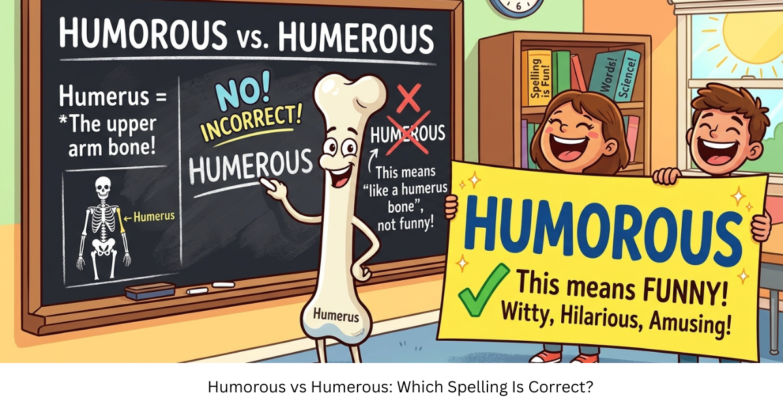
When comparing humorous vs humerous, there is one important thing to remember: humorous is the correct spelling in standard English, while humerous is a misspelling. If you’re describing a funny person, an amusing story, or a joke that makes people laugh, humorous is the word you want.
Let’s explore the meaning, pronunciation, usage, examples, and common mistakes associated with these spellings so you can use the word confidently in your writing.
Humorous vs Humerous: What’s the Difference?
The difference is straightforward. One spelling is accepted in standard English, and the other is not.
| Word |
Correctness |
Meaning |
| Humorous |
Correct |
Funny, amusing, or entertaining |
| Humerous |
Incorrect |
A common misspelling of humorous |
The word humorous describes something that causes amusement or makes people laugh. You might use it when talking about a comedian, a funny movie, a witty comment, or a lighthearted conversation.
On the other hand, humerous is generally a spelling mistake rather than a recognized alternative. Although people sometimes write it because it looks or sounds right, it should be avoided in formal and informal writing.
Easy rule to remember: If you mean funny or amusing, write humorous, with an o after the m.
What Does Humorous Mean?
Humorous is an adjective used to describe someone or something that expresses humor or creates amusement. It can refer to a person’s personality, a piece of writing, a situation, or an event.
Humor can take many forms. It might involve clever wordplay, gentle teasing, an unexpected twist, or a funny observation about everyday life.
Here are a few examples:
- A humorous person: Someone who regularly makes others laugh.
- A humorous story: A story written or told to entertain people.
- A humorous comment: A remark intended to be funny or amusing.
- A humorous situation: An event that people find entertaining or laughable.
For example, if your friend tells a funny story about getting lost while following GPS directions, you could say, “That was a humorous story!”
The word doesn’t always mean that something is laugh-out-loud funny. Sometimes, it describes subtle wit, playful language, or a lighthearted approach to a serious topic.
How to Use Humorous in a Sentence
Understanding a word becomes much easier when you see it in context. Here are several examples showing how humorous can be used naturally.
Everyday Examples
- My brother has a humorous way of explaining even the simplest things.
- The teacher used humorous examples to make the lesson more interesting.
- Her humorous response made everyone at the table laugh.
- We watched a humorous movie together on Saturday night.
- He wrote a humorous article about the challenges of working from home.
Examples for School and Professional Writing
- The author uses a humorous tone to keep readers engaged.
- A humorous introduction can make a presentation more memorable.
- The speaker included humorous anecdotes throughout the speech.
- Her humorous writing style appeals to readers of different ages.
- The advertisement uses a humorous approach to promote the product.
Notice that the spelling remains the same in every sentence. Whether you’re writing an email, an academic assignment, a blog post, or a social media caption, humorous is the appropriate choice.
Why Do People Spell Humorous as Humerous?
There are several reasons people make this mistake, and none of them is particularly surprising.
1. The Pronunciation Can Be Confusing
Depending on the speaker’s accent, the vowel sounds in humorous may be reduced or pronounced in a way that makes the spelling less obvious. When people write words based on how they sound, spelling errors can happen.
2. English Spelling Is Not Always Predictable
English contains many words whose spellings don’t follow a simple pattern. Words that sound similar can have different spellings, and familiar letter combinations can lead writers to make incorrect assumptions.
3. The Word Looks Similar to Other Terms
People may associate humorous with words that have different spellings or meanings. For example, humerus is a genuine English word referring to the upper arm bone. This similarity can make the spelling even more confusing.
4. Typing Errors Go Unnoticed
When writing quickly, it’s easy to type humerous instead of humorous. Basic spell-checkers may catch this mistake, but not every writing tool identifies every error, especially when a misspelling resembles another word.
The best solution is simple: learn the correct spelling and check it whenever you’re unsure.
Humorous vs Humerous vs Humerus
One reason this spelling question can be confusing is that humerous looks similar to humerus, which is an actual anatomical term.
Here’s how the three forms compare.
| Word |
Meaning |
Example |
| Humorous |
Funny or amusing |
His humorous speech entertained the audience. |
| Humerous |
Common misspelling of humorous |
She wrote “humerous” instead of “humorous.” |
| Humerus |
The bone in the upper arm |
The doctor examined the patient’s humerus. |
The distinction between humorous and humerus is especially important. The first relates to comedy and amusement, while the second relates to human anatomy.
For example, “The humorous story made us laugh” describes something funny. “The humerus connects the shoulder region to the elbow” describes a bone.
One extra letter can change the context entirely, so always consider what you intend to communicate.
Is Humorous British or American English?
Humorous is the standard spelling in both British and American English. There is no regional spelling difference that makes humerous correct in either variety.
You can confidently use humorous in:
- American English essays and articles
- British English assignments and publications
- Australian and Canadian English writing
- Professional emails and business communication
- Websites, blogs, and social media posts
Although pronunciation can vary across regions, the accepted spelling remains the same.
Synonyms of Humorous
If you want to avoid repeating the same adjective in your writing, several alternatives can communicate a similar idea. However, each has a slightly different meaning.
| Synonym |
Meaning or usage |
| Funny |
Causing laughter or amusement |
| Amusing |
Entertaining or pleasant to watch or hear |
| Hilarious |
Extremely funny |
| Witty |
Clever and amusing, often through language |
| Comical |
Funny, sometimes because something is ridiculous |
| Entertaining |
Enjoyable and engaging |
| Lighthearted |
Cheerful, relaxed, and not overly serious |
| Playful |
Full of fun or gentle teasing |
For example, you could describe a comedian as hilarious, a clever remark as witty, or a relaxed conversation as lighthearted.
Choosing the right synonym helps make your writing more precise and interesting.
Tips to Remember the Correct Spelling
If you frequently confuse these spellings, try the following techniques.
1. Associate the Word With Humor
Think of the noun humor and the adjective humorous. Both contain the letter sequence h-u-m-o-r.
This connection makes it easier to remember that humorous contains an o, not an e, after the m.
2. Learn the Word as a Pair
Remember these two related words together:
- Humor — the quality of being funny or amusing.
- Humorous — describing something funny or amusing.
Learning related words as a group can help reinforce their spelling and meaning.
3. Read Your Writing Aloud
Reading aloud may help you identify awkward wording, but pronunciation alone won’t always reveal a spelling error. Combine this technique with a visual spelling check.
4. Use a Reliable Dictionary
When you encounter an unfamiliar word or an uncertain spelling, consult a reputable dictionary. This is particularly helpful when writing articles, assignments, or professional documents.
5. Proofread Before Publishing
Before submitting an assignment or publishing a blog post, search your document for humerous. If you intended to describe something funny, replace it with humorous.
Frequently Asked Questions
1. Is humorous or humerous correct?
Humorous is the correct spelling in standard English. Humerous is generally considered a misspelling and should not be used in place of the adjective meaning funny or amusing.
2. What does humorous mean?
Humorous means funny, amusing, or capable of causing laughter. It can describe a person, story, joke, comment, movie, or situation.
3. How do you spell humorous correctly?
The correct spelling is H-U-M-O-R-O-U-S. Remember the letter o after m to avoid the common mistake of writing humerous.
4. Is humerous ever correct?
In standard contemporary English, humerous is not the accepted spelling of the adjective meaning funny. If you intend to describe something amusing, use humorous.
5. What is the difference between humorous and funny?
Both words describe something that causes amusement. Funny is more common in everyday conversation, while humorous can sound slightly more formal and is frequently used in descriptions of writing, speeches, and communication styles.
For example, “That joke is funny” sounds conversational, while “The article has a humorous tone” sounds more descriptive.
6. What is the difference between humorous and humerus?
Humorous means funny or amusing. Humerus is the name of the long bone in the upper arm, extending between the shoulder and the elbow.
These words have different meanings and should not be confused.
7. Is humorous spelled differently in British and American English?
No. Both British and American English use humorous. The spelling does not change based on which variety of English you use.
8. What is another word for humorous?
Common alternatives include funny, amusing, witty, comical, hilarious, and entertaining. The best choice depends on the situation and how strong or subtle the humor is.
9. Can I use humorous in formal writing?
Yes. Humorous is appropriate in formal writing when describing a lighthearted tone, an amusing example, a comic narrative, or a speaker’s style. Its suitability depends on the purpose and tone of the document.
10. Why do people search for humorous vs humerous?
People commonly search for this comparison because the words look similar and the pronunciation may not make the correct spelling obvious. The main takeaway is that humorous is the accepted spelling for something funny.
Conclusion
When it comes to humorous vs humerous, the choice is clear: humorous is the correct spelling, while humerous is a common spelling mistake.
Use humorous whenever you want to describe something funny, entertaining, witty, or amusing. Remember its connection to the word humor, and you’ll have a simple way to avoid this error in the future.
If you’re working on an essay, writing a blog post, or preparing professional content, taking a moment to check the spelling can make your writing clearer and more polished. For more helpful explanations of commonly confused English words, explore related spelling and grammar guides to keep improving your writing skills.