Have you ever typed a thank-you message and paused to wonder whether grateful or greatful is the correct spelling? You’re not alone. These two words look almost identical, and because they sound the same when spoken, it’s easy to see why people mix them up.
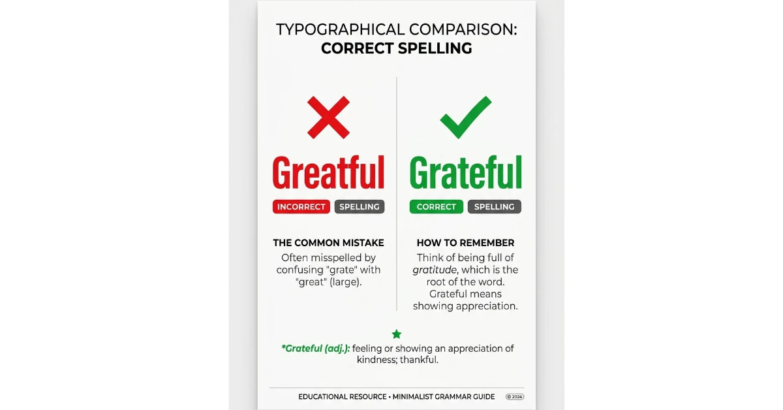
When comparing grateful vs greatful, only one spelling is correct in standard English: grateful. Whether you’re writing a heartfelt message, sending a professional email, or updating a social media post, knowing the difference will help you communicate more confidently.
Let’s explore the meaning of the word, why the mistake happens, examples of correct usage, and a few simple tricks to remember the spelling.
Grateful vs Greatful: Which One Is Correct?
The correct spelling is grateful. The word greatful is a common spelling mistake and is not accepted as the standard spelling in modern English.
| Word |
Is It Correct? |
Explanation |
| Grateful |
Yes |
Expresses appreciation, thankfulness, or gratitude. |
| Greatful |
No |
A misspelling of grateful. |
Example:
- Correct: I’m grateful for everything you’ve done for me.
- Incorrect: I’m greatful for everything you’ve done for me.
Although greatful might look logical because it resembles the word great, English spelling doesn’t always follow the patterns we expect. In this case, the correct word has an entirely different origin.
What Does Grateful Mean?
The word grateful is an adjective that describes feeling or expressing appreciation for something someone has done, something you have received, or a positive experience in your life.
You might feel grateful when a friend helps you during a difficult time, when a colleague supports your work, or when you recognize the good things you have in your life.
Here are a few examples:
- I’m grateful to my parents for their constant support.
- She was grateful for the opportunity to learn a new skill.
- We are grateful to everyone who attended the event.
- He felt grateful that his family was safe after the storm.
- I’m truly grateful for your kindness and patience.
Notice that gratitude doesn’t always require a grand gesture. Sometimes, a small act of kindness is enough to make someone feel appreciated.
Synonyms of Grateful
Several words have meanings similar to grateful, although their exact usage can differ depending on the context.
- Thankful: Feeling pleased and appreciative because of something good.
- Appreciative: Recognizing the value of someone’s help, effort, or kindness.
- Indebted: Feeling that you owe someone something because of their assistance.
- Obliged: Feeling thankful, often in response to a favor.
- Appreciative of: Recognizing the importance or value of something.
For example, you could say, “I’m thankful for your help” or “I’m grateful for your help.” Both sentences express appreciation.
Why Do People Spell Grateful Incorrectly?
There are several reasons people accidentally write greatful instead of grateful.
1. It Looks Like the Word Great
The most obvious reason is that greatful appears to combine great with the suffix -ful. Since the word great means excellent, impressive, or wonderful, people sometimes assume that adding -ful creates a word meaning full of positive feelings.
However, the correct spelling is based on the history of grateful, not on the modern word great.
2. Both Words Sound the Same
In standard English pronunciation, grateful and the misspelling greatful would ordinarily sound identical if read aloud. This makes the mistake difficult to notice during casual conversation or when relying on speech-to-text software.
Because pronunciation doesn’t reveal the error, it’s important to remember the written form.
3. English Spelling Can Be Unpredictable
English contains many words whose spellings don’t follow the patterns learners expect. Familiar examples include separate, definitely, and accommodate.
The best way to avoid these mistakes is to learn the correct spelling and see it used regularly in sentences.
How to Remember the Correct Spelling
If you frequently confuse these two spellings, a simple memory trick can help.
Remember the Connection to Gratitude
Think of the related words grateful and gratitude.
Both contain the letters grat at the beginning. Remembering this connection makes it easier to avoid inserting the extra letter sequence from great.
You can use this simple reminder:
Grateful comes from gratitude, not great.
Repeat the phrase whenever you write a thank-you message or an expression of appreciation.
Practice With Everyday Sentences
The more often you use the correct spelling, the easier it becomes to remember. Try completing these sentences:
- I’m ______ for your advice.
- We are ______ to everyone who supported us.
- She felt ______ for the opportunity.
The correct answer for all three sentences is grateful.
You can also enable spell-checking in your writing software, but don’t rely on it entirely. Learning the spelling yourself will help you write accurately even when automatic corrections aren’t available.
How to Use Grateful in a Sentence
The adjective grateful commonly appears with the prepositions for and to. Understanding the difference between these constructions will help you use the word naturally.
Grateful for Something
Use grateful for when referring to something you appreciate.
Examples:
- I’m grateful for your friendship.
- She is grateful for the chance to work with such a talented team.
- We are grateful for the support we received from our community.
- He was grateful for the extra time to complete the project.
Grateful to Someone
Use grateful to when identifying the person or people you appreciate.
Examples:
- I’m grateful to my teacher for believing in me.
- She is grateful to her colleagues for their encouragement.
- We are grateful to our customers for their continued trust.
You can also combine both constructions in one sentence: “I’m grateful to you for helping me prepare for the interview.”
Grateful in Professional Writing
The word is suitable for formal emails, workplace communication, business correspondence, and professional networking.
For example:
- “I’m grateful for the opportunity to discuss this position with you.”
- “We are grateful to our clients for their continued partnership.”
- “I would be grateful if you could share the updated report.”
The final example uses grateful as part of a polite request. In this context, it expresses appreciation in advance rather than necessarily describing something that has already happened.
Grateful vs. Thankful: Is There a Difference?
Although grateful and thankful are often interchangeable, they can carry slightly different shades of meaning.
Grateful often emphasizes appreciation for someone’s kindness, generosity, support, or a meaningful benefit. Thankful can emphasize appreciation for a positive outcome or relief that something unpleasant did not happen.
Consider these examples:
- “I’m grateful to my friend for helping me find a job.”
- “I’m thankful that everyone arrived home safely.”
These distinctions are tendencies rather than strict rules. In everyday English, both words frequently express the same basic feeling of appreciation.
Common Mistakes to Avoid
When writing about appreciation, watch out for these frequent errors:
Mistake 1: Adding an extra ‘e’
Incorrect: I’m greatful for your support.
Correct: I’m grateful for your support.
Mistake 2: Confusing the adjective with the noun
Incorrect: I feel gratitude for your help, so I am gratitude.
Correct: I feel gratitude for your help, so I am grateful.
Gratitude is a noun, while grateful is an adjective.
Mistake 3: Using the wrong preposition
Less natural: I’m grateful about you for helping me.
Better: I’m grateful to you for helping me.
Mistake 4: Assuming spell-check catches every mistake
Some tools may identify the misspelling, but automated writing suggestions are not a substitute for understanding the correct word. When in doubt, consult a reliable dictionary.
Frequently Asked Questions
1. Is grateful or greatful correct?
Grateful is the correct spelling in standard English. Greatful is a misspelling and should not be used in formal or informal writing.
2. Why is grateful not spelled greatful?
The word comes through French from the Latin word gratus, meaning pleasing or thankful. It is related to gratitude, not derived by combining the modern English word great with -ful. This is why the spelling uses grat- rather than great-.
3. What is the meaning of grateful?
Grateful means feeling or expressing appreciation and thankfulness for a benefit, kindness, favor, or positive experience.
For example: “I’m grateful for all the encouragement I’ve received.”
4. Is grateful a real word?
Yes. Grateful is a standard English adjective used to describe a feeling of appreciation or thankfulness.
5. What is the difference between grateful and gratitude?
Grateful is an adjective that describes a person or their feelings. Gratitude is a noun that refers to the feeling of appreciation itself.
Examples:
- “I am grateful for your help.”
- “I feel deep gratitude for your help.”
Both sentences communicate appreciation, but they use different parts of speech.
6. How do you spell grateful in American and British English?
The spelling is the same in both American and British English: grateful. Unlike certain words that have regional spelling variations, this word does not change between the two varieties.
7. Can I write greatful in a text message?
You might see the misspelling in casual messages, but greatful is still incorrect. Writing grateful is the better choice, even in a quick text or social media comment.
8. What is another word for grateful?
Common alternatives include thankful, appreciative, obliged, and indebted. The best choice depends on your sentence and the level of formality you want to convey.
9. Is grateful used in formal emails?
Yes. It is widely used in professional emails, job applications, thank-you notes, and business communication. For example, “I would be grateful for your feedback” is a polite and professional way to request someone’s input.
10. What is an easy trick to remember grateful?
Remember the related word gratitude. Both begin with grat-, which can help you recall the correct spelling. The phrase “grateful comes from gratitude, not great” is an easy way to reinforce the difference.
Conclusion
When it comes to Grateful vs Greatful, the answer is simple: grateful is the correct spelling, while greatful is a common mistake. The word describes appreciation for kindness, support, opportunities, and the positive things we experience in life.
To remember it, connect grateful with gratitude rather than great. Pay attention to how the word appears in everyday writing, and practice using constructions such as grateful for your help and grateful to my friend.
The next time you write a thank-you message, send a professional email, or express appreciation online, you’ll know which spelling to choose. If you enjoy learning about commonly confused English words, explore more grammar and spelling guides to build your vocabulary and write with greater confidence.