Have you ever wanted to congratulate someone on a special achievement but suddenly wondered whether you’re spelling the word correctly? The confusion between congratulate and congradulate is surprisingly common, especially when writing quickly or relying on pronunciation.
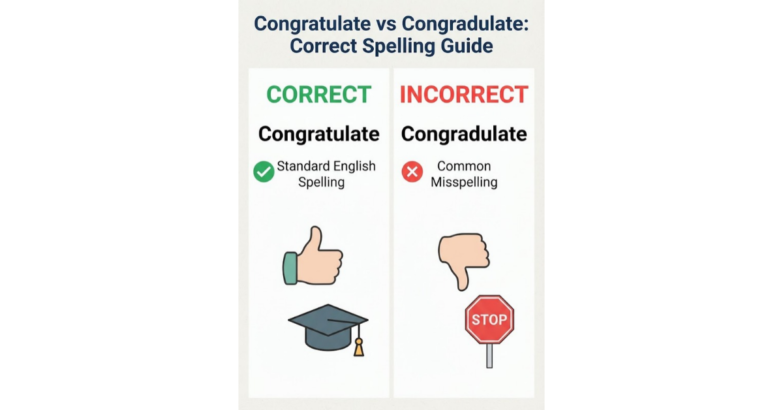
When comparing congratulate vs congradulate, there is only one correct spelling in standard English: congratulate. The word contains a “t” after “a” in the middle, not a “d.” Although congradulate may look familiar, it is a misspelling.
Whether you’re writing a congratulatory message, a professional email, or a social media caption, understanding this spelling difference will help you express yourself confidently. Let’s explore the meaning, pronunciation, examples, and simple ways to remember the correct spelling.
Congratulate or Congradulate: Which One Is Correct?
The correct spelling is congratulate.
The incorrect spelling, congradulate, replaces the letter “t” with “d.” This mistake often happens because the word’s pronunciation can make the middle consonant less obvious.
Here’s a quick comparison:
| Word |
Correct or Incorrect? |
Explanation |
| Congratulate |
Correct |
Standard English spelling |
| Congradulate |
Incorrect |
The letter “d” is used instead of “t” |
| Congratulations |
Correct |
Noun expressing praise or good wishes |
| Congratulated |
Correct |
Past tense of congratulate |
| Congratulating |
Correct |
Present participle of congratulate |
| Congratulatory |
Correct |
An adjective relating to congratulations |
Remember: The correct spelling is congratulate, with a “t” in the middle.
What Does Congratulate Mean?
The verb congratulate means to express pleasure, praise, or good wishes to someone because of an achievement, success, or happy event.
People commonly congratulate others when they:
- Graduate from school or university.
- Get a new job or promotion.
- Get married or welcome a new baby.
- Win a competition or achieve a personal goal.
- Celebrate a birthday, anniversary, or milestone.
For example:
“Everyone gathered to congratulate Sarah on her graduation.”
In this sentence, congratulate describes the act of expressing happiness and appreciation for Sarah’s achievement.
The word can also be used to acknowledge someone for making a good decision or accomplishing something difficult.
Why Is Congratulate Often Misspelled as Congradulate?
The confusion between congratulate and congradulate usually comes from pronunciation, spelling habits, and the influence of similar-looking words.
1. The Middle Consonant Sounds Similar
In everyday speech, the “t” in congratulate may sound softer or less distinct, depending on the speaker’s accent. Some people may hear a sound resembling “d” and assume that the spelling follows the pronunciation.
However, the correct spelling remains congratulate.
2. People Spell Words Based on Sound
English spelling does not always match pronunciation perfectly. This can lead people to write words as they hear them, especially when they are unfamiliar with the correct spelling.
The mistake is understandable, but checking the spelling helps avoid it.
3. Familiarity With Similar Words
English has many words containing “d” in the middle, such as graduate and dedicate. Since congratulate is associated with graduation and achievement, some people may mistakenly connect it with the spelling of graduate.
Although the meanings can overlap in certain situations, the spelling of congratulate is different.
How to Remember the Correct Spelling of Congratulate
If you frequently confuse congratulate with congradulate, a simple memory trick can help.
Use the T-for-Toast Trick
Think of the word “toast.”
When someone achieves something important, you might raise a toast to congratulate them.
Both toast and congratulate contain the letter “t.”
You can also break the word into smaller parts:
Con + grat + ulate = Congratulate
Focus on the “grat” section, which contains the correct “t.”
Another useful technique is to write the word several times:
- Congratulate
- Congratulate
- Congratulate
Then use it in a sentence:
“I want to congratulate you on your success.”
Practicing the word in context helps reinforce its correct spelling.
Congratulate vs Congratulations: What’s the Difference?
Although congratulate and congratulations share the same root, they serve different grammatical purposes.
| Word |
Part of Speech |
Meaning |
Example |
| Congratulate |
Verb |
To express praise or good wishes |
“I congratulate you on your promotion.” |
| Congratulations |
Noun or interjection |
An expression of praise or good wishes |
“Congratulations on your promotion!” |
| Congratulated |
Verb, past tense |
Expressed praise or good wishes |
“We congratulated the winner.” |
| Congratulating |
Verb form |
The act of expressing praise |
“She is congratulating her friend.” |
| Congratulatory |
Adjective |
Expressing praise or good wishes |
“He sent a congratulatory message.” |
The most important distinction is that congratulate describes an action, while congratulations is the expression itself.
For example:
- Correct: “I want to congratulate you.”
- Correct: “Congratulations on your achievement!”
- Incorrect: “I want to congradulate you.”
How to Use Congratulate in a Sentence
Understanding the meaning of a word is helpful, but knowing how to use it correctly makes your writing more effective.
Here are some examples of congratulate in everyday English.
Congratulate Someone on an Achievement
- “I want to congratulate you on passing your exams.”
- “We congratulated the team on winning the championship.”
- “She congratulated her brother on his new job.”
The word is commonly followed by “on” when referring to a specific achievement or event.
Congratulate Someone for an Action
You can also use congratulate with “for” when emphasizing the action or behavior that deserves praise.
Examples:
- “I congratulate you for standing up for what you believe in.”
- “The teacher congratulated the students for their hard work.”
Both “congratulate someone on something” and “congratulate someone for doing something” are common constructions.
Congratulate Someone in a Professional Setting
The word is frequently used in business communication, workplace messages, and formal announcements.
Examples:
- “I would like to congratulate you on your promotion.”
- “Please join me in congratulating our colleague on this achievement.”
- “We congratulate the entire team on completing the project successfully.”
These expressions are appropriate for professional emails, speeches, and announcements.
Is Congratulate a Verb?
Yes, congratulate is a verb.
A verb describes an action, and congratulating someone is the act of expressing praise or good wishes.
The word can appear in different forms depending on the sentence:
- Present tense: congratulate
- Third-person singular: congratulates
- Past tense: congratulated
- Present participle: congratulating
For example:
“She congratulates her friends whenever they achieve something important.”
“Yesterday, I congratulated my colleague on his promotion.”
Each form retains the letter “t” in the middle.
What Is the Origin of the Word Congratulate?
The word congratulate comes from the Latin verb congratulari, meaning to wish joy or express happiness with someone.
It is formed from Latin elements associated with expressing shared joy or happiness.
The word entered English through French and Latin influences, eventually developing into the modern English verb congratulate.
Its origin helps explain why the word is associated with celebration, praise, and expressing happiness for another person’s success.
Common Mistakes to Avoid When Using Congratulate
Besides confusing the spelling, people sometimes make grammatical mistakes when using congratulate.
Here are a few common errors to watch out for:
- Writing “congradulate”: Always use “t” in the middle.
- Using the wrong verb form: Use congratulated for past events and congratulating for ongoing actions.
- Forgetting “on” when mentioning an achievement: “I congratulate you on your success” is a natural construction.
- Confusing congratulate with congratulations: Use the verb for the action and the noun for the expression.
- Using overly complicated expressions: A simple “Congratulations on your achievement!” is often more effective than a long, formal sentence.
Paying attention to these details will make your writing clearer and more natural.
Frequently Asked Questions
1. Is it congratulate or congradulate?
Congratulate is the correct spelling. Congradulate is incorrect because it uses “d” instead of “t” in the middle of the word.
2. Why do people spell congratulate as congradulate?
The mistake often happens because the middle consonant can sound less distinct in spoken English. People may write the word based on how they hear it rather than its standard spelling.
3. What does congratulate mean?
To congratulate means to express praise, happiness, or good wishes to someone for an achievement or positive event. For example, you can congratulate someone on graduating or getting a promotion.
4. What is the past tense of congratulate?
The past tense is congratulated. For example: “I congratulated my friend on her new job.”
5. Is congratulate a verb or a noun?
Congratulate is a verb because it describes the action of expressing praise or good wishes. The noun form is congratulation, while congratulations is commonly used as an expression of praise.
6. How do you spell congratulate correctly?
The correct spelling is C-O-N-G-R-A-T-U-L-A-T-E. A helpful memory trick is to focus on the “grat” section, which contains the letter “t.”
7. Is congratulations spelled with a “t” or a “d”?
The correct spelling is congratulations, with a “t.” The same spelling rule applies to congratulate, congratulated, and congratulating.
8. Can I use congratulate in a formal email?
Yes. Congratulate is appropriate for both formal and informal writing. For example: “I would like to congratulate you on your well-deserved promotion.”
Conclusion
When comparing congratulate vs congradulate, the correct spelling is always congratulate. The word contains a “t” in the middle, while congradulate is a common spelling mistake.
Remember that congratulate means to express praise, happiness, or good wishes for someone’s achievement. Its related forms, including congratulations, congratulated, and congratulating, also retain the “t.”
To improve your spelling, practice writing the word, use it in everyday sentences, and proofread your messages before sending them. If you’re interested in learning more about commonly confused English words, explore additional spelling guides to strengthen your vocabulary and write with greater confidence.