Have you ever planned a day out with friends and wondered whether to write outing or outting? It may look like a small spelling difference, but choosing the correct word makes your writing clearer and more professional.
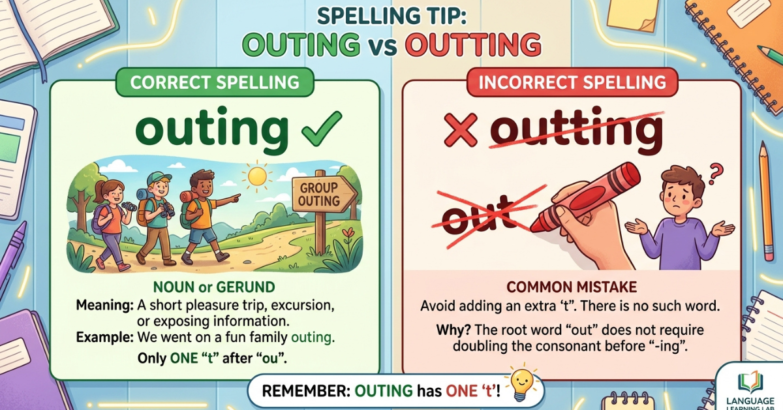
The correct spelling is outing, with one “t.” The word outting is a common spelling mistake and is not the standard spelling of the word used to describe a short trip, social activity, or recreational excursion.
Whether you’re writing a school assignment, a social media caption, a travel blog, or a message to friends, understanding the difference will help you use the word confidently.
Outing or Outting: The Correct Spelling
Outing is the correct spelling. It refers to a short trip or visit somewhere for pleasure, relaxation, entertainment, or a particular activity.
The spelling outting, with two “t”s, is incorrect when you mean a recreational trip or social visit.
Here is a quick comparison:
| Word |
Correct? |
Meaning |
| Outing |
Yes |
A short trip or recreational activity |
| Outting |
No |
A common misspelling of outing |
Example: “We went on a family outing to the park last Sunday.”
In this sentence, outing describes a pleasant activity away from home.
What Does Outing Mean?
An outing is an activity that involves going somewhere, usually for enjoyment, relaxation, sightseeing, or spending time with other people. It can be a simple visit to a nearby café or a planned day trip to a beach, museum, amusement park, or countryside destination.
Outings can be organized for different occasions, including:
- Family outings: Spending quality time with family members.
- School outings: Educational trips to museums, historical places, or nature parks.
- Office outings: Activities organized by employers to encourage teamwork and employee interaction.
- Friends’ outings: Meeting friends for shopping, dining, movies, or other recreational activities.
- Romantic outings: Going on a date, visiting a scenic location, or enjoying a meal together.
- Educational outings: Visiting places that provide practical learning experiences outside the classroom.
The main idea is simple: an outing usually involves leaving your usual surroundings to enjoy an activity or experience.
Why Is It Spelled Outing Instead of Outting?
English spelling can be confusing because adding a suffix sometimes requires doubling the final consonant. However, this rule does not apply to every word.
The word outing comes from the verb out, with the suffix -ing added to it. The final “t” is not doubled, so the correct form is outing.
Compare these examples:
- Out + ing = outing
- Visit + ing = visiting
- Walk + ing = walking
- Sit + ing = sitting
- Run + ing = running
Notice that sitting and running double their final consonants, while outing does not. These differences depend on English spelling rules and the structure of the original word.
A useful way to remember the spelling is to associate outing with the word out. When you go out for an enjoyable activity, you go on an outing.
How to Use Outing in a Sentence
The word is commonly used in everyday conversations, school writing, travel content, and workplace communication.
Here are some natural examples:
Family Outing Examples
- We planned a family outing to the zoo during the holidays.
- Our Sunday outing turned into a memorable adventure.
- Everyone enjoyed the picnic during our family outing.
- A weekend outing is a great way to reconnect with loved ones.
School Outing Examples
- The students went on an educational outing to the science museum.
- Our school outing included a visit to a historical monument.
- The teacher asked us to write an essay about our school outing.
Friends and Social Outing Examples
- I’m planning an outing with my friends this weekend.
- Our outing to the new restaurant was a lot of fun.
- Let’s arrange a group outing after our exams.
Office Outing Examples
- The company organized an outing to celebrate the team’s achievements.
- An office outing can help colleagues build stronger relationships.
- Everyone enjoyed the outdoor games during the annual company outing.
These examples demonstrate how the same word can describe many different activities without changing its spelling.
What Is the Difference Between an Outing, an Excursion, and a Trip?
Although these words have similar meanings, there are small differences in how they are used.
| Word |
Meaning |
Example |
| Outing |
A recreational or social activity away from home |
A family outing to the park |
| Excursion |
An organized or relatively short journey, often for a specific purpose |
A school excursion to a museum |
| Trip |
A general journey from one place to another |
A business trip to another city |
| Picnic |
An outdoor meal, often in a park or natural setting |
A picnic beside a lake |
| Getaway |
A short break from everyday routines |
A weekend getaway to the mountains |
An outing often emphasizes enjoyment and social interaction, while a trip can be for business, personal errands, or leisure. An excursion may have a more organized or educational purpose.
These terms can overlap. For example, a visit to a national park might be described as a family outing, a day trip, or an excursion, depending on the context.
Popular Types of Outings
Planning an enjoyable day does not always require a large budget or extensive preparation. The best activity often depends on your interests, available time, and the people joining you.
Here are some popular ideas.
1. Outdoor Outings
Outdoor activities are ideal for people who enjoy fresh air and natural surroundings.
Some options include:
- Visiting a local park or botanical garden.
- Going hiking or cycling.
- Spending a day at the beach.
- Arranging a picnic with friends.
- Exploring a nature reserve.
2. Family Outings
Family activities provide an opportunity to spend time together outside the usual home routine.
You could visit an amusement park, explore a historical landmark, watch a movie, or try a new restaurant. For families with children, interactive museums and wildlife parks can combine entertainment with learning.
3. Friends’ Outings
A social outing can be as simple as meeting for coffee or as elaborate as planning a full day of activities.
Popular choices include shopping, bowling, visiting a new café, attending a concert, or exploring an unfamiliar neighborhood.
4. School and Educational Outings
Educational visits help students connect classroom lessons with real-world experiences.
Museums, science centers, historical buildings, farms, and environmental centers can all make useful destinations. Teachers can improve the experience by giving students a small research task or reflection activity before or after the visit.
5. Office and Team-Building Outings
Workplace outings allow colleagues to interact in a more relaxed environment.
Activities might include team sports, escape rooms, outdoor adventures, group meals, or creative workshops. A well-planned event should accommodate different interests, physical abilities, and comfort levels.
How to Plan a Memorable Outing
A little preparation can make a day out more enjoyable and reduce unnecessary stress.
Follow these simple steps:
- Choose a destination. Pick a place that suits the interests of everyone attending.
- Set a budget. Consider transportation, food, entrance fees, and any additional activities.
- Check the weather. Outdoor plans are easier when you know what conditions to expect.
- Decide on transportation. Work out how everyone will reach the destination and return home.
- Pack the essentials. Depending on your plans, bring water, snacks, comfortable shoes, sunscreen, or any necessary tickets.
- Allow some flexibility. Avoid scheduling every minute. Leave room for spontaneous activities and breaks.
- Keep safety in mind. Follow local guidelines, stay aware of your surroundings, and make sure everyone knows the meeting point if the group separates.
You do not need an elaborate itinerary for every outing. Sometimes, the most enjoyable experiences come from keeping things simple.
Common Mistakes When Using Outing
Even though the word is straightforward, it is easy to make spelling or usage mistakes when writing quickly.
Mistake 1: Writing Outting
Incorrect: “We had a great outting yesterday.”
Correct: “We had a great outing yesterday.”
Remember that the standard spelling contains only one “t.”
Mistake 2: Using Outing for Every Journey
An outing usually suggests a recreational or social activity. If someone travels to another city for work, business trip is generally more appropriate.
For example:
- Recreational: “We went on an outing to the lake.”
- Professional: “She went on a business trip to Karachi.”
Mistake 3: Confusing Outing With Going Out
The expressions are related, but they are not always interchangeable.
“Going out” can refer to leaving home for almost any reason, including running errands. An outing more often suggests a planned or enjoyable activity away from one’s usual surroundings.
Frequently Asked Questions
1. Is it outing or outting?
Outing is correct. Outting is a misspelling when referring to a trip, excursion, or recreational activity.
2. What is the meaning of outing in English?
An outing is a short trip or visit somewhere for enjoyment, relaxation, social interaction, or recreation.
3. Why is outing spelled with one T?
The word is formed by adding -ing to out. The final “t” is not doubled, making outing the standard spelling.
4. What is the plural of outing?
The plural is outings. For example, “Our family enjoys weekend outings to nearby parks.”
5. What is a family outing?
A family outing is an activity or short trip that family members enjoy together, such as visiting a park, going to the cinema, or having a picnic.
6. Is an outing the same as a trip?
Not exactly. A trip is a general journey, while an outing usually refers to a recreational or social activity away from home. However, a single activity can be described using either word.
7. Can outing be used for school activities?
Yes. A school outing often involves students visiting a museum, historical site, zoo, or another destination for educational or recreational purposes.
8. What are some synonyms for outing?
Depending on the context, similar words include excursion, trip, day trip, visit, and recreational excursion. Picnic and getaway may also fit certain situations, although their meanings are more specific.
9. How do you use outing in a sentence?
You can write, “We are planning an outing to the beach this weekend.” The word describes the planned recreational activity.
10. Is outing a noun or a verb?
Outing is commonly used as a noun when referring to a recreational trip. It can also appear as the -ing form of the verb out in other contexts, including the expression “outing someone,” which has a different meaning.
Conclusion
When deciding between outing or outting, remember that outing is the correct spelling. It refers to a short recreational trip, social activity, or visit away from your usual surroundings, whether you’re spending time with family, meeting friends, visiting a school destination, or enjoying a company event.
The easiest way to remember it is to connect the word with out: when you go out to enjoy an activity, you go on an outing.
Use the correct spelling in your essays, captions, emails, and everyday conversations. If you’re looking for more helpful explanations of confusing English words, explore related spelling guides and vocabulary articles to keep improving your writing.