Have you ever written a thank-you message and wondered whether to use grateful or greatful? It is a surprisingly common spelling mistake, especially because both words look as though they could be correct. However, only one spelling is accepted in standard English.
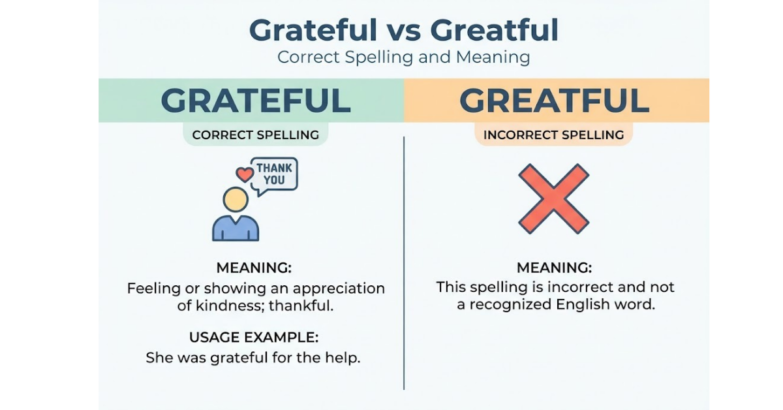
When comparing grateful vs greatful, the correct spelling is grateful, with an a instead of the second e in great. The word means feeling or showing appreciation for something or someone.
Although greatful may look logical because it resembles the word great, it is not a standard English word. Understanding the difference will help you write clearer emails, messages, essays, and social media posts.
Grateful vs Greatful: Which One Is Correct?
The correct spelling is grateful.
The word greatful is a common misspelling. It may appear in informal writing, online comments, or social media posts, but it is not recognized as the standard spelling in English dictionaries.
Here’s a quick comparison:
| Word |
Correct or Incorrect? |
Meaning |
| Grateful |
Correct |
Feeling or expressing appreciation |
| Greatful |
Incorrect |
A common spelling mistake |
| Gratitude |
Correct |
The quality or feeling of being thankful |
| Gratefully |
Correct |
In a grateful or appreciative manner |
| Gratefulness |
Correct |
The state of feeling grateful |
Remember: If you’re writing about appreciation, kindness, or thankfulness, always use grateful.
What Does Grateful Mean?
The word grateful is an adjective that describes someone who feels thankful or appreciative.
People often use it when they want to acknowledge a kindness, recognize someone’s support, or express appreciation for something meaningful in their lives.
For example:
- “I’m grateful for your help.”
- “She was grateful for the opportunity to study abroad.”
- “We are grateful to everyone who supported our project.”
- “He felt grateful for the time he spent with his family.”
In each example, the word expresses appreciation for something positive.
Being grateful does not necessarily mean that everything in life is perfect. Someone can experience difficulties and still feel grateful for the people, opportunities, or experiences that bring meaning to their life.
Why Is Grateful Often Misspelled as Greatful?
The confusion between grateful and greatful usually comes from the familiar word great.
Because great means excellent, wonderful, or impressive, people sometimes assume that adding -ful creates greatful. However, the spelling of grateful comes from a different word origin.
1. The Word Great Creates Confusion
The word great is common in everyday English. When people want to express appreciation, they may connect the idea of gratitude with something great or wonderful.
This association makes greatful seem reasonable, even though it is incorrect.
2. English Spelling Is Not Always Predictable
English contains many words that sound similar but have different spellings and origins. In this case, the correct spelling cannot be determined simply by connecting the word with its meaning.
Learning the word as a complete spelling pattern is more reliable than trying to build it from great.
3. Typing Errors Become Familiar
When people repeatedly see or type a misspelled word, it can begin to look correct. This is one reason why greatful appears in online writing despite being incorrect.
A quick proofreading habit can help prevent this mistake.
Grateful vs Greatful: Meaning and Pronunciation
Both spellings may look similar, but only grateful has a recognized meaning in standard English.
| Feature |
Grateful |
Greatful |
| Standard spelling |
Yes |
No |
| Part of speech |
Adjective |
Not a standard English word |
| Meaning |
Thankful or appreciative |
No established standard meaning |
| Pronunciation |
GRAYT-fuhl |
No standard pronunciation |
| Example |
“I’m grateful for your support.” |
Incorrect spelling |
The correct word is generally pronounced GRAYT-fuhl.
The pronunciation resembles the word great, which helps explain why people sometimes mistakenly spell it greatful. However, pronunciation does not change the accepted spelling.
How to Remember the Correct Spelling of Grateful
If you frequently confuse grateful and greatful, a simple memory trick can help.
Use the Gratitude Connection
Think of the word gratitude.
Both grateful and gratitude begin with the letters “grat.” This shared spelling makes it easier to remember that the correct word contains an a.
Grateful → Gratitude → Thankfulness
You can also practice the word in a sentence:
“I am grateful for the little things in life.”
Writing the word in context helps reinforce its spelling and meaning at the same time.
Remember This Simple Rule
- Grateful = Thankful
- Great = Excellent or wonderful
- Greatful = Incorrect spelling
The word great describes something impressive, while grateful describes a feeling of appreciation.
Grateful vs Greatful: Examples in Everyday Sentences
Understanding the word becomes easier when you see how it is used in different situations.
Examples of Grateful in Personal Messages
- “I’m truly grateful to have you in my life.”
- “I am grateful for your kindness and support.”
- “She was grateful for the thoughtful birthday gift.”
- “We feel grateful for the memories we created together.”
Examples of Grateful in Professional Writing
- “I am grateful for the opportunity to interview for this position.”
- “Our team is grateful for your continued support.”
- “We are grateful to our customers for their trust.”
- “I would be grateful if you could review the attached document.”
Notice that grateful works naturally in both personal and professional communication.
Examples of Greatful as an Incorrect Spelling
These sentences contain the incorrect spelling:
- “I am greatful for your help.”
- “She feels greatful for the opportunity.”
- “We are greatful to our customers.”
The correct versions replace greatful with grateful.
Grateful vs Thankful: What Is the Difference?
Grateful and thankful are closely related words. Both express appreciation, and they can often be used interchangeably.
However, there can be a slight difference in tone.
Grateful often emphasizes appreciation for a person, kindness, opportunity, or meaningful experience.
Thankful often emphasizes relief or appreciation for a particular situation or outcome.
For example:
- “I’m grateful for my friend’s support during a difficult time.”
- “I’m thankful that everyone arrived home safely.”
These distinctions are not strict rules. In many situations, both words communicate the same feeling.
Grateful vs Gratitude: Understanding the Difference
Although grateful and gratitude share the same root, they have different grammatical functions.
| Word |
Part of Speech |
Meaning |
Example |
| Grateful |
Adjective |
Feeling thankful |
“I am grateful for your kindness.” |
| Gratitude |
Noun |
The feeling of appreciation |
“I expressed my gratitude.” |
| Gratefully |
Adverb |
In an appreciative manner |
“She gratefully accepted the gift.” |
| Gratefulness |
Noun |
The state of being grateful |
“His gratefulness was evident.” |
Use grateful when describing a person or their feelings. Use gratitude when referring to the feeling itself.
For example, you can say, “I feel grateful,” but “I feel gratitude” is less natural in many everyday contexts.
Is Grateful an Adjective?
Yes, grateful is an adjective.
An adjective describes a person, place, thing, or idea. In this case, grateful describes someone’s emotional state or attitude.
Examples include:
- “She is grateful.”
- “He felt grateful for the support.”
- “They were grateful to receive the award.”
The word is often followed by the preposition for when describing what someone appreciates.
For example: “I am grateful for your advice.”
It can also be followed by to when identifying the person receiving appreciation:
“I am grateful to my parents.”
You can combine both:
“I am grateful to my parents for their encouragement.”
Frequently Asked Questions
1. Is it grateful or greatful?
Grateful is the correct spelling. Greatful is a common misspelling and is not accepted as standard English.
2. Why is grateful not spelled greatful?
The word grateful comes from the Latin word gratus, meaning pleasing or thankful. It is related to the word gratitude, not formed by adding -ful to great.
3. What does grateful mean?
Grateful means feeling or expressing appreciation for someone or something. It is commonly used to acknowledge kindness, help, support, or positive experiences.
4. How do you pronounce grateful?
The standard pronunciation is approximately GRAYT-fuhl. The pronunciation resembles great, but the correct spelling is still grateful.
5. Is greatful a real word?
Greatful is not a standard English word. It is generally considered a misspelling of grateful.
6. What is the difference between grateful and thankful?
Both words express appreciation. Grateful often emphasizes appreciation for a person or kindness, while thankful can also emphasize relief or appreciation for a particular outcome.
7. What is the noun form of grateful?
The noun form is gratitude. For example: “I want to express my gratitude for your support.”
8. How can I remember the spelling of grateful?
Connect grateful with gratitude. Both words begin with “grat,” which makes it easier to remember that the correct spelling uses an a rather than an e.
Conclusion
When comparing grateful vs greatful, the correct spelling is always grateful. It is an adjective that describes appreciation, thankfulness, or recognition of someone’s kindness.
The spelling greatful is incorrect, even though it may seem logical because of its similarity to the word great. A simple way to remember the difference is to connect grateful with gratitude, which shares the same beginning.
Whether you’re writing a personal message, a professional email, or an article, using the correct spelling helps your writing look polished and confident. Keep practicing the word in everyday sentences, and explore more commonly confused English words to strengthen your spelling and vocabulary.