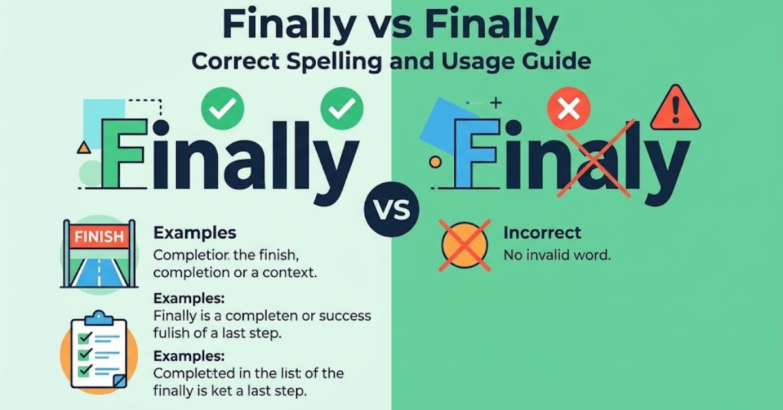
Have you ever finished writing a sentence and paused to wonder whether the word should be finaly or finally? It is an easy mistake to make, especially when typing quickly or relying on how a word sounds. However, knowing the correct spelling can help you write more confidently in emails, school assignments, professional documents, and everyday conversations.
When comparing finaly vs finally, the answer is straightforward: finally is the correct spelling in standard English, while finaly is a misspelling. The word contains two l’s before the letter y, and leaving one out makes the spelling incorrect.
In this guide, you’ll learn what finally means, how to use it in sentences, why people misspell it, and how to remember the correct form.
Finaly vs Finally: Which One Is Correct?
The correct spelling is finally, with two l’s. The spelling finaly, with only one l, is incorrect in standard English.
Although both versions may look similar, only finally is recognized as the standard spelling of the adverb derived from the word final.
| Word |
Correct or Incorrect? |
Explanation |
| Finally |
Correct |
Standard English spelling |
| Finaly |
Incorrect |
Missing one l |
| Final |
Correct |
An adjective or noun, depending on usage |
| Finalize |
Correct |
A verb meaning to complete or settle something |
| Finalization |
Correct |
The process of making something final |
For example:
- Correct: “I finally finished my homework.”
- Incorrect: “I finaly finished my homework.”
The first sentence uses the standard spelling. The second contains a spelling mistake, even though readers can probably understand the intended meaning.
What Does Finally Mean?
The word finally is an adverb that commonly means after a long time, at the end of a process, or as the last point in a sequence. Its exact meaning depends on the context in which it appears.
People often use it to describe something that has happened after waiting, completing several steps, or reaching the conclusion of an event.
Here are three common meanings of finally:
1. Finally Means After a Long Wait
This is one of the most common uses of the word. It expresses relief, impatience, or satisfaction when something happens after a delay.
Examples:
- “The bus finally arrived after 40 minutes.”
- “I finally received a response to my email.”
- “She finally passed her driving test after several attempts.”
In these sentences, finally emphasizes that the event took longer than expected or required patience.
2. Finally Means At the End
The word can also describe the last stage of an activity, process, or event.
Examples:
- “We finally reached the top of the mountain.”
- “After several discussions, the team finally made a decision.”
- “The movie finally came to an end.”
Here, the word highlights the completion of an experience or process.
3. Finally Introduces the Last Point
In writing and speaking, finally can introduce the last item in a list of arguments, instructions, or ideas.
Examples:
- “First, gather your materials. Next, prepare the mixture. Finally, follow the safety instructions.”
- “We need to consider the cost, the schedule, and finally, the expected results.”
- “Finally, I’d like to thank everyone who helped organize the event.”
This usage is especially common in essays, presentations, reports, and step-by-step guides.
Why Is Finally Often Misspelled as Finaly?
The spelling mistake usually occurs because writers forget to double the final consonant of final before adding the ending -ly.
The word finally is formed from final and the suffix -ly. The spelling retains both l’s: one from the end of final and one at the beginning of the suffix.
Because the word is familiar and relatively easy to pronounce, people sometimes type it from memory without noticing the missing letter.
Common reasons for the error include:
- Typing too quickly: Fast typing can lead to omitted letters.
- Relying on pronunciation: The extra l does not create a separate sound.
- Autocorrect limitations: Some tools may not catch every spelling error, especially in unusual contexts.
- Visual familiarity: Repeated exposure to a misspelling can make it appear correct.
The easiest solution is to remember that the word finally contains the complete word final followed by -ly.
How to Remember the Correct Spelling of Finally
If you often confuse finaly and finally, a simple spelling trick can make the correct version easier to remember.
Use the Word-Building Method
Start with the word FINAL and add LY:
FINAL + LY = FINALLY
Notice that the final l in final remains, and the suffix -ly begins with another l. That gives you two consecutive l’s.
Try this short practice exercise:
- Write the word final.
- Add the suffix -ly.
- Check that the result is finally, not finaly.
- Use the word in a complete sentence.
For example: “After months of preparation, we finally launched the project.”
Practicing the word in context helps reinforce both its spelling and meaning.
Remember the Double-L Rule
You can also memorize the word visually by focusing on the two l’s in the middle:
F I N A L L Y
Whenever you write the word, take a moment to check that both letters are present. This small habit can prevent a common spelling error.
Finally vs Final: What Is the Difference?
Although finally and final share the same root, they perform different grammatical functions.
Final is generally an adjective describing something that comes at the end or represents the last stage. It can also be a noun, as in a sports final or an end-of-term examination.
Finally is an adverb that describes when something happens or introduces the last point in a sequence.
Compare these examples:
- “This is my final decision.” — Final describes the decision.
- “I have finally made my decision.” — Finally describes when the decision was made.
- “The final chapter was exciting.” — Final describes the chapter.
- “The story finally reached its conclusion.” — Finally describes the completion of the story.
Understanding the difference helps you choose the correct word based on the structure and meaning of your sentence.
How to Use Finally in Everyday Sentences
The word finally is useful in casual conversations, formal writing, and professional communication. Here are examples from different situations.
Everyday Conversations
- “I finally found my missing keys.”
- “We’re finally going on vacation.”
- “You finally called me back!”
These examples often express relief, excitement, or mild frustration after waiting.
Academic and Professional Writing
- “Finally, the results support the original hypothesis.”
- “The committee finally approved the proposal.”
- “Finally, the report identifies several areas for improvement.”
In formal writing, finally can help organize ideas and signal the last point in an explanation.
Social Media and Text Messages
- “Finally, it’s Friday!”
- “I finally got some free time.”
- “Finally finished my exams!”
The spelling remains the same whether you’re writing a formal report or a casual text message.
Is Finally the Same as Eventually?
Finally and eventually are similar, but they are not always interchangeable.
Finally often emphasizes the completion of a process or the end of a wait. It can also introduce the last point in a list.
Eventually generally means that something happens after some time, delay, or sequence of events, without necessarily emphasizing that it is the last item in a list.
For example:
- “After several delays, the train finally arrived.”
- “After several delays, the train eventually arrived.”
Both sentences are correct. The first may place greater emphasis on the arrival as the conclusion of a frustrating wait, while the second focuses on the fact that the arrival happened after a period of time.
However, you would normally use finally rather than eventually to introduce the last item in an organized list: “Finally, check your work before submitting it.”
Common Spelling Mistakes Related to Finally
People sometimes confuse finally with other words that have similar spelling patterns. Knowing the correct forms can improve your overall writing accuracy.
| Incorrect Spelling |
Correct Spelling |
| Finaly |
Finally |
| Usualy |
Usually |
| Actualy |
Actually |
| Usfuly |
Usefully |
| Basicly |
Basically |
| Especialy |
Especially |
The correct spellings of usually, actually, and especially also contain doubled letters in their standard forms. However, spelling rules differ between words, so it is best to learn each word individually rather than assume every adverb follows the same pattern.
Frequently Asked Questions
1. Is it finaly or finally?
Finally is correct. It contains two l’s, while finaly is a misspelling that should be avoided in standard English writing.
2. Why does finally have two l’s?
The word is formed from final and the suffix -ly. The final l in final and the initial l in -ly appear together, producing the spelling finally.
3. What does finally mean in simple words?
Finally means something happens after a wait or at the end of a process. It can also introduce the last point in a list or explanation.
4. Is finally one word or two?
Finally is one word. It should not be written as two separate words or with a space between its letters.
5. Is finally an adverb?
Yes, finally is an adverb. It can describe when an action occurs, indicate that a process has ended, or introduce the last point in a sequence.
6. Can I use finally at the beginning of a sentence?
Yes. For example, “Finally, we can begin the presentation.” When it introduces the final point in a sentence or list, it is commonly followed by a comma.
7. What is another word for finally?
Depending on the context, alternatives include eventually, ultimately, at last, in the end, and lastly. These words have slightly different meanings, so choose the one that best matches your intended message.
8. How can I stop spelling finally incorrectly?
Remember the formula FINAL + LY = FINALLY. Practicing the word in sentences and checking for both l’s when proofreading can help you avoid the mistake.
Conclusion
When comparing finaly vs finally, remember that finally is the only correct spelling in standard English. The incorrect form finaly is missing one l, making it a common but avoidable spelling mistake.
The word finally means after a wait, at the end of a process, or as the last point in a sequence. To remember its spelling, combine final with -ly and keep both l’s.
Whether you’re writing an essay, sending a message, or preparing a professional document, using the correct spelling makes your writing clearer and more polished. For more practical language tips, explore additional guides on commonly confused English words and spelling mistakes.