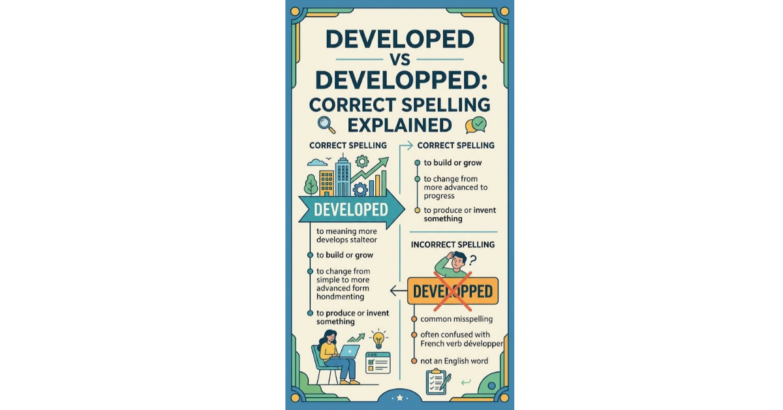
Have you ever written a sentence and wondered whether the correct spelling is developed or developped? It is an easy mistake to make, especially when you’re familiar with English words that double their final consonants before adding a suffix.
When comparing developed vs developped, the answer is straightforward: developed is the correct spelling in standard English, while developped is incorrect. Whether you’re writing a school assignment, a business report, or a casual message, knowing the correct form helps you communicate clearly and confidently.
In this guide, we’ll explain the spelling rule, explore the meaning of developed, provide practical sentence examples, and answer common questions about related words such as developing, development, and developer.
Developed vs Developped: Which One Is Correct?
Developed is the correct spelling in both American and British English. The word is the past tense and past participle of the verb develop.
The spelling developped, with a double p, is a common misspelling. Although it might look plausible because English sometimes doubles consonants before adding endings, the word develop does not follow that pattern.
Here’s a quick comparison:
| Spelling |
Correct or Incorrect? |
Explanation |
| Developed |
Correct |
Standard past tense and past participle |
| Developped |
Incorrect |
Contains an unnecessary second p |
| Developing |
Correct |
Present participle or gerund |
| Development |
Correct |
Noun referring to the process or result of developing |
| Developer |
Correct |
A person or organization that develops something |
Remember: The correct form is developed, with one p and the ending -ed.
What Does Developed Mean?
The word developed has several meanings depending on the context. It generally describes something that has grown, progressed, improved, or reached a particular stage.
It can refer to personal skills, technology, ideas, land, businesses, or even countries.
For example:
- “She developed excellent communication skills during her first year at work.”
- “The company developed a new mobile application.”
- “They developed a plan to reduce operating costs.”
- “The photographer developed the film in a darkroom.”
- “The country has a highly developed transportation system.”
In each example, the word describes a process of growth, creation, progress, or change.
Developed as a Verb
As a verb, developed indicates that an action happened in the past or has been completed.
For example, in the sentence “The team developed a new strategy,” the word describes an action the team performed.
It can also appear as a past participle with auxiliary verbs:
- “The software has developed significantly over the years.”
- “A new treatment was developed by the research team.”
- “She had developed a strong interest in science.”
The exact meaning depends on the surrounding sentence.
Developed as an Adjective
Developed can also function as an adjective describing something that has reached an advanced or mature state.
Examples include:
- “The region has a well-developed road network.”
- “He has a highly developed sense of responsibility.”
- “The company operates in a developed market.”
This use is especially common when discussing infrastructure, skills, industries, and economies.
Why Is Developped Incorrect?
The confusion often comes from a familiar English spelling rule: some verbs double their final consonant before adding -ed or -ing.
For example:
- Stop → stopped
- Plan → planned
- Drop → dropped
- Prefer → preferred
Because these words double their final consonants, writers may assume that develop should become developped. However, that assumption is incorrect.
The standard spelling is:
Develop + ed = Developed
The final consonant of develop is p, but the word does not meet the usual spelling conditions for doubling that consonant. In particular, the final syllable is not stressed in the way required for the common consonant-doubling rule.
Compare the following examples:
| Base Verb |
Correct Past Tense |
Reason |
| Develop |
Developed |
No doubling of p |
| Open |
Opened |
No doubling of n |
| Visit |
Visited |
No doubling of t |
| Stop |
Stopped |
Final consonant is doubled |
| Admit |
Admitted |
Final stressed syllable triggers doubling |
The best approach is to learn developed as the standard spelling rather than trying to apply the doubling rule mechanically.
Developed vs Developped in American and British English
Some English words have different spellings in American and British English. For example, Americans commonly write color, while British writers generally use colour.
However, developed is correct in both varieties of English. There is no standard American-versus-British spelling difference that makes developped acceptable.
| American English |
British English |
| Developed |
Developed |
| Developing |
Developing |
| Development |
Development |
| Developer |
Developer |
Whether you’re writing for an American audience, a British publication, or an international readership, use developed.
How to Use Developed Correctly in Sentences
One of the easiest ways to remember a spelling is to see it used naturally. The following examples show how developed works in different situations.
1. In Education
“Students developed stronger research skills after completing the project.”
Here, developed describes the improvement of a skill over time.
2. In Business
“The company developed a marketing strategy to reach new customers.”
In this example, the word refers to creating or producing something.
3. In Technology
“Engineers developed a more efficient battery system.”
The word describes the creation of a new technology or solution.
4. In Personal Growth
“She developed greater confidence after speaking at several events.”
Here, it refers to a personal quality that grew through experience.
5. In Health and Science
“Researchers developed a new method for detecting the condition.”
The word describes the creation of a method through research and experimentation.
6. In Everyday Conversation
“I developed an interest in photography when I was a teenager.”
This sentence describes how an interest began and grew over time.
Notice that the spelling remains developed in every example, regardless of the context.
Developed, Developing, and Development: What’s the Difference?
These related words share the same root, but each has a different grammatical function.
| Word |
Part of Speech |
Meaning |
Example |
| Develop |
Verb |
To grow, improve, or create |
“We develop new ideas.” |
| Developed |
Past-tense verb or adjective |
Grew, created, or reached an advanced stage |
“They developed a new system.” |
| Developing |
Present participle or gerund |
Growing, improving, or creating |
“The team is developing a product.” |
| Development |
Noun |
The process or result of growth or creation |
“The development took two years.” |
| Developer |
Noun |
A person or organization that develops something |
“The developer released an update.” |
Understanding these forms helps you avoid grammatical errors as well as spelling mistakes.
When Should You Use Developed?
Use developed when referring to a completed action or describing something that has reached a particular stage.
For example: “The researchers developed a new technique.”
When Should You Use Developing?
Use developing when an action is ongoing or when describing something that is still growing or changing.
For example: “The researchers are developing a new technique.”
When Should You Use Development?
Use development when referring to the process, event, or result of developing something.
For example: “The development of the new technique took several months.”
Common Spelling Mistakes Similar to Developped
The confusion between developed and developped is part of a broader challenge in English spelling. Some words require doubled consonants, while others do not.
Here are a few comparisons worth remembering:
- Developed, not developped: The correct past tense of develop.
- Opened, not openned: The correct past tense of open.
- Visited, not visitted: The correct past tense of visit.
- Stopped, not stoped: The correct past tense of stop.
- Planned, not planed: The correct past tense of plan when referring to making a plan. (The spelling planed is also a valid word with a different meaning, such as smoothing wood with a plane.)
These examples demonstrate why it’s important to learn the spelling of individual words instead of assuming every verb follows the same rule.
Tips to Remember the Correct Spelling of Developed
If you regularly confuse developed with developped, a few simple habits can help.
- Remember the base word: Start with develop, which contains only one p.
- Add the ending directly: Write develop + ed = developed.
- Compare it with familiar words: Think of opened and visited, which also do not double the final consonant.
- Practice with sentences: Write “The team developed a new plan” several times to reinforce the correct spelling.
- Use a spell-checker: A reliable spelling tool can catch errors when proofreading longer documents.
The goal is to recognize the correct form automatically so that you can focus on expressing your ideas rather than second-guessing individual words.
Frequently Asked Questions
1. Is it developed or developped?
Developed is the correct spelling. Developped is a misspelling and is not accepted as standard English.
2. Why is developed spelled with one p?
The verb develop does not follow the consonant-doubling pattern used in words such as stop and plan. Adding -ed produces developed, with one p.
3. Is developped ever correct in British English?
No. Developed is the standard spelling in both British and American English. The double-p spelling is not a recognized regional alternative.
4. What is the past tense of develop?
The simple past tense is developed. For example: “The company developed a new product last year.”
5. Is developing spelled with one p or two?
Developing is spelled with one p. The correct spelling is D-E-V-E-L-O-P-I-N-G.
6. What is the noun form of developed?
The related noun is development. It refers to the process or result of growing, improving, creating, or advancing something.
7. How do you use developed in a sentence?
You can use it to describe a completed action or an advanced state. For example: “The engineers developed a faster computer system.”
8. Why do people write developped?
People often write developped because they mistakenly apply the consonant-doubling rule used in words such as stopped and planned. Remembering the base word develop helps prevent this error.
Conclusion
When choosing between developed vs developped, the correct answer is developed. It is the standard spelling in both American and British English, whether you’re describing a completed action, a personal skill, a technological innovation, or something that has reached an advanced stage.
The key is to remember that develop contains one p and takes the ending -ed without doubling that consonant. Related forms such as developing, development, and developer follow their own spelling patterns, but none requires a double p.
If you want to improve your English writing, practice using these words in sentences and explore other commonly confused spellings. Small improvements in spelling can make your writing clearer, more professional, and easier to understand.