Have you ever written a congratulatory message and paused to wonder whether the correct spelling is congratulate or congradulate? You’re not alone. These two spellings look and sound similar, making it easy to mix them up when writing a card, sending a text, or congratulating someone on an achievement.
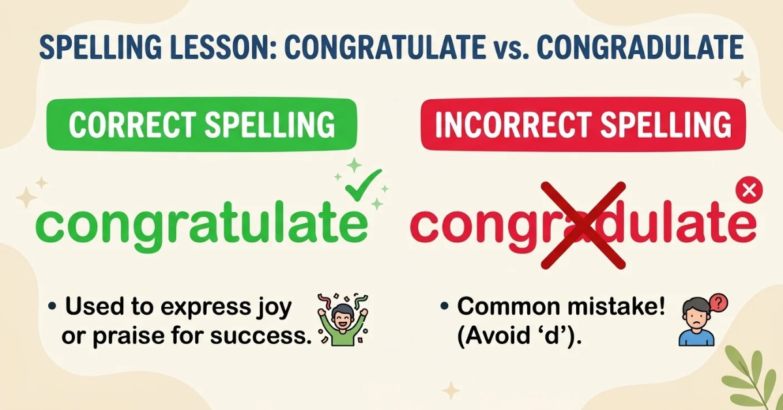
The correct spelling is congratulate. The word congradulate is a common spelling mistake and is not accepted as the standard spelling in modern English. Although the difference is only one letter, using the correct form helps make your writing clearer and more professional.
Let’s look at the meaning, pronunciation, examples, and simple tricks that will help you remember the correct spelling.
Congratulate vs Congradulate: What’s the Difference?
The main difference is that congratulate is the correct English word, while congradulate is a misspelling.
| Word |
Correct? |
Meaning |
| Congratulate |
Yes |
To express pleasure or praise for someone’s achievement, success, or good fortune |
| Congradulate |
No |
A common misspelling of congratulate |
For example, you would write, “I want to congratulate you on your promotion,” rather than “I want to congradulate you on your promotion.”
The correct spelling contains the letter t after “gra”: c-o-n-g-r-a-t-u-l-a-t-e. Remembering this small detail can help you avoid the mistake in everyday writing.
What Does Congratulate Mean?
The verb congratulate means to express happiness, approval, or admiration when someone experiences something positive. It is commonly used for achievements, important milestones, celebrations, and personal successes.
You might congratulate someone for:
- Getting a new job or earning a promotion.
- Graduating from school, college, or university.
- Getting married or welcoming a new baby.
- Winning a competition or receiving an award.
- Completing a difficult project or reaching a personal goal.
The word can also be used in professional settings. For instance, a manager might congratulate an employee for meeting a target, while a friend might congratulate someone for passing an exam.
Examples of Congratulate in Sentences
Here are some natural examples showing how to use the word correctly:
- I would like to congratulate you on your outstanding achievement.
- Everyone gathered to congratulate Sarah on her graduation.
- We should congratulate the team for completing the project ahead of schedule.
- My friends called to congratulate me on my new job.
- The principal congratulated the students on their excellent examination results.
- Please congratulate your brother on his wedding.
- She sent a message to congratulate her colleague on the promotion.
In each sentence, the word expresses recognition or appreciation for something positive.
Why Do People Spell It Congradulate?
There are a few reasons people mistakenly write congradulate instead of congratulate.
1. The Words Sound Similar
In everyday speech, the middle sounds of congratulate can make the word difficult to spell. Depending on a person’s accent and speaking speed, the letter t may not be clearly noticeable.
When people write words based on how they sound, they sometimes substitute one letter for another.
2. Confusion With Similar Words
English contains words that sound alike but have different spellings and meanings. Writers may also associate congradulate with words such as “graduate” or “graduation.”
Since graduation is an occasion when people frequently congratulate one another, the two words may become mixed up in someone’s mind. However, congratulate and graduate have different spellings and should not be combined.
3. Typing Too Quickly
Misspellings often happen when people type messages quickly on phones, laptops, or social media platforms. If you have written the incorrect version before, your fingers may repeat the same pattern without you noticing.
Spell-checking tools can help identify the error, but learning the correct spelling is more reliable than depending entirely on automatic corrections.
How to Remember the Correct Spelling
If you frequently confuse these spellings, try one of the following techniques.
Remember the T in Congratulate
The easiest method is to focus on the letter T in the middle of the word.
Break the word into smaller parts:
CON + GRAT + ULATE = CONGRATULATE
Pay special attention to “grat.” Once you remember that the correct word contains a t, it becomes easier to avoid the incorrect version.
Connect It With Congratulations
Another useful trick is to remember the related word congratulations.
For example:
- Correct: Congratulations on your success!
- Correct: I congratulate you on your success.
- Incorrect: I congradulate you on your success.
Both congratulate and congratulations contain the same “congrat” spelling pattern.
Practice With Short Sentences
Writing the word a few times in meaningful sentences can reinforce the correct spelling.
Try completing these examples:
- I want to ______ you on your achievement.
- Please accept my ______ on your success.
- We gathered to ______ the winners.
The correct answers are “congratulate,” “congratulations,” and “congratulate.”
Congratulate, Congratulations, and Congratulatory: Related Words
Understanding related words makes it easier to use the correct form in different situations.
| Word |
Part of speech |
Example |
| Congratulate |
Verb |
I congratulate you on your success. |
| Congratulations |
Noun or interjection |
Congratulations on your new home! |
| Congratulation |
Noun |
She offered her congratulation to the winner. |
| Congratulatory |
Adjective |
He sent a congratulatory message. |
The plural form congratulations is much more common in everyday conversation than the singular congratulation. Meanwhile, congratulatory is useful when describing a message, speech, note, or gesture intended to celebrate someone’s success.
For example, “We sent a congratulatory card to our colleague” sounds natural in both personal and professional writing.
Is Congradulate Ever Correct?
No. In standard modern English, congradulate is considered a misspelling of congratulate. It should not be used in formal documents, school assignments, business emails, professional messages, or published articles.
You might encounter the incorrect form in online comments, informal messages, or social media posts. Its appearance in these places does not make it an accepted spelling.
If you are editing someone else’s writing, replace congradulate with congratulate wherever the intended meaning is to express praise or happiness for another person’s success.
How to Use Congratulate in Everyday Writing
Choosing the correct word is only part of effective communication. The way you phrase your congratulations also matters.
Here are a few examples for different situations.
For Friends and Family
- Congratulations on your graduation! I’m so proud of you.
- I want to congratulate you on your new job. You deserve it!
- Congratulations on your wedding. Wishing you both a wonderful future together.
For Work and Business
- I would like to congratulate the entire team on completing this project successfully.
- Please join me in congratulating our colleague on this well-deserved promotion.
- We congratulate the company on reaching this important milestone.
For Academic Achievements
- Congratulations on passing your final examinations.
- I would like to congratulate all the graduates on their hard work and dedication.
- The teacher congratulated the student for winning the science competition.
These examples demonstrate how the same word works naturally in casual, formal, and professional communication.
Frequently Asked Questions
1. Which spelling is correct: congratulate or congradulate?
Congratulate is the correct spelling. Congradulate is a common misspelling and should be avoided in standard English writing.
2. Why do people write congradulate?
People often write it because the two forms sound similar when spoken. Confusion with the word “graduate” and typing mistakes can also contribute to the error.
3. How do you spell congratulate correctly?
The correct spelling is C-O-N-G-R-A-T-U-L-A-T-E. Remember the letter “t” in the middle of the word.
4. Is congratulate a verb or a noun?
Congratulate is a verb. It describes the action of expressing pleasure or praise for someone’s achievement. Congratulations is the related noun commonly used to express good wishes.
5. What is the difference between congratulate and congratulations?
Congratulate describes an action, as in “I congratulate you on your promotion.” Congratulations is an expression of good wishes, as in “Congratulations on your promotion!”
6. Can I use congradulate in a formal email?
No. Use congratulate in formal emails, business correspondence, applications, academic work, and other professional writing.
7. What is the adjective form of congratulate?
The adjective is congratulatory. For example, you might send a congratulatory email, write a congratulatory note, or deliver a congratulatory speech.
8. Is it correct to say “congratulate you for” or “congratulate you on”?
Both constructions can occur in English, but “congratulate someone on something” is the usual and widely recommended pattern when referring to an achievement.
For example: “I congratulate you on your success.”
Conclusion
When deciding between congratulate and congradulate, the answer is straightforward: congratulate is the correct spelling. The other form is a common spelling error, often caused by similar pronunciation or confusion with the word “graduate.”
To remember the correct form, focus on the letter t in “congrat.” Practice using the word in sentences, and remember that related forms such as congratulations and congratulatory follow the same spelling pattern.
The next time you write a message celebrating someone’s achievement, take a moment to check your spelling. A correctly written congratulatory message helps you communicate your appreciation clearly and confidently.