Have you ever wondered whether to say phasing or pacing when describing how something progresses over time? Although these two words look and sound somewhat similar, they have different meanings. Understanding phasing vs pacing can help you choose the right term in writing, business communication, project planning, storytelling, and everyday conversations.
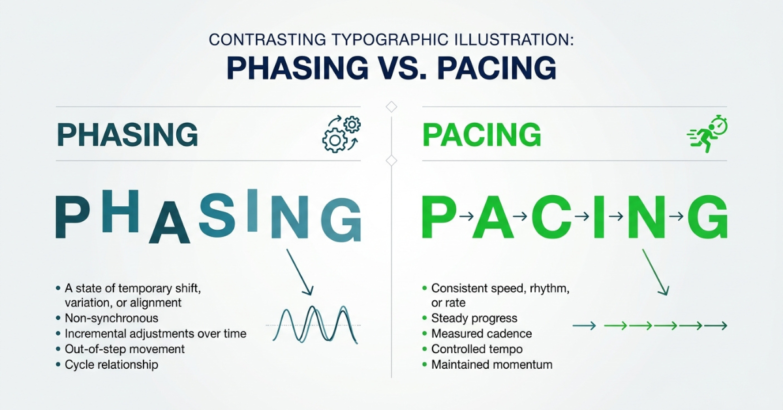
The main difference comes down to how something develops. Phasing involves dividing a process into distinct stages or introducing something gradually in planned steps. Pacing, on the other hand, refers to the speed, rhythm, or timing at which something progresses.
Both concepts are useful when managing work, delivering information, organizing activities, or controlling the flow of an experience. Let’s explore their definitions, differences, examples, and common uses so you can confidently tell them apart.
What Is Phasing?
Phasing is the process of arranging an activity, project, change, or development into separate stages. Each phase represents a particular part of the overall process, often with its own objectives, tasks, and deadlines.
Instead of completing everything at once, an individual or organization introduces changes in a structured sequence. This approach can make complicated tasks easier to manage, reduce disruption, and allow progress to be reviewed at different points.
Examples of phasing
Consider a company planning to introduce new software across its organization. Rather than switching every employee to the new system on the same day, management might introduce it in three phases:
- Phase one: Test the software with a small team.
- Phase two: Introduce it to selected departments.
- Phase three: Make it available to the entire organization.
This is phasing because the rollout is divided into clearly defined stages.
Other examples include:
- Construction: Completing a building project in separate stages.
- Education: Introducing a revised curriculum one grade level at a time.
- Business: Rolling out a new product across selected markets before expanding further.
- Government: Introducing a new policy in stages rather than implementing every provision immediately.
- Technology: Migrating different groups of users to a new platform in sequence.
In each case, the emphasis is on the structure and order of implementation.
What Is Pacing?
Pacing refers to the speed, rhythm, or rate at which something happens or progresses. It describes whether an activity moves quickly, slowly, steadily, or with frequent pauses.
Unlike phasing, pacing does not necessarily divide a process into separate stages. Instead, it focuses on how quickly those stages or activities unfold and whether the overall tempo is appropriate for the situation.
Examples of pacing
Imagine a teacher explaining a difficult mathematical concept. If students are struggling, the teacher may slow down, provide additional examples, and allow more time for questions. If students understand the material quickly, the teacher may move forward at a faster pace.
This is pacing because the teacher is adjusting the speed of instruction.
Other examples include:
- Writing: Controlling the speed at which readers encounter events and information.
- Public speaking: Adjusting speech speed, pauses, and emphasis to keep an audience engaged.
- Project management: Maintaining a sustainable work rate to meet deadlines without overwhelming the team.
- Sports: Managing effort and speed throughout a competition.
- Learning: Adjusting the rate at which new concepts are introduced.
- Fitness: Balancing workout intensity and recovery to maintain an appropriate training rhythm.
In these situations, pacing concerns the tempo of progress rather than the division of work into stages.
Phasing vs. Pacing: Key Differences
Although both concepts relate to progress over time, they address different questions.
| Aspect |
Phasing |
Pacing |
| Main meaning |
Dividing a process into stages |
Controlling the speed or rhythm of progress |
| Primary focus |
Sequence and structure |
Tempo and timing |
| Main question |
What happens at each stage? |
How quickly should it happen? |
| Typical approach |
Organize work into phases |
Adjust the rate of activity |
| Example in business |
Launching a product in three markets sequentially |
Adjusting the speed of the launch campaign |
| Example in education |
Teaching a course in separate units |
Adjusting how quickly students cover each unit |
| Common benefit |
Makes complex processes easier to organize |
Helps maintain a suitable and sustainable rate |
The simplest way to remember the difference is that phasing determines the stages, while pacing determines the speed at which progress happens.
A simple side-by-side example
Suppose a company is redesigning its website.
- Phasing: The company completes research first, design second, development third, and testing fourth.
- Pacing: The team decides how much work to complete each week and how quickly to move through the planned activities.
The company can use both approaches simultaneously. Phasing establishes the project’s structure, while pacing helps the team maintain an appropriate rate of progress within that structure.
Phasing vs. Pacing in Different Contexts
The exact application of these terms varies depending on the field. Understanding the context can make their meanings even clearer.
1. Phasing vs. pacing in project management
In project management, phasing helps divide a large initiative into manageable stages. A project might move through planning, design, implementation, testing, and delivery.
Pacing focuses on the rate of work throughout those stages. A project manager might adjust staffing, workload, or deadlines to prevent delays and keep the team productive.
For example, a phased implementation might require each department to adopt a new system separately. The pacing decision determines how much time each department receives before the next rollout begins.
Effective project planning generally requires both a clear sequence and a realistic work rate.
2. Phasing vs. pacing in writing and storytelling
Writers use pacing to influence how readers experience a story. Fast pacing can create urgency through short scenes, rapid action, and limited interruptions. Slow pacing can build atmosphere, develop characters, or give emotional moments room to breathe.
Phasing, in a broader writing or publishing context, can describe releasing material in planned stages. For example, an author might publish a series of articles in phases as part of a larger editorial plan.
These terms are not interchangeable. Pacing affects the flow of the reader’s experience, while phasing organizes how content or a larger project is introduced.
3. Phasing vs. pacing in education
Phasing in education may involve introducing a curriculum change across different grades, schools, or academic years. This staged approach gives teachers and administrators time to adapt.
Pacing concerns the speed at which lessons are taught and students are expected to learn. Teachers may slow down when a concept is difficult or move faster when students demonstrate strong understanding.
A well-phased curriculum can still be poorly paced if lessons move too quickly. Similarly, a well-paced lesson can be part of a poorly organized rollout. The two concepts solve different problems.
4. Phasing vs. pacing in business strategy
Businesses often use phasing when introducing new products, changing internal processes, expanding into markets, or implementing organizational reforms.
Pacing helps determine how aggressively those activities should progress. A company might expand in phases across several regions while pacing its investment, marketing, and recruitment according to demand.
Using both concepts can help businesses avoid introducing too many changes simultaneously or moving so slowly that they miss important opportunities.
5. Phasing vs. pacing in healthcare and rehabilitation
In rehabilitation, pacing commonly refers to managing activity levels to avoid doing too much at once. A person may alternate activity with rest and adjust effort according to professional guidance and individual tolerance.
Phasing may refer to a structured treatment or rehabilitation program that progresses through defined stages, depending on the condition and treatment plan.
These terms have different applications in clinical settings, and their meanings can vary by specialty. Treatment decisions should follow advice from an appropriately qualified healthcare professional rather than a general definition of either word.
Can Phasing and Pacing Be Used Together?
Yes. In fact, many successful projects and activities depend on both.
Phasing provides a roadmap by identifying the stages that must be completed. Pacing determines how quickly work moves through those stages, taking account of resources, deadlines, complexity, and people’s capacity.
For example, a business implementing a new customer relationship management (CRM) system might use the following approach:
- Planning phase: Identify requirements and prepare the system.
- Pilot phase: Test the system with a small group.
- Expansion phase: Introduce it to additional departments.
- Full implementation phase: Make the system available across the company.
The business then establishes a realistic pace for each phase. The pilot might run for several weeks to allow adequate testing, while the final rollout might happen more quickly once the system has been validated.
The phases establish what comes next. The pace determines how quickly the organization gets there.
How to Choose Between Phasing and Pacing
If you’re unsure which word to use, consider what you want to describe.
Choose phasing when your focus is on:
- Breaking a project into distinct stages.
- Introducing changes in a planned sequence.
- Organizing a rollout or implementation.
- Explaining which activities happen first, second, and last.
- Structuring a long-term initiative.
Choose pacing when your focus is on:
- Controlling the speed of progress.
- Adjusting the rate of learning or work.
- Improving the rhythm of a presentation or story.
- Managing effort, intensity, or workload.
- Determining whether progress is too fast, too slow, or appropriate.
Quick test
Ask yourself: Am I describing the stages of a process or the speed at which it moves?
If you’re describing the stages, phasing is probably the right word. If you’re describing the speed or rhythm, pacing is generally more appropriate.
For instance, “We are phasing the rollout across three departments” describes the implementation sequence. “We are pacing the rollout to give each department enough time to adapt” describes the rate at which it proceeds.
Common Mistakes to Avoid
Because the terms are related to progress and timing, it’s easy to confuse them. These are some common mistakes worth avoiding.
1. Treating the words as synonyms. Phasing and pacing are related, but they describe different aspects of a process.
2. Assuming phasing always means moving slowly. A phased process can move quickly or slowly. Its defining feature is the division into stages, not the total duration.
3. Assuming pacing requires separate stages. An activity can have a consistent or changing pace without being divided into formal phases.
4. Ignoring context. In business, education, writing, and healthcare, the practical application of each term may differ. Consider the subject before deciding which word fits.
5. Confusing timing with sequence. A schedule may specify when each phase begins, but the sequence of stages and the speed of execution remain distinct considerations.
Recognizing these differences makes your writing more precise and helps prevent misunderstandings when discussing plans, performance, or progress.
Frequently Asked Questions
What is the main difference between phasing and pacing?
Phasing means dividing a process into distinct stages or introducing changes in a planned sequence. Pacing means controlling the speed or rhythm at which the process progresses.
Is phasing the same as pacing?
No. Phasing focuses on structure and sequence, whereas pacing focuses on speed and timing. A project can be phased into several stages and paced differently within each stage.
What is an example of phasing?
A company introducing new software to one department at a time is using phasing. The rollout is divided into separate stages rather than happening across the entire organization at once.
What is an example of pacing?
A teacher slowing down a lesson because students need more time to understand a concept is adjusting the pace of instruction. The focus is on the rate of progress rather than the sequence of stages.
Which is more important: phasing or pacing?
Neither is universally more important. Phasing helps establish an organized sequence, while pacing helps ensure that progress occurs at a suitable rate. The best approach depends on the activity and its objectives.
Can a project have good phasing but poor pacing?
Yes. A project may have well-defined stages but unrealistic deadlines that force the team to rush. In this situation, the structure is sound, but the pace needs adjustment.
Can pacing change without changing the phases?
Yes. A team can keep the same project stages while extending deadlines, increasing resources, or adjusting workloads to change the rate of progress.
What is the difference between phasing and pacing in project management?
Phasing divides a project into stages such as planning, development, testing, and launch. Pacing determines how quickly the team works through those stages and whether the schedule is realistic.
Conclusion
Understanding phasing vs pacing becomes much easier when you focus on the two ideas behind the terms. Phasing is about dividing a process into organized stages, while pacing is about managing the speed and rhythm of progress.
Whether you’re planning a business rollout, designing a curriculum, writing a story, or managing a complex project, both concepts can help you work more effectively. Use phasing to establish a clear sequence and pacing to make sure progress happens at an appropriate rate.
The next time you discuss a project or explain how something develops, ask yourself whether you’re describing its structure or its speed. That simple distinction will help you choose the right word and communicate your ideas more clearly.