Have you ever paused while writing an email, completing an assignment, or posting on social media because you weren’t sure whether to write planning or planing? You’re not alone. These two words look almost identical, but they have different meanings and are used in very different situations.
The difference between planning or planing comes down to context. Planning usually means preparing for something in advance, while planing refers to smoothing a surface with a tool or moving across water in a particular way. Understanding when to use each spelling can help you write more clearly and avoid common grammar mistakes.
Let’s look at their meanings, spelling rules, practical examples, and a few easy ways to remember the difference.
Planning vs. Planing: What’s the Difference?
Although the words differ by just one letter, their meanings are quite distinct.
| Word |
Meaning |
Example |
| Planning |
Making arrangements or deciding what to do |
We are planning a family trip. |
| Planing |
Smoothing wood or another material with a plane |
The carpenter is planing the wooden door. |
| Planing |
Moving over water on a boat at sufficient speed |
The speedboat is planing across the lake. |
In everyday writing, planning is the correct spelling when you’re talking about preparing, organizing, or arranging something. Planing is correct when the context involves woodworking or certain types of movement across water.
For example, if you’re organizing a birthday party, you’re planning it. If you’re using a woodworking tool to make a wooden board smooth, you’re planing it.
What Does Planning Mean?
Planning is the process of thinking ahead, setting goals, organizing resources, and deciding which steps to take to achieve a particular result. It can apply to almost any part of life, from arranging a weekend outing to managing a major business project.
The word is commonly used in education, business, travel, personal finance, event management, and everyday conversations.
Examples of Planning in Sentences
Here are some examples showing how to use the word correctly:
- We are planning a vacation to the mountains next summer.
- She is planning to start her own business.
- The marketing team is planning a new advertising campaign.
- Careful planning helped us finish the project on time.
- They spent the weekend planning their wedding.
- I’m planning to learn a new skill this year.
In each sentence, the word refers to preparing for a future action or deciding how something should happen.
Why Is Planning Spelled With Two Ns?
The spelling rule is straightforward. The verb plan ends with a consonant-vowel-consonant pattern. When you add a suffix beginning with a vowel, such as -ing, you generally double the final consonant.
The result is:
- Plan + ing = planning
- Run + ing = running
- Sit + ing = sitting
- Stop + ing = stopping
This rule helps preserve the short vowel sound in the original word. Writing planing when you mean making arrangements is a spelling mistake because it changes the word.
What Does Planing Mean?
Planing has two main uses, depending on the context.
1. Planing in Woodworking
In woodworking, planing means removing thin layers from a piece of wood to make its surface smooth, flat, or level. This is typically done with a hand plane or a powered planer.
Carpenters and furniture makers use this technique to prepare wood for construction, improve the fit of wooden components, and create a clean finish.
Examples of planing in woodworking:
- The carpenter is planing the wooden table.
- Planing the rough board made it smooth enough for painting.
- He used a power planer to remove the uneven edges.
- The wood needs additional planing before assembly.
Notice that the word describes a physical process rather than making future arrangements.
2. Planing in Boating
In boating, planing describes a condition in which a boat moves fast enough for hydrodynamic forces to support much of its weight, allowing it to ride higher on the water rather than moving entirely in a displacement mode.
For example:
- The motorboat began planing as its speed increased.
- The hull is designed to help the vessel plane efficiently.
- The boat was planing smoothly across the water.
This technical use is less common in everyday writing, but it is correct.
Planning or Planing: Which One Should You Use?
The easiest way to choose the correct word is to consider what you’re trying to describe.
Use planning when talking about:
- Making arrangements for an event
- Setting goals or developing strategies
- Organizing a project or schedule
- Preparing for a trip
- Deciding what to do in the future
Use planing when talking about:
- Smoothing or leveling a wooden surface
- Using a hand plane or power planer
- A boat rising onto the water’s surface at speed
Quick Examples to Remember
Correct: I’m planning a trip to London.
Incorrect: I’m planing a trip to London.
Correct: The carpenter is planing the wooden board.
Incorrect: The carpenter is planning the wooden board.
The second pair illustrates how changing one letter can change the intended meaning of a sentence.
Common Spelling Mistakes With Planning and Planing
Because the two words look so similar, people sometimes use them interchangeably. However, they are not interchangeable in standard English.
Here are some common mistakes and their corrections:
| Incorrect usage |
Correct usage |
| I am planing my wedding. |
I am planning my wedding. |
| We are planing a business strategy. |
We are planning a business strategy. |
| She is planing to study abroad. |
She is planning to study abroad. |
| The carpenter is planning the wood. |
The carpenter is planing the wood. |
The first three examples refer to preparation or intention, so planning is appropriate. The last example describes smoothing wood, so planing is the correct choice.
Another useful distinction is the phrase planning to. When you want to express an intention to do something, use planning to followed by the base form of a verb.
For example, “I’m planning to visit my grandparents” is correct, whereas “I’m planing to visit my grandparents” is not.
Easy Tricks to Remember the Difference
If you frequently confuse these spellings, a simple memory trick can help.
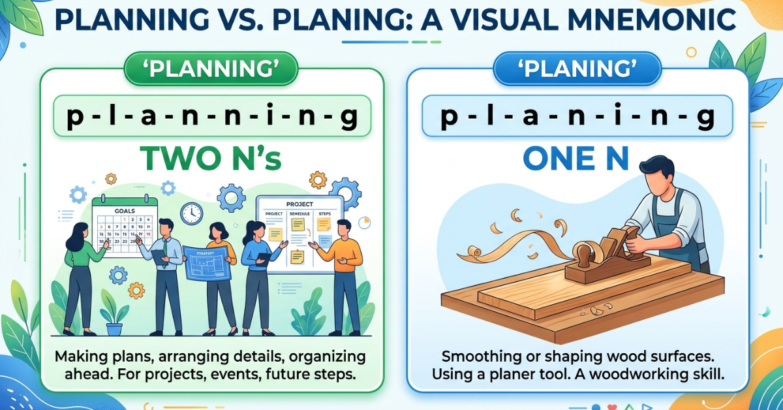
Remember the Double N
Think of planning as making a next step. Both ideas involve looking ahead and preparing for what comes next.
Remember:
Plan + ing = planning
Whenever you’re talking about organizing, preparing, or making decisions for the future, the double-n spelling is the one you need.
Connect Planing With a Plane
The word planing contains the word plane, which is the name of a woodworking tool used to smooth wood.
This association makes it easier to remember that planing usually relates to a physical surface or a boat moving across water.
Ask Yourself One Simple Question
Before choosing the spelling, ask: “Am I preparing for something, or am I smoothing something?”
- Preparing for something? Use planning.
- Smoothing a surface or describing a boat’s movement? Use planing.
This quick test works well in emails, schoolwork, professional documents, and everyday writing.
Frequently Asked Questions
1. Is it planning or planing?
Both are correct English words, but they have different meanings. Planning refers to preparing or organizing something, while planing usually refers to smoothing a surface with a tool or a boat moving over water at speed.
2. Why is planning spelled with two Ns?
The final consonant in plan is doubled when the suffix -ing is added. This follows the common consonant-vowel-consonant spelling rule: plan becomes planning, just as run becomes running.
3. Is “I am planing to go” correct?
No. When expressing an intention to do something, the correct sentence is “I am planning to go.” The word planing does not express this meaning in standard English.
4. What is the past tense of planning?
The past tense of plan is planned. For example, “We planned the entire event last month.” The final consonant is doubled before adding -ed for the same general spelling reason.
5. What is the difference between a plan and planning?
A plan is an idea, arrangement, or set of steps intended to achieve a goal. Planning is the process of developing or organizing that plan.
For example, “Our plan is to launch a website” describes the intended action, while “We are planning the website launch” describes the process of preparing for it.
6. Can planing be used outside woodworking?
Yes. In boating, planing describes a vessel moving fast enough to ride on top of the water to a significant degree. The term is also used in certain technical contexts involving the shaping or smoothing of surfaces.
7. How can I remember the correct spelling in an exam?
Associate planning with preparation and future goals, and associate planing with a plane used to smooth wood. If the sentence describes an intention, arrangement, or upcoming activity, choose planning.
Conclusion
The difference between planning or planing may seem small, but choosing the right spelling makes your writing more accurate and easier to understand.
Use planning when discussing goals, arrangements, preparation, or future activities. Use planing when referring to smoothing wood or describing a boat moving across water at speed.
The simplest way to remember the distinction is to connect the double-n spelling with making plans and the single-n spelling with a woodworking plane. With a little practice, you’ll be able to choose the correct word confidently.
If you’re interested in improving your English, explore more grammar guides and commonly confused words to strengthen your spelling, vocabulary, and everyday communication skills.