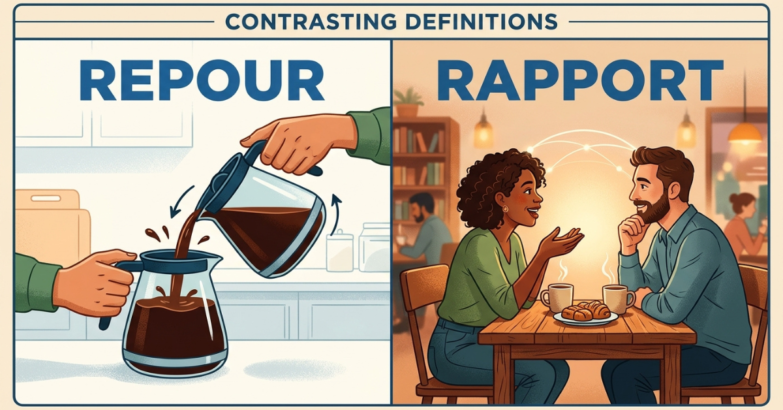
Have you ever come across the words repour and rapport and wondered whether they mean the same thing? They look somewhat similar, and their pronunciation can be confusing, especially if you’re learning English or improving your writing.
The difference between Repour vs Rapport is straightforward once you understand how each word is used. Repour is a verb that means to pour something again, while rapport is a noun that describes a positive connection or mutual understanding between people. Knowing the distinction will help you choose the right word in everyday conversations, professional emails, and academic writing.
What Does Repour Mean?
Repour is a verb that means to pour a liquid again. It is formed by combining the prefix re-, meaning “again,” with the word pour.
You might use this word when a drink has been spilled, a liquid needs to be transferred to another container, or something needs to be poured again for a better result.
Examples of Repour in a Sentence
Here are some examples that show how the word works in everyday English:
- The waiter offered to repour the wine after the glass was accidentally knocked over.
- I had to repour my coffee because I spilled it on the counter.
- She decided to repour the paint mixture into a clean container.
- Please repour the water carefully so it doesn’t splash.
- The bartender had to repour the drink after noticing a mistake.
In each example, the word describes an action involving pouring. It does not describe a relationship, feeling, or personal connection.
When Should You Use Repour?
Use repour when you want to describe pouring something a second time. Common situations include:
- Food and drinks: Pouring coffee, tea, juice, or wine again.
- Cooking: Transferring sauces or other liquids into a different container.
- Painting and crafts: Pouring paint or a liquid mixture again.
- Laboratory work: Transferring liquids during a procedure, when appropriate.
Remember that repour is relatively specific. If you simply want to add more liquid to an empty container, refill may be the more natural word.
What Does Rapport Mean?
Rapport is a noun that describes a friendly, comfortable relationship in which people understand one another and communicate well. It often involves trust, mutual respect, empathy, and a sense of connection.
The word is commonly used in workplaces, schools, healthcare, sales, and everyday relationships. For example, a manager who listens to employees and communicates openly may develop strong rapport with the team.
According to the Cambridge Dictionary, rapport refers to a good understanding of someone and the ability to communicate well with them.
Examples of Rapport in a Sentence
Consider these examples:
- The teacher developed a strong rapport with her students.
- The sales representative built rapport with the client by listening carefully.
- A good doctor-patient relationship often depends on effective communication and rapport.
- The manager has excellent rapport with the marketing team.
- The interviewer established rapport with the candidate before asking difficult questions.
- Their natural rapport made the conversation feel relaxed and comfortable.
Notice that the word describes the quality of a relationship rather than a physical action.
Why Is Rapport Important?
Building rapport can make communication easier and help people work together more effectively. It is particularly valuable in situations where trust and cooperation matter.
Some common benefits include:
- Better communication: People feel more comfortable sharing their thoughts and concerns.
- Stronger professional relationships: Colleagues, clients, and managers can work together more effectively.
- Improved customer experience: Customers may feel more understood when representatives listen and respond thoughtfully.
- Greater trust: Respectful, consistent communication can help people develop confidence in one another.
- Better teamwork: A positive connection can make collaboration more natural.
Rapport does not mean that two people must agree on everything. They can have different opinions and still communicate respectfully and understand each other.
Repour vs Rapport: Key Differences
Although the two words look similar, their meanings, grammatical roles, and uses are different.
| Feature |
Repour |
Rapport |
| Meaning |
To pour something again |
A positive connection or mutual understanding |
| Part of speech |
Verb |
Noun |
| Main context |
Liquids and pouring |
Relationships and communication |
| Example |
Please repour the juice. |
She has good rapport with her team. |
| Common phrase |
Repour the drink |
Build or establish rapport |
The easiest way to remember the distinction is to associate repour with liquids and rapport with people.
Repour vs Rapport: Pronunciation
Pronunciation is another reason these words can be confusing.
- Repour: Commonly pronounced ree-POUR.
- Rapport: Commonly pronounced ra-PORE or rə-PORE, depending on the speaker and accent.
In both words, the final sound can resemble “pour,” but the first syllable differs. The exact pronunciation of rapport varies somewhat between English accents.
Repour vs Rapport: Grammar and Word Usage
Understanding the grammatical role of each word makes it easier to use it correctly.
Repour is a verb. It describes an action and can change form depending on the sentence.
Examples:
- I repour the coffee when necessary.
- She repoured the tea into another cup.
- They will repour the drink if required.
Rapport is a noun. It names a type of interpersonal connection and is usually used with verbs such as build, establish, develop, or maintain.
Examples:
- We built rapport during the meeting.
- She established rapport with the new client.
- Good communication helps maintain rapport.
A common mistake is treating rapport as a verb. Instead of saying “I rapport with my colleagues,” write “I build rapport with my colleagues.”
Repour vs Rapport: Common Mistakes to Avoid
Even though the meanings are different, these words are easy to mix up when writing quickly. Here are a few mistakes to watch for.
1. Using Rapport When You Mean Repour
Incorrect: “Please rapport the water into the glass.”
Correct: “Please repour the water into the glass.”
The sentence describes pouring water again, so the verb repour is appropriate.
2. Using Repour When You Mean Rapport
Incorrect: “The manager developed a good repour with the employees.”
Correct: “The manager developed good rapport with the employees.”
The sentence describes a positive workplace relationship, so rapport is the correct word.
3. Treating Rapport as a Verb
Incorrect: “The salesperson rapported with the customer.”
Correct: “The salesperson built rapport with the customer.”
Use a suitable verb such as build, establish, or develop with the noun rapport.
4. Confusing Rapport With a General Relationship
The words relationship and rapport are related, but they are not identical.
A relationship is a broad term for a connection between people. Rapport specifically emphasizes a comfortable connection, mutual understanding, and effective communication.
For example, two people may have a professional relationship without having particularly strong rapport. When they communicate naturally and understand each other well, it is more accurate to describe their rapport as strong.
Repour vs Rapport: Which Word Should You Choose?
Choosing the correct word depends entirely on what you want to communicate. If your sentence describes a liquid being poured again, choose the verb repour. If it describes a positive connection between people, use the noun rapport.
Here are a few practical scenarios:
| Situation |
Correct word |
Example |
| A drink spills |
Repour |
Please repour my tea. |
| A teacher connects with students |
Rapport |
She has a great rapport with her class. |
| A waiter serves wine again |
Repour |
The waiter repoured the wine. |
| A salesperson connects with a client |
Rapport |
He quickly established rapport with the client. |
| A colleague develops trust with a team |
Rapport |
She maintains good rapport with her coworkers. |
When you’re unsure, read the sentence and ask yourself whether you’re describing an action involving liquid or a relationship between people. That simple check will usually give you the answer.
Tips for Remembering the Difference
If you frequently confuse these words, try these easy memory techniques.
1. Associate Repour With Pour
The word repour contains the word pour. The prefix re- means again, so the meaning becomes easy to remember: pour again.
Example: “I need to repour the juice into a clean glass.”
2. Associate Rapport With Relationships
Think of rapport as a connection between people. It is the kind of understanding that helps conversations feel comfortable and natural.
Example: “The new manager built rapport with the employees.”
3. Practice Both Words in Context
Instead of memorizing definitions alone, write two sentences of your own:
- One sentence describing a liquid being poured again.
- One sentence describing a positive relationship.
Using both words in context makes their different meanings easier to recall when writing emails, essays, reports, or social media posts.
Frequently Asked Questions
Is repour a real English word?
Yes. Repour is a recognized English verb meaning to pour something back or pour it again. It is listed in the Collins English Dictionary.
What does rapport mean in simple words?
Rapport means having a comfortable, positive connection with another person. It usually involves understanding, trust, and good communication.
Is it repour or rapport when describing a relationship?
Use rapport when describing a relationship. For example, “The manager has excellent rapport with the team” is correct. Repour refers to pouring a liquid again.
How do you pronounce repour and rapport?
Repour is commonly pronounced “ree-POUR.” Rapport is often pronounced “ra-PORE,” although pronunciation varies by accent.
Can I use rapport as a verb?
No. In standard English, rapport is a noun. You can say “build rapport,” “develop rapport,” “establish rapport,” or “maintain rapport.”
What is the difference between rapport and relationship?
A relationship is any connection between people or groups. Rapport describes a particularly comfortable connection characterized by mutual understanding and effective communication.
What is another word for rapport?
Depending on the context, alternatives include understanding, connection, bond, harmony, and affinity. These words have slightly different meanings, so choose one that fits your sentence.
Is repour the same as refill?
Not exactly. Repour means to pour something again, while refill means to fill a container again or add more of its contents. For example, you might refill an empty glass by pouring water into it, but the two verbs emphasize different actions.
Conclusion
The difference between Repour vs Rapport comes down to two entirely different meanings. Repour describes the action of pouring a liquid again, whereas rapport describes a positive connection built through understanding and communication.
Remember the simple rule: liquids are repoured, while relationships develop rapport. With a little practice, you’ll be able to distinguish these words and use them correctly in everyday conversations, professional communication, and written English.
For more helpful explanations of commonly confused English words, explore related grammar and vocabulary guides to strengthen your writing skills.