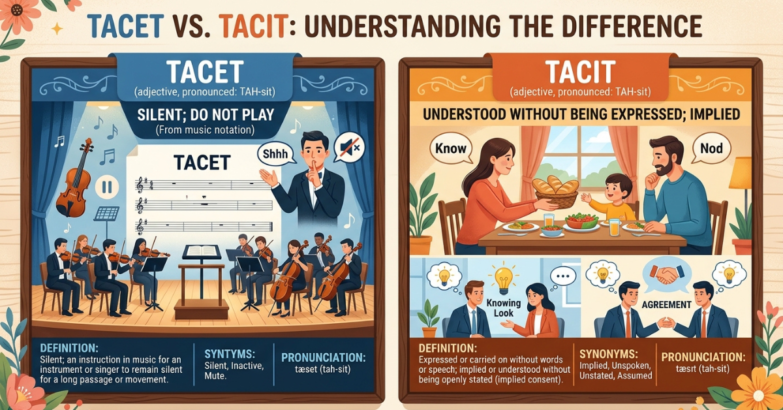
Some English words look almost identical but have completely different meanings. Tacet and tacit are a perfect example. They differ by just one letter, yet using the wrong one can change the meaning of a sentence entirely.
When comparing Tacet vs Tacit, the most important thing to remember is that tacet is primarily a musical term indicating silence, while tacit describes something understood or accepted without being directly expressed.
Although both words relate to the idea of something unspoken or absent, they belong to different contexts. Understanding their meanings, pronunciation, and usage will help you choose the right word in writing, conversation, and professional communication.
What Does Tacet Mean?
Tacet is a Latin-derived musical term meaning “it is silent” or “it remains silent.” Musicians use it in written music to indicate that a particular instrument or voice should not play during a specified section or, in some cases, an entire movement.
Unlike a general instruction to be quiet, tacet is a specific musical direction printed in a score.
Examples of Tacet in a Sentence
Here are a few examples that show how the word is used:
- Music: The flute tacet during the second movement of the symphony.
- Orchestral performance: The conductor reminded the trumpets that they tacet throughout the opening section.
- Musical notation: The score indicates that the percussion section is tacet for this movement.
The word is especially common in orchestral, chamber, and ensemble music, where individual instruments may rest while others continue playing.
What Does Tacet Mean in Sheet Music?
In sheet music, tacet tells a musician not to play for a designated passage. For example, a score might indicate that the violin section tacets during an entire movement while the other instruments perform.
This instruction is useful because it avoids the need to write repeated rests across many measures.
A related expression is tutti, an Italian musical term meaning “all” or “everyone,” which indicates that the ensemble plays together. While these terms serve different purposes, they help performers understand when to participate and when to remain silent.
Important distinction: Tacet does not necessarily mean that the entire performance stops. It generally applies to the specific instrument, voice, or musical part identified in the score.
What Does Tacit Mean?
Tacit is an adjective that describes something understood, accepted, or communicated without being explicitly stated.
It often refers to an agreement, assumption, approval, expectation, or understanding that exists even though nobody has formally expressed it in words.
For example, if two colleagues routinely cover each other’s responsibilities without discussing the arrangement, they may have a tacit understanding.
Examples of Tacit in a Sentence
Consider these everyday and professional examples:
- Workplace: There was a tacit agreement that everyone would finish the project before Friday.
- Relationships: They shared a tacit understanding that neither would discuss the private conversation.
- Business: The manager’s silence was interpreted as tacit approval of the proposal.
- Social situations: By following the established routine, the new employee accepted the team’s tacit rules.
- Legal context: The court examined whether the parties’ actions demonstrated tacit consent.
In each example, the underlying idea is understood through behavior, circumstances, or shared expectations rather than an explicit statement.
What Is a Tacit Agreement?
A tacit agreement is an arrangement that is understood through actions or circumstances rather than formally stated in words.
Imagine that two neighbors regularly take turns collecting each other’s mail while one is away. Neither person has written down the arrangement, but their repeated actions establish a mutual understanding.
That is a simple example of a tacit agreement.
In business and legal settings, however, a tacit agreement should not automatically be treated as a legally binding contract. Whether an agreement is enforceable depends on the relevant law and the facts of the situation.
Tacet vs Tacit: Key Differences
Although the spelling is similar, the words serve different purposes.
| Feature |
Tacet |
Tacit |
| Part of speech |
Musical direction; also used as a verb in musical contexts |
Adjective |
| Main meaning |
Remains silent or does not play |
Understood without being stated |
| Primary context |
Music and musical notation |
Everyday language, business, social relationships, and law |
| Example |
The oboe tacet in this movement. |
They reached a tacit agreement. |
| Related concept |
Musical silence |
Implicit understanding |
The easiest way to distinguish them is to consider what the sentence describes. If it concerns an instrument not playing, tacet is likely appropriate. If it concerns an unstated agreement or understanding, tacit is the correct choice.
Tacet vs Tacit Pronunciation
The words look alike, but their pronunciation is different.
- Tacet: Commonly pronounced TAY-set or TAH-set, depending on musical tradition and language background.
- Tacit: Pronounced TASS-it, with the first syllable sounding like “tass.”
Pronunciation can vary slightly by region, particularly for the musical term tacet. When speaking, pay attention to the context as well as the sound.
For a quick memory aid, associate tacet with a musical set of instructions and tacit with a thought that remains unspoken.
Tacet vs Tacit: How to Use Each Word Correctly
Choosing between these words becomes much easier when you identify the situation.
Use Tacet When Talking About Music
Choose tacet when referring to an instrument or musical part that should remain silent.
Correct:
“The clarinet tacet during the final movement.”
Incorrect:
“We reached a tacet agreement about the deadline.”
The second sentence is incorrect because an agreement is not a musical part.
Use Tacit When Describing an Unspoken Understanding
Choose tacit when an understanding, approval, expectation, or agreement is implied rather than directly communicated.
Correct:
“There was a tacit understanding that the meeting would begin on time.”
Incorrect:
“The trumpet was tacit during the performance.”
The second sentence should use tacet because it describes an instrument not playing.
A Simple Memory Trick
Use this quick technique to remember the difference:
- Tacet = music and silence. Think of an instrument resting during a performance.
- Tacit = implied or unspoken. Think of an understanding that does not need to be said aloud.
If you remember these two associations, you can avoid most spelling and usage mistakes.
Common Mistakes When Using Tacet and Tacit
Because the words differ by only one letter, it is easy to confuse them. Here are some common mistakes to avoid.
1. Using tacet to describe an agreement
Incorrect: “The two companies had a tacet agreement.”
Correct: “The two companies had a tacit agreement.”
An agreement is understood or implied, not a musical passage.
2. Using tacit to describe musical silence
Incorrect: “The bassoon is tacit in the second movement.”
Correct: “The bassoon is tacet in the second movement.”
The musical direction is tacet.
3. Assuming both words are interchangeable
The words are not synonyms. Although both can be associated with something that is not explicitly present, their meanings and grammatical functions differ.
4. Confusing tacit with a formal or written agreement
A tacit understanding does not necessarily involve a signed document or spoken promise. It can develop through actions, established practices, or shared expectations.
Likewise, an arrangement described as tacit is not automatically legally enforceable.
Related Words: Tacit, Implicit, and Unspoken
Understanding related vocabulary can help you use tacit more precisely.
- Implicit: Suggested or understood without being directly expressed. Example: “The instructions contained an implicit warning.”
- Unspoken: Not expressed in words. Example: “There was an unspoken tension in the room.”
- Implied: Communicated indirectly through words, actions, or circumstances. Example: “Her response implied that she disagreed.”
- Silent: Making no sound or not speaking. Example: “The room fell silent.”
These words overlap with tacit in some situations, but they are not always interchangeable. For example, tacit approval emphasizes acceptance inferred from circumstances, while silent simply describes an absence of speech or sound.
Frequently Asked Questions
1. What is the main difference between tacet and tacit?
Tacet is a musical term indicating that an instrument or voice does not play during a specified section. Tacit is an adjective describing an understanding or agreement that exists without being explicitly stated.
2. Does tacet mean silent?
Yes. In musical notation, tacet indicates that a particular instrument, voice, or musical part remains silent during a designated passage or movement.
3. Does tacit mean unspoken?
Yes, in many contexts. Tacit describes something understood, accepted, or implied without being directly expressed in words.
4. Is tacit approval the same as explicit approval?
No. Explicit approval is clearly communicated, such as through a direct statement or written confirmation. Tacit approval is inferred from actions or circumstances. Silence alone does not always establish approval.
5. Is tacit agreement legally binding?
It can be in some circumstances, but not automatically. Legal enforceability depends on the applicable law, the parties’ conduct, and whether the necessary elements of an agreement are present.
6. How do you pronounce tacet and tacit?
Tacet is commonly pronounced TAY-set or TAH-set in musical contexts. Tacit is pronounced TASS-it. Pronunciation of the musical term can vary by tradition.
7. Can tacet and tacit be used as nouns?
Tacet is primarily used as a musical direction and can function as a verb in musical descriptions. Tacit is an adjective, so it normally modifies a noun, as in “tacit consent” or “tacit understanding.”
8. What is an example of tacit understanding?
If coworkers routinely exchange shifts without formally discussing the arrangement because they both understand the routine, they may have a tacit understanding.
9. What is the opposite of tacit?
Depending on the context, possible opposites include explicit, stated, and express. For example, an explicit agreement is directly communicated, while a tacit agreement is implied.
10. Which word should I use: tacet or tacit?
Use tacet when writing about musical silence. Use tacit when describing an implied understanding, agreement, approval, or expectation.
Conclusion
The difference between tacet and tacit comes down to context. One belongs primarily to music, where it tells a performer to remain silent; the other describes an understanding that exists without being openly expressed.
When deciding which word to use, ask yourself whether you are discussing a musical performance or an unspoken idea. If the subject is an instrument that does not play, choose tacet. If it is an implied agreement or shared understanding, choose tacit.
Keep this distinction in mind, and you will be able to use both words confidently in writing, conversation, and professional communication. For more helpful vocabulary comparisons, explore related guides that explain confusing English words and their correct usage.