Have you ever said the same thing as a friend at exactly the same time, only to hear someone shout, “Jinx!”? Or perhaps you’ve heard someone blame a run of bad luck on a jinx. The word appears in everyday conversations, movies, games, and popular culture, but its spelling can sometimes cause confusion.
So, is it spelled Jinks or Jinx? The answer depends on the context, although jinx is the standard spelling when referring to bad luck, a supposed curse, or the familiar game played when two people say the same thing simultaneously.
In this guide, we’ll explore the difference between the two spellings, explain the word’s meaning and history, and share practical examples to help you use it correctly.
Jinks or Jinx: Which Is Correct?
In most everyday situations, jinx is the correct word. It is a recognized English noun and verb associated with bad luck, misfortune, and the act of supposedly bringing bad luck to someone or something.
The spelling jinks also exists in English, but it has a different meaning and is much less common in modern conversation.
Here’s a quick comparison:
| Word |
Meaning |
Example |
| Jinx |
A person, thing, or influence believed to bring bad luck; also a verb meaning to cause or bring about bad luck |
“Don’t jinx our chances of winning.” |
| Jinks |
Usually appears in the expression “high jinks,” meaning playful, noisy, or mischievous behavior |
“The children got up to some high jinks at the party.” |
If you’re talking about a curse, unlucky circumstances, or the game people play after saying the same word together, use jinx.
If you’re describing lively mischief or playful trouble, you may be thinking of jinks, particularly in the expression “high jinks.”
What Does Jinx Mean?
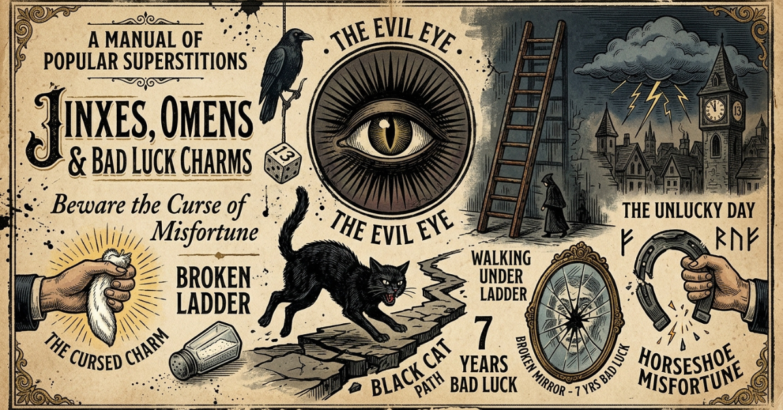
A jinx is something or someone believed to cause bad luck. The word can describe a supposed curse, an unlucky situation, or a person who seems to experience repeated misfortune.
People often use the term casually rather than literally. For example, a football fan might avoid talking about a team’s likely victory because they don’t want to tempt fate.
Consider these examples:
- “Every time I wear these shoes, something goes wrong. They must be jinxed.”
- “Don’t say we’ll definitely win. You’ll jinx it!”
- “Our team has lost three games in a row. I think we have a jinx.”
- “She believes talking about her plans too early will jinx them.”
In each case, the word expresses a belief that mentioning something, doing something, or encountering a particular person or object could bring bad luck.
Of course, there is no scientific evidence that saying a word or discussing a future event can magically cause misfortune. The expression is generally used as a superstition, joke, or figure of speech.
What Does Jinks Mean?
Unlike jinx, the word jinks is most familiar in the phrase “high jinks.” This expression refers to energetic, playful, mischievous, or sometimes slightly unruly behavior.
For example:
- “The friends spent the evening getting into high jinks.”
- “Their holiday was full of laughter and high jinks.”
- “The students’ high jinks continued long after the teacher left the room.”
The expression usually describes harmless fun, pranks, or lively activities. Depending on the context, it can also suggest behavior that is a little disruptive.
The important distinction is that jinks does not normally refer to a curse or bad luck. If someone says, “Don’t jinx me,” replacing the final letter with a k would make the spelling incorrect for that meaning.
Why Do People Confuse Jinks and Jinx?
The confusion is understandable because the two words look and sound similar. Both are short, contain the same basic letters, and are pronounced similarly in many English accents.
There are several reasons people mix them up.
1. Similar pronunciation
The words jinx and jinks can sound nearly identical when spoken. This makes it easy to choose the wrong spelling when writing from memory.
2. Familiar expressions
Many people hear the phrase “jinx!” during childhood games without learning its spelling. Others encounter “high jinks” in books, television shows, or conversations and assume the words are interchangeable.
3. Informal online communication
Text messages, social media posts, and online chats often encourage quick writing. As a result, people may type the spelling that looks familiar rather than checking which word fits the meaning.
The easiest way to avoid confusion is to remember that jinx relates to bad luck, while jinks is most commonly associated with playful mischief.
What Does Jinx Mean in Everyday Conversation?
The word has several related uses, depending on the situation.
Jinx as a noun
As a noun, jinx can refer to a supposed source of bad luck.
Examples:
- “That old superstition says the broken mirror brings a jinx.”
- “He thinks the stadium is a jinx because his team always loses there.”
- “I don’t believe in jinxes, but this week has been terrible.”
Jinx as a verb
As a verb, jinx means to supposedly bring bad luck to someone or something.
Examples:
- “Don’t jinx our holiday by predicting rain.”
- “I hope I haven’t jinxed the interview by talking about the job too soon.”
- “She was afraid to celebrate before the results arrived because she didn’t want to jinx her chances.”
The verb is especially common in casual speech. It often communicates nervousness about celebrating success before it actually happens.
Jinx as a playful exclamation
Friends sometimes say “Jinx!” when they speak the same word or phrase at the same time.
For example:
Person A: “I’m hungry.”
Person B: “I’m hungry.”
Person A: “Jinx!”
The exclamation turns an ordinary coincidence into a small social game. Some versions involve rules about who spoke first, whether the other person can speak, or whether someone must say a particular phrase to release the jinx.
These rules vary between families, schools, and friend groups. There is no single universal set of rules.
What Is the Origin of the Word Jinx?
The precise history of jinx is not completely settled, but the word became established in American English during the late nineteenth and early twentieth centuries.
It is commonly associated with superstition, curses, and unlucky influences. Its exact etymological roots remain uncertain, and proposed explanations have not all been conclusively established.
Over time, the word moved beyond its association with supernatural beliefs. Today, people use it in a wide range of everyday situations, from sports commentary to friendly teasing.
For example, an athlete might avoid discussing a potential record before a competition because they fear tempting fate. A colleague might joke that mentioning a successful project too early could bring bad luck.
This development illustrates how a word rooted in superstition can become an ordinary part of conversational English.
The related expression “high jinks” has a separate history and meaning. It is associated with boisterous entertainment and playful misbehavior rather than the idea of a curse.
How to Use Jinx Correctly in a Sentence
If you’re unsure which spelling to choose, think about the meaning you want to communicate.
Use jinx when referring to:
- Bad luck or a supposed curse.
- Someone or something believed to cause misfortune.
- The act of supposedly bringing bad luck to a situation.
- The playful exclamation used when two people say the same thing simultaneously.
Use jinks when referring to lively or mischievous behavior, particularly in the phrase “high jinks.”
Here are a few more examples to make the distinction clearer:
Correct: “Don’t jinx the game before it starts.”
Correct: “The cousins were up to their usual high jinks.”
Incorrect for the intended meaning: “Don’t jinks our chances.”
Incorrect for the intended meaning: “We have a jinks on our team.”
The last two examples use jinks where jinx is required. Remembering the difference will help you avoid common spelling mistakes.
Is Jinx a Real Word?
Yes, jinx is a standard English word found in dictionaries. It functions as both a noun and a verb.
As a noun, it can describe a supposed curse or an unlucky influence. As a verb, it means to bring or cause bad luck, usually in the sense of a superstition.
The word is also widely used informally as an exclamation during the familiar game in which two people say the same thing at once.
Although its meaning often involves superstition, using the word does not mean someone genuinely believes in curses. Many people use it humorously or simply as a familiar expression.
Is Jinks a Real Word?
Yes, jinks is also a real English word, although it is less common than jinx in contemporary everyday conversation.
Its best-known use is in “high jinks,” which describes lively, playful, or mischievous behavior. The expression can refer to anything from harmless pranks to a noisy evening with friends.
For instance, saying “The party was full of high jinks” suggests that people were having fun, joking around, and perhaps getting into a little trouble.
The word’s existence does not make it a suitable substitute for jinx. Correct spelling depends on the meaning of the sentence.
Frequently Asked Questions
1. Is it spelled Jinks or Jinx?
Both spellings exist, but they have different meanings. Jinx is the standard spelling for bad luck, a supposed curse, or the familiar exclamation used when two people say the same thing simultaneously. Jinks is most commonly seen in the expression “high jinks.”
2. What does jinx mean in simple words?
A jinx is something believed to bring bad luck. People also use the word as a verb when they think talking about an event might somehow cause it to go wrong.
3. What does jinks mean in English?
Jinks is associated with playful, noisy, or mischievous behavior, especially in the phrase “high jinks.” It is not the usual word for a curse or an unlucky influence.
4. Why do people say jinx when they speak at the same time?
People say “jinx” as part of a familiar social game when two people say the same word or phrase simultaneously. The rules vary, but the exclamation is usually meant playfully rather than as a serious claim about supernatural forces.
5. Can jinx be used as a verb?
Yes. For example, “Don’t jinx our chances of winning” uses jinx as a verb. It expresses the speaker’s concern that talking too confidently about a future outcome might bring bad luck.
6. Is being jinxed real?
There is no reliable scientific evidence that a person, word, or object can magically cause bad luck through a jinx. People generally use the concept to describe coincidences, express superstition, or joke about a streak of unfortunate events.
7. What does high jinks mean?
“High jinks” means lively, playful, or mischievous activity. For example, “The children got into high jinks during the school trip” suggests they were joking around or behaving energetically.
8. Is jinx formal or informal?
The word is used in both written and spoken English, but it is especially common in informal conversation. It can appear in formal writing when discussing superstition, language, or cultural beliefs, though a more precise term may be preferable in academic contexts.
9. What is the plural of jinx?
The usual plural noun is jinxes. For example, “He doesn’t believe in jinxes.” The spelling changes to include -es rather than simply adding s.
10. How can I remember the difference between jinks and jinx?
Associate the letter x in jinx with the idea of a curse or bad luck. For jinks, remember the expression “high jinks,” which refers to playful mischief.
Conclusion
Choosing between Jinks and Jinx becomes easy once you understand what each word means. Although both are legitimate English spellings, they are not interchangeable.
Use jinx when talking about bad luck, a supposed curse, or the game people play when they say the same thing simultaneously. Use jinks when referring to playful mischief, particularly in the expression “high jinks.”
The next time you hear someone say, “Don’t jinx it,” you’ll know exactly what they mean and how to spell it correctly. If you’re exploring confusing English words, learning the difference between similar-sounding terms is a simple way to improve your vocabulary, spelling, and everyday communication.