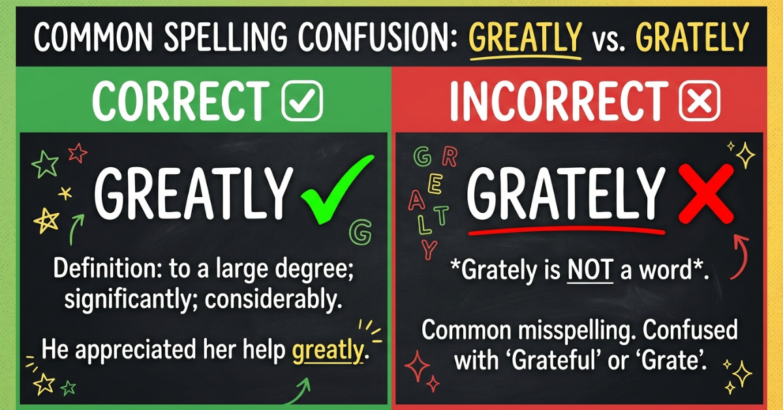
Have you ever written a sentence like “I appreciate it grately” and wondered whether the spelling looks right? You are not alone. Many people confuse Grately or Greatly because the words sound similar when spoken, but only one is the standard spelling in modern English.
The correct word is greatly. It is an adverb used to describe something that happens to a large degree or extent. Although “grately” may appear in online searches, casual writing, or spelling mistakes, it is not the accepted spelling of the word people usually intend to use.
In this guide, you will learn the difference between these spellings, understand the meaning of greatly, and discover practical examples to help you use it confidently in everyday writing.
Grately or Greatly: What Is the Correct Spelling?
Greatly is the correct spelling. It is the standard English adverb derived from the adjective “great.”
The word “great” describes something significant, impressive, or large in degree. Adding the suffix “-ly” forms “greatly,” which describes the extent to which an action or change occurs.
For example:
- Correct: I greatly appreciate your support.
- Incorrect: I grately appreciate your support.
- Correct: Her confidence has greatly improved.
- Incorrect: Her confidence has grately improved.
If you are writing an email, preparing an assignment, creating website content, or communicating professionally, always use “greatly” when you mean to express a high degree or significant extent.
What Does Greatly Mean?
Greatly means to a large extent, considerably, or very much. It is commonly used to emphasize the intensity, importance, or magnitude of an action, feeling, or change.
The word appears frequently in professional communication, academic writing, personal messages, and everyday conversations.
Here are a few examples:
- “Your advice has greatly helped me.” This means the advice was very helpful.
- “The new system greatly reduced processing time.” This means processing time decreased considerably.
- “I greatly admire her determination.” This expresses a strong degree of admiration.
- “The weather has greatly improved.” This means the weather is noticeably better than before.
In each example, “greatly” modifies a verb or describes the extent of an action or change.
Why Do People Write Grately Instead of Greatly?
There are several reasons people make this spelling mistake.
1. Similar pronunciation
In everyday speech, the difference between certain vowel sounds can be difficult to notice. Because “greatly” is pronounced with the sound found in “great,” some writers mistakenly spell it as “grately.”
2. Confusion with other words
English contains words with similar spelling patterns, including “grateful,” “gratitude,” and “greatness.” When people write quickly, they may mix up these patterns.
For example, “I am grateful for your help” is correct, as is “I greatly appreciate your help.” However, “I grately appreciate your help” is incorrect.
3. Typing too quickly
Simple typing errors can happen to anyone, particularly when writing messages, blog posts, social media captions, or emails without proofreading.
4. Learning English spelling rules
English spelling is not always predictable. Some adverbs are formed by adding “-ly” to an adjective, but writers still need to recognize the correct base word and its spelling.
A useful habit is to remember the word “great” first. When you want to describe the extent of an action, write “greatly.”
Greatly Meaning With Example Sentences
Understanding how a word works in context is often easier than memorizing its definition. Here are several examples showing how “greatly” can be used.
Greatly in Everyday Conversation
- “I greatly appreciate everything you have done for me.”
- “Your visit greatly improved my day.”
- “We greatly enjoyed our weekend together.”
- “I would greatly appreciate your feedback.”
These sentences show how the word can express appreciation, enjoyment, and the significance of an experience.
Greatly in Professional Writing
- “The updated marketing strategy greatly improved customer engagement.”
- “Your contribution has greatly benefited the team.”
- “The new software greatly simplifies our workflow.”
- “The company has greatly expanded its services.”
In business communication, “greatly” can help describe meaningful improvements, results, and contributions. However, when discussing measurable outcomes, include specific figures where available rather than relying on general statements alone.
Greatly in Academic Writing
- “The findings greatly contribute to our understanding of the subject.”
- “Environmental conditions greatly influence plant growth.”
- “Access to education can greatly affect future opportunities.”
In academic writing, the word can emphasize the extent of an effect or contribution. Use it carefully and support significant claims with reliable evidence.
Greatly vs. Grateful: Understanding the Difference
Another common source of confusion is the difference between “greatly” and “grateful.” Although both words may appear in expressions of appreciation, they serve different grammatical purposes.
| Word |
Meaning |
Example |
| Greatly |
To a large degree or extent |
I greatly appreciate your help. |
| Grateful |
Feeling thankful |
I am grateful for your help. |
| Great |
Excellent, important, or large in degree |
You did a great job. |
| Gratitude |
The feeling of being thankful |
I expressed my gratitude. |
Notice the difference between these two sentences:
- “I greatly appreciate your kindness.”
- “I am grateful for your kindness.”
Both sentences are correct, but their grammatical structures differ. “Greatly” modifies the verb “appreciate,” while “grateful” describes how the speaker feels.
Remembering this distinction can help you avoid spelling and grammar mistakes.
Synonyms of Greatly
Depending on the sentence, several words and phrases can replace “greatly.” The best choice depends on the intended meaning and tone.
Common alternatives include:
- Considerably: To a noticeable or substantial degree.
- Significantly: To an important or meaningful extent.
- Substantially: By a large amount or degree.
- Deeply: With strong feeling or intensity.
- Tremendously: To a very great degree.
- Profoundly: In a deep or far-reaching way.
- Very much: A simple, conversational alternative.
For example:
- “The changes greatly improved performance.”
- “The changes significantly improved performance.”
- “The changes substantially improved performance.”
These sentences are similar, but their nuances differ. “Significantly” may suggest importance or measurable impact, while “substantially” often emphasizes the size of a change.
Choose the synonym that best fits your sentence rather than replacing words automatically.
How to Remember the Correct Spelling
If you frequently confuse these spellings, a simple memory trick can help.
Start with “great,” then add “ly” to form “greatly.”
The spelling remains consistent:
- Great + ly = greatly
- Greatly appreciate
- Greatly improve
- Greatly influence
- Greatly increase
You can also remember a complete sentence, such as “I greatly appreciate your help.” Familiar phrases make it easier to recognize the correct spelling when writing quickly.
Before publishing an article or sending a professional email, use a spell-checking tool and read the sentence once more. Automated tools are helpful, but understanding the meaning and grammar of a word is even better.
Frequently Asked Questions
1. Is grately a real word?
“Grately” is not the standard English spelling of the adverb used to mean “to a large extent.” In most cases, writers who use it intend to write “greatly.”
2. Is greatly or grately correct?
“Greatly” is correct. Use it when describing the extent of an action, feeling, improvement, or change. For example, “I greatly appreciate your support” is correct.
3. What does greatly mean in simple words?
Greatly means “very much,” “considerably,” or “to a large degree.” For example, “This change greatly helped us” means the change helped us a lot.
4. How do you spell greatly?
The correct spelling is G-R-E-A-T-L-Y. It begins with “great” and ends with “ly.”
5. Can I say “I appreciate it greatly”?
Yes. “I appreciate it greatly” is grammatically correct and expresses strong appreciation. “I greatly appreciate it” is also correct and often sounds more natural in everyday conversation.
6. What is the difference between greatly and great?
“Great” is an adjective, while “greatly” is an adverb.
For example, “She did a great job” uses “great” to describe the job. “She greatly improved her skills” uses “greatly” to describe the extent of the improvement.
7. Is greatly formal or informal?
“Greatly” works in both formal and informal contexts. It is suitable for business emails, academic writing, reports, and everyday conversation, although simpler alternatives such as “a lot” may sound more relaxed.
8. What are some alternatives to greatly?
Depending on the context, you can use “considerably,” “significantly,” “substantially,” “deeply,” or “very much.” Each alternative has a slightly different meaning, so choose one that fits the sentence.
Conclusion
When deciding between Grately or Greatly, remember that “greatly” is the correct standard spelling. It means “to a large extent” or “very much” and is useful when describing changes, feelings, improvements, and the importance of an action.
The easiest way to remember it is to start with the word “great” and add “-ly.” Whether you are writing a professional email, completing an assignment, or publishing website content, using the correct spelling will make your writing clearer and more polished.
If you are unsure about another commonly confused English word, explore more spelling and grammar guides to build your vocabulary and write with greater confidence.