Have you ever typed a word, looked at it twice, and wondered whether the letters are in the right order? That is exactly what happens with gauge and guage. They look similar, sound the same in everyday English, and are easy to mix up when writing quickly.
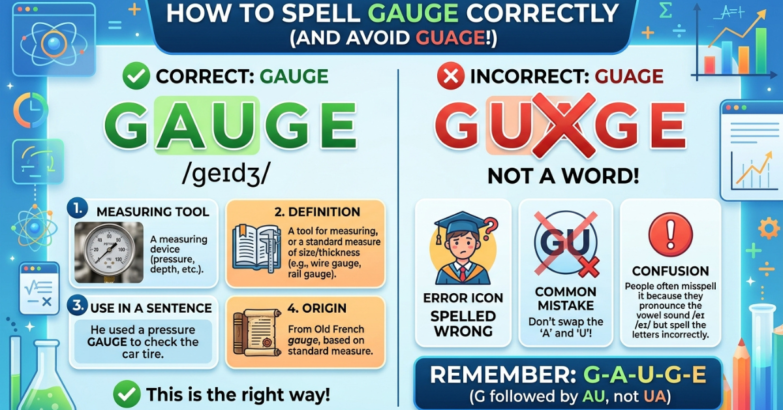
When comparing gauge vs guage, the correct spelling is gauge. The spelling guage is a common misspelling and is not accepted as the standard spelling of the word in modern English.
Whether you are writing an email, preparing a technical report, working on an assignment, or describing someone’s opinion, knowing the difference helps you communicate clearly. Let’s explore the meaning of gauge, how to use it correctly, and why this particular spelling causes so much confusion.
Gauge vs Guage: The Quick Answer
Here is the simplest way to remember the difference:
| Word |
Correct? |
Explanation |
| Gauge |
Yes |
The standard English spelling |
| Guage |
No |
A common spelling mistake |
Remember: Always write gauge, with the letters a and u appearing in that order after the initial g.
For example:
- Correct: We need to gauge customer satisfaction.
- Incorrect: We need to guage customer satisfaction.
- Correct: Check the pressure gauge before starting the machine.
- Incorrect: Check the pressure guage before starting the machine.
The important point is that gauge can be used as both a noun and a verb, depending on the context.
What Does Gauge Mean?
The word gauge has several meanings, but they generally relate to measuring, estimating, or determining something.
1. Gauge as a Noun
As a noun, a gauge is an instrument or standard used to measure something. It can also refer to a measurement itself or a particular size or thickness.
Examples include:
- Pressure gauge: Measures the pressure of a gas or liquid.
- Fuel gauge: Shows how much fuel remains in a vehicle.
- Rain gauge: Measures the amount of rainfall.
- Wire gauge: Indicates the thickness or diameter of a wire.
- Railway gauge: Refers to the distance between the inner faces of railway rails.
Example sentence: The mechanic checked the pressure gauge before repairing the equipment.
2. Gauge as a Verb
As a verb, gauge means to measure, assess, estimate, or judge something.
You do not always need a physical measuring instrument to gauge something. The word is also commonly used when discussing feelings, opinions, performance, or public reactions.
Examples:
- We conducted a survey to gauge customer satisfaction.
- It was difficult to gauge her reaction to the news.
- The company wants to gauge demand before launching its new product.
- Teachers use assessments to gauge students’ understanding.
In these examples, the word refers to evaluating or estimating something rather than taking a physical measurement.
Why Do People Confuse Gauge and Guage?
There are several reasons this spelling mistake is so common.
1. The Pronunciation Can Be Misleading
In standard English, gauge is commonly pronounced /ɡeɪdʒ/, rhyming with words such as page and cage.
The pronunciation does not clearly reveal the order of the vowels. Someone who hears the word but has not seen it written may reasonably guess the spelling incorrectly.
2. The Vowel Combination Is Unusual
English spelling does not always follow predictable patterns. In gauge, the letters au appear together, but the word is pronounced with the long-a sound heard in page.
This can make the spelling seem unintuitive, especially for people learning English or writing quickly.
3. Typing Errors Become Habits
When people repeatedly type a misspelled word, they may begin to recognize the incorrect version as familiar. This is particularly common with words that are not used every day.
Search engines and spell-checking tools can help identify such mistakes, but they are not a substitute for learning the correct spelling.
How to Use Gauge Correctly in a Sentence
The easiest way to learn a word is to see how it works in different situations.
Everyday Examples
- I tried to gauge how everyone felt about the proposal.
- She watched his expression to gauge his reaction.
- We need to gauge the amount of time required for the project.
- The manager asked for feedback to gauge employee satisfaction.
Technical and Scientific Examples
- The technician read the pressure gauge carefully.
- Use a rain gauge to measure rainfall accurately.
- The engineer checked the wire gauge before selecting the cable.
- The instrument helps researchers gauge changes in temperature and pressure.
Business and Marketing Examples
The word is also useful in professional communication, particularly when discussing research, customer behavior, and business decisions.
- The survey will help us gauge customer interest in the new service.
- Website analytics can help marketers gauge audience engagement.
- The sales team is trying to gauge demand for the upcoming product.
- Customer feedback provides a useful way to gauge brand perception.
These examples demonstrate that gauge is a versatile word suitable for casual, academic, technical, and professional writing.
Gauge vs. Measure: Is There a Difference?
Although gauge and measure have overlapping meanings, they are not always interchangeable.
Measure often suggests determining an amount, size, length, weight, or other quantity using a defined unit or method.
Gauge can mean measuring in a technical sense, but it frequently suggests making an assessment or estimate, particularly when the result is not expressed as a precise numerical value.
Compare these examples:
- Measure the table’s length using a tape measure. This refers to finding a specific physical dimension.
- Gauge the audience’s reaction to the presentation. This refers to assessing people’s responses.
- Check the pressure gauge. This refers to reading an instrument designed to indicate pressure.
The distinction is not absolute, because gauge can also involve numerical measurements. However, understanding this general difference will help you choose the most natural word.
What Is the Origin of the Word Gauge?
The history of gauge helps explain why its spelling is not immediately obvious.
The word entered English through Anglo-French and Old French forms associated with measuring, standards, and quantities. Historical spellings and pronunciations changed over time, leaving modern English with a spelling that does not always look intuitive to contemporary readers.
English contains many words whose spellings preserve elements of their historical development. For that reason, trying to determine the spelling of every word purely from its pronunciation is not always reliable.
The best approach is to learn frequently confused words in their standard written form and reinforce that knowledge through reading and practice.
Easy Ways to Remember the Correct Spelling
If you frequently confuse the two spellings, try these practical techniques.
1. Remember the Phrase “Gauge the Page”
Both gauge and page end with the same letter sequence, -age, and rhyme in standard pronunciation.
Think of this sentence: Gauge the page before you turn it.
It gives you a simple phrase to recall whenever you are unsure about the spelling.
2. Associate Gauge With Measuring Instruments
Imagine a pressure gauge on a machine or a fuel gauge in a car. Connecting the word with a familiar object makes it easier to remember its correct written form.
3. Use a Spelling Checker
Word processors and browser-based writing tools can flag guage as a potential spelling error. Still, check the suggested correction rather than accepting every automated recommendation without thought.
4. Practice With Short Sentences
Write a few sentences using the word as both a noun and a verb.
For example:
- The gauge shows the current pressure.
- We need to gauge customer interest.
- The mechanic replaced the faulty gauge.
Repeated exposure in meaningful contexts is often more effective than memorizing a spelling in isolation.
Common Mistakes to Avoid
When writing gauge, keep these points in mind:
- Do not write guage when you mean the standard English word.
- Do not assume that a word’s pronunciation tells you exactly how to spell it.
- Remember that gauge can be a noun or a verb.
- Choose between gauge and measure according to the context.
- Check spelling carefully in technical documents, professional emails, and published content.
One additional detail: gage is an established alternative spelling in certain contexts, particularly in some American technical usage and specialized terms. However, gauge is the widely recognized standard spelling for general writing. This does not make guage correct.
Frequently Asked Questions
1. Is gauge or guage correct?
Gauge is the correct standard spelling. Guage is a common misspelling and should generally be avoided in formal, academic, and professional writing.
2. Why is gauge spelled with “au”?
The spelling reflects the word’s historical development through older French forms and English usage. Its pronunciation does not make the vowel sequence obvious, which is why many writers find it confusing.
3. How do you pronounce gauge?
Gauge is generally pronounced gayj, represented phonetically as /ɡeɪdʒ/. It rhymes with page, cage, and age in standard English pronunciation.
4. What does gauge mean in simple words?
As a noun, a gauge is a device or standard used for measuring something. As a verb, it means to measure, estimate, or assess something, such as pressure, interest, or someone’s reaction.
5. Is gauge an American or British spelling?
Gauge is the standard spelling in both American and British English. The spelling does not change between these two major varieties of English.
6. Is gage also a correct spelling?
Yes, gage is an established variant used in certain contexts. Nevertheless, gauge is the safer and more widely accepted choice for general writing.
7. What is the plural of gauge?
The plural form is gauges. For example: The technician checked all the pressure gauges before starting the system.
8. Can gauge be used as a verb?
Yes. You can gauge someone’s reaction, gauge customer demand, or gauge the effectiveness of a campaign. In each case, the word means to assess or estimate something.
9. What is the difference between gauge and measure?
Measure often refers to determining a quantity or dimension, while gauge can also mean estimating or evaluating something. Their meanings overlap, so the best choice depends on the sentence.
10. How can I remember the correct spelling?
Remember the phrase “gauge the page.” Both words rhyme, and the phrase reinforces the correct spelling of gauge.
Conclusion
When it comes to Gauge vs Guage, the answer is straightforward: gauge is the correct spelling, while guage is a common spelling error.
The word can describe a measuring instrument, a standard of measurement, or the act of estimating and assessing something. From checking a vehicle’s fuel gauge to gauging customer interest in a new product, it has a wide range of everyday and professional uses.
If you find yourself hesitating between the two spellings, remember “gauge the page” and double-check your writing when necessary. A small spelling correction can make your content clearer, more credible, and easier for readers to understand.
For more practical spelling comparisons and explanations of commonly confused English words, explore related grammar and vocabulary guides to strengthen your everyday writing.