Have you ever written a message to someone you care about and suddenly wondered whether the word is friend or freind? It’s a surprisingly common spelling mistake, especially because English words don’t always follow predictable spelling patterns.
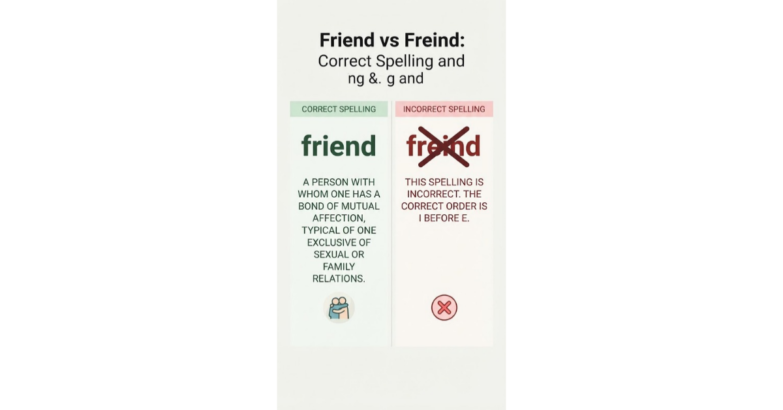
When comparing friend vs freind, the correct spelling is friend, with the letters “ie” appearing before “nd.” The spelling freind is incorrect and should not be used in standard English writing.
Whether you’re writing a birthday message, a social media caption, a school assignment, or a professional email, knowing the correct spelling helps you communicate confidently. Let’s explore the difference, meaning, pronunciation, and practical ways to remember this frequently misspelled word.
Friend vs Freind: Which One Is Correct?
The correct spelling is friend.
The word contains six letters: F-R-I-E-N-D. The incorrect spelling freind switches the positions of the letters “i” and “e.”
Here’s a quick comparison:
| Word |
Correct or Incorrect? |
Explanation |
| Friend |
Correct |
Standard English spelling |
| Freind |
Incorrect |
The letters “i” and “e” are reversed |
| Friends |
Correct |
Plural form of friend |
| Friendly |
Correct |
Describes someone who is kind or approachable |
| Friendship |
Correct |
The relationship between friends |
Remember: Write “friend,” not “freind.” The “i” comes before the “e” in this word.
What Does Friend Mean?
A friend is someone you know, like, trust, or share a meaningful relationship with. Friends often support one another, spend time together, and offer companionship during both happy and difficult moments.
The word can describe different types of relationships, from casual acquaintances to close companions.
For example:
- “My best friend has known me since childhood.”
- “She is a good friend who always listens.”
- “I met a new friend at school.”
- “A true friend supports you when life gets difficult.”
In everyday English, friend is a common noun used to describe a person with whom you have a friendly relationship.
Why Is Friend Often Misspelled as Freind?
The mistake usually occurs because people confuse the order of the letters “i” and “e.” Since English spelling is full of exceptions, writers sometimes apply familiar patterns to words that don’t follow them.
Here are some common reasons behind the error.
1. Confusion About the “I Before E” Rule
Many English learners are taught the spelling rule:
“I before E, except after C.”
This rule helps with words such as:
- Believe
- Field
- Piece
- Receive
- Ceiling
However, the rule has many exceptions and cannot be applied to every English word.
The correct spelling of friend is one example where the “ie” combination appears despite the pronunciation and spelling patterns that learners may expect.
2. Writing Too Quickly
When typing quickly, it’s easy to reverse two letters without noticing. Because freind looks similar to friend, the mistake may go unnoticed during casual writing.
This is particularly common in text messages, social media posts, and informal emails.
3. Learning English Through Pronunciation
The word friend is pronounced /frend/. The vowel sounds like a short “e,” which may make the spelling less intuitive for learners.
Since the pronunciation doesn’t clearly reveal the “ie” sequence, it’s useful to memorize the written form separately.
How to Remember the Correct Spelling of Friend
If you regularly confuse friend and freind, a simple memory trick can make the correct spelling easier to remember.
Use the “FRI-END” Memory Trick
Break the word into two parts:
FRI + END = FRIEND
Think of the phrase:
“A friend is there until the end.”
This phrase connects the spelling to the meaning of friendship and places the letters “i” and “e” in the correct order.
Another useful trick is to remember that friend contains the same “ie” sequence as words such as:
Although these words don’t share the same meaning, recognizing the letter pattern can help reinforce the spelling.
Practice Writing the Word
One of the simplest ways to remember the spelling is to use it in sentences.
Try writing these examples:
- My friend is coming over today.
- I want to thank my friend for helping me.
- A good friend always tells the truth.
- We have been friends for many years.
Repeated exposure to the correct spelling helps make it more familiar.
Friend vs Freind: Examples in Sentences
Understanding the spelling difference becomes easier when you see the word used in everyday situations.
Correct Examples Using Friend
- “My friend gave me a wonderful birthday gift.”
- “She is my closest friend.”
- “I called my friend to ask for advice.”
- “A friend in need is a friend indeed.”
- “He introduced me to his new friend.”
Incorrect Examples Using Freind
The following examples contain spelling mistakes:
- “My freind is coming tomorrow.”
- “She is my best freind.”
- “I want to meet your freind.”
- “Thank you for being my freind.”
In each sentence, replace freind with friend to make the spelling correct.
Friend, Friends, Friendly, and Friendship: What’s the Difference?
These words are related, but they serve different grammatical purposes.
| Word |
Part of Speech |
Meaning |
Example |
| Friend |
Noun |
A person you have a friendly relationship with |
“He is my friend.” |
| Friends |
Plural noun |
More than one friend |
“We are old friends.” |
| Friendly |
Adjective |
Kind, pleasant, or approachable |
“She is very friendly.” |
| Friendship |
Noun |
The relationship between friends |
“Their friendship is strong.” |
| Befriend |
Verb |
To become a friend to someone |
“He befriended his new neighbor.” |
Notice that each word retains the correct spelling pattern from friend.
Learning these related forms can improve your vocabulary and help you avoid spelling mistakes in other situations.
Is Friend a Noun or a Verb?
The word friend is most commonly used as a noun.
For example:
“My friend lives nearby.”
In this sentence, friend identifies a person.
However, friend can also be used as a verb, particularly in the context of social media. To friend someone means to add that person to your online friends list.
For example:
“I decided to friend my new classmate on Facebook.”
The spelling remains the same regardless of whether the word is used as a noun or a verb.
Is Freind Ever Correct?
No. Freind is not the standard spelling of the English word referring to a companion or someone you know and trust.
It may appear in informal messages, online comments, or typing mistakes, but it is not accepted as the correct spelling in standard English.
If you encounter the word in writing, it’s best to correct it to friend.
Frequently Asked Questions
1. Is it friend or freind?
Friend is the correct spelling. The letters “i” and “e” appear in that order, while freind is a misspelling.
2. Why is friend spelled with “ie”?
The spelling of friend follows its established historical form in English. Although the pronunciation sounds like “frend,” the standard spelling retains the “ie” combination.
3. How do you spell friend correctly?
The correct spelling is F-R-I-E-N-D. A helpful memory trick is “FRI + END,” which can remind you that the “i” comes before the “e.”
4. What is the plural of friend?
The plural form is friends. For example: “I have many friends at school.”
5. Is friend an exception to the “I before E” rule?
Yes. The word friend contains “ie,” but its spelling is not easily explained by the simplified “I before E” rule. English has many exceptions, so memorizing common words is often helpful.
6. What is the difference between friend and friendship?
A friend is a person with whom you share a friendly relationship. Friendship describes the relationship itself.
7. Is freind a real English word?
No. Freind is a common spelling error, not a standard English word. The correct form is friend.
Conclusion
When deciding between friend vs freind, the correct spelling is always friend. The word contains the letters “ie” in that order, and switching them creates a spelling mistake.
Remember the simple trick “FRI + END” to make the spelling easier to recall. Whether you’re writing a personal message, a school assignment, or a professional email, using the correct spelling helps your writing look clear and polished.
Keep practicing the word in everyday sentences, and explore more commonly confused English words to strengthen your spelling, vocabulary, and confidence in writing.