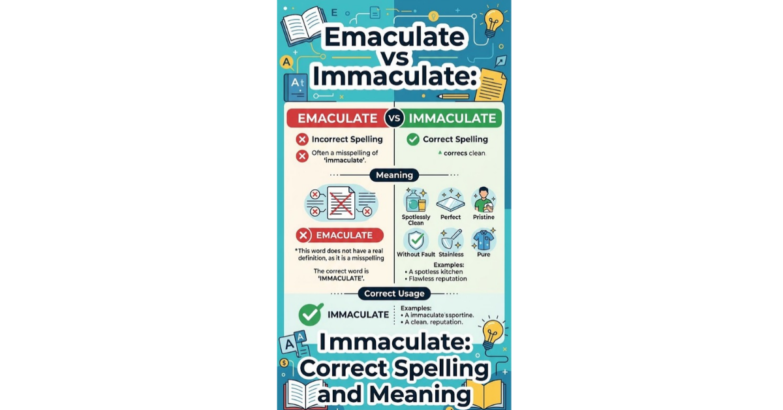
Have you ever wanted to describe a perfectly clean room, a flawless outfit, or an impressive performance but hesitated over the spelling of the word? The confusion between emaculate vs immaculate is more common than you might think. Although both forms may look plausible at first glance, only one is the standard English spelling.
The correct word is immaculate, meaning perfectly clean, neat, or free from flaws. Emaculate is a misspelling of this word and should not be used in standard English writing.
Whether you’re writing a social media caption, completing a school assignment, or preparing a professional document, knowing the difference will help you communicate more confidently. Let’s look at the meaning, pronunciation, examples, and simple ways to remember the correct spelling.
Emaculate vs Immaculate: Which One Is Correct?
Immaculate is the correct spelling. The word begins with the letters im, followed by maculate, giving us the full spelling: I-M-M-A-C-U-L-A-T-E.
Emaculate is incorrect when intended as the word meaning perfectly clean or flawless. It is not the standard English spelling found in dictionaries for that meaning.
Here’s a quick comparison:
| Spelling |
Correct or Incorrect? |
Meaning |
| Immaculate |
Correct |
Perfectly clean, neat, or without flaws |
| Emaculate |
Incorrect |
Common misspelling of immaculate |
| Immaculately |
Correct |
In a perfectly clean or flawless manner |
| Immaculateness |
Correct |
The quality of being immaculate |
| Immaculation |
Rare |
A rare word associated with making something spotless or pure |
Quick tip: If you’re describing something spotless or flawless, always write immaculate, not emaculate.
What Does Immaculate Mean?
The word immaculate is an adjective used to describe something that is exceptionally clean, tidy, or free from imperfections. It can refer to physical cleanliness, careful presentation, or something that appears flawless.
For example, an immaculate kitchen has clean surfaces, neatly arranged utensils, and no visible mess. Similarly, an immaculate suit looks perfectly maintained, with no noticeable stains, wrinkles, or damage.
The word can also describe things that are not physical. Someone might give an immaculate performance, meaning it was executed with exceptional precision and almost no mistakes.
Examples of Immaculate in Everyday Sentences
Here are some natural examples showing how to use the word correctly:
- “Her bedroom was immaculate, with everything in its proper place.”
- “He arrived at the interview wearing an immaculate suit.”
- “The hotel is known for its immaculate rooms and excellent service.”
- “The goalkeeper delivered an immaculate performance during the final.”
- “She keeps her car immaculate, inside and out.”
- “The chef presented an immaculate dish that looked almost too beautiful to eat.”
- “Their garden remained immaculate throughout the summer.”
In each sentence, immaculate communicates a high standard of cleanliness, neatness, or perfection.
Why Do People Confuse Emaculate and Immaculate?
The confusion usually comes from pronunciation, spelling habits, and unfamiliarity with the word’s origin. Because the first vowel in immaculate may sound slightly different depending on the speaker’s accent, some people mistakenly begin the word with an e.
There are a few common reasons this spelling mistake occurs.
1. The First Vowel Can Be Misheard
English vowels do not always sound the way learners expect them to. When someone hears immaculate in conversation, they might interpret the opening sound as an e and write emaculate.
However, pronunciation does not change the standard spelling. The correct first two letters are im.
2. The Word Is Less Common Than Simpler Synonyms
Words such as clean, neat, and perfect are used more frequently in everyday conversations. People who encounter immaculate less often may be unsure how to spell it.
Reading the word in different contexts can help make its spelling more familiar.
3. Typing Errors Become Habits
A person who repeatedly types emaculate may eventually become accustomed to seeing the incorrect version. This is one reason spell-checking tools and proofreading are useful, especially when writing articles, assignments, or professional messages.
How to Remember the Correct Spelling of Immaculate
If you frequently confuse emaculate with immaculate, a few simple strategies can help you remember the correct form.
Use the “I’m Immaculate” Memory Trick
Think of the phrase “I’m immaculate.” The word I’m begins with the same two letters as immaculate: I and M.
You can also divide the word into manageable parts:
IM + MACULATE = IMMACULATE
Focus on the opening im and the double m. This visual pattern makes the correct spelling easier to recognize.
Practice With a Sentence
Write the following sentence a few times:
“My room is immaculate because I clean it regularly.”
Then try creating your own sentences using the word. Practicing it in context helps you remember both its spelling and meaning.
Check Before Publishing
When you’re unsure about a word, use a trusted dictionary or spell-checking tool. This is especially helpful if you’re writing content for a website, preparing a résumé, or submitting an academic assignment.
Immaculate vs Immaculately: What’s the Difference?
Although immaculate and immaculately share the same root, they perform different grammatical functions.
Immaculate is an adjective. It describes a person, place, object, or performance.
Example: “The apartment is immaculate.”
Immaculately is an adverb. It describes how an action is performed or how something appears.
Example: “The apartment is immaculately maintained.”
Here are additional examples:
| Word |
Part of Speech |
Example |
| Immaculate |
Adjective |
“She has immaculate handwriting.” |
| Immaculately |
Adverb |
“The room was immaculately decorated.” |
| Immaculateness |
Noun |
“The immaculateness of the display impressed the visitors.” |
Understanding these forms helps you use the word accurately in different sentences.
Synonyms of Immaculate
If you want to avoid repeating immaculate in your writing, several alternatives can express a similar idea. The best choice depends on whether you’re describing cleanliness, appearance, accuracy, or quality.
Common synonyms include:
- Spotless: Completely clean, with no visible stains.
- Pristine: In its original or an exceptionally clean condition.
- Flawless: Without mistakes or imperfections.
- Perfect: Having no faults or shortcomings.
- Neat: Tidy and well-organized.
- Unblemished: Free from marks, damage, or imperfections.
- Unstained: Not marked or soiled.
- Faultless: Without errors or shortcomings.
These words are related, but they are not always interchangeable. For example, spotless usually emphasizes cleanliness, while flawless often emphasizes the absence of errors or defects.
Is Immaculate Only Used to Describe Cleanliness?
No. Although immaculate commonly describes something clean or tidy, it can also refer to excellence, precision, and the absence of flaws.
Consider these examples:
- Appearance: “He wore an immaculate white shirt.”
- Home: “They maintain an immaculate house.”
- Sports: “The player made an immaculate pass.”
- Work: “Her report was immaculate, with no errors.”
- Presentation: “The designer created an immaculate visual display.”
In each case, the word suggests that something meets an exceptionally high standard.
However, the exact meaning depends on context. Describing a room as immaculate usually refers to cleanliness, while describing a performance as immaculate emphasizes execution and precision.
Is Immaculate a Formal or Informal Word?
Immaculate works in both formal and informal English. It is suitable for everyday conversation, professional writing, academic assignments, product descriptions, and creative content.
For example, you could say, “Your shoes look immaculate” in a casual conversation. In a more formal review, you might write, “The facility maintains immaculate hygiene standards.”
The word can make descriptions more precise and expressive, especially when clean or good does not fully capture the standard you’re describing.
Frequently Asked Questions
1. Is it emaculate or immaculate?
Immaculate is the correct spelling. Emaculate is a common misspelling and should not be used when describing something perfectly clean or flawless.
2. What does immaculate mean in simple words?
Immaculate means extremely clean, neat, or free from imperfections. For example, an immaculate room is very clean and organized.
3. How do you pronounce immaculate?
In common English pronunciation, immaculate is pronounced approximately ih-MAK-yuh-lit. The exact pronunciation can vary slightly by accent.
4. What is an example of immaculate?
An example is: “Her white sneakers remained immaculate even after the long walk.” This means the sneakers stayed exceptionally clean.
5. Is immaculate a positive word?
Yes. Immaculate generally has a positive meaning because it suggests cleanliness, precision, or a lack of flaws. It can be used to compliment someone’s appearance, work, home, or performance.
6. What is the opposite of immaculate?
Common opposites include dirty, messy, stained, flawed, and imperfect. The most suitable antonym depends on the context. For example, dirty is appropriate for a room, while flawed may be more suitable for a plan or performance.
7. What is the difference between immaculate and perfect?
Immaculate often emphasizes cleanliness, presentation, or exceptional precision. Perfect is broader and can describe anything without faults or shortcomings, depending on the context.
8. Why is emaculate considered incorrect?
The standard English word is spelled immaculate, with the letters im at the beginning and a double m. The spelling emaculate does not follow the accepted spelling of this word.
Conclusion
When choosing between emaculate vs immaculate, remember that immaculate is the correct spelling. It describes something exceptionally clean, neat, precise, or free from flaws, while emaculate is a misspelling.
The easiest way to remember the difference is to focus on the opening letters IM and the double m in immaculate. Practicing the word in everyday sentences, reading regularly, and checking unfamiliar spellings can help you avoid this mistake in the future.
If you’re interested in improving your English vocabulary, explore more spelling guides covering commonly confused words. Small improvements like these can make your writing clearer, more accurate, and more professional.