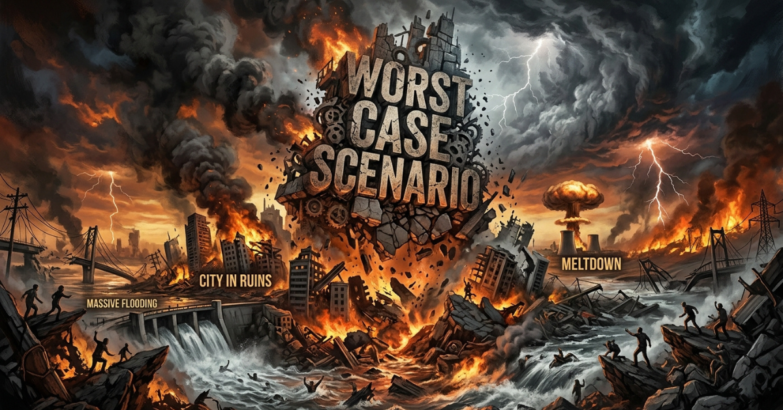
Have you ever written “worse case scenario” in a message, email, or assignment and wondered whether it was correct? You’re not alone. Many people confuse “worse case” and “worst case” because the words sound similar and both describe something negative.
However, there is a clear grammatical difference between them. If you’re talking about the most unfavorable possible outcome, the correct expression is “worst-case scenario.” The phrase “worse case” is not always grammatically incorrect, but it usually does not fit when you’re referring to the absolute worst possible situation.
In this guide, we’ll explain the difference between these expressions, show you how to use them in everyday conversations, and provide practical examples to help you remember the correct form.
Is It Worse Case or Worst Case?
“Worst case” is the correct choice when referring to the most unfavorable possible outcome.
The difference comes down to how the adjectives worse and worst work in English grammar.
- Worse: The comparative form of bad. It compares two things or situations.
- Worst: The superlative form of bad. It describes the least favorable option among three or more possibilities, or the lowest point on a scale of severity.
For example:
- Correct: “In the worst case, we may have to cancel the trip.”
- Incorrect for the intended meaning: “In the worse case, we may have to cancel the trip.”
- Correct: “This situation is worse than the one we faced last year.”
The key is simple: use worse to compare and worst to describe the most unfavorable possibility.
What Does “Worst Case” Mean?
The expression “worst case” refers to the most negative, difficult, or undesirable outcome that could reasonably happen in a particular situation.
People commonly use it when discussing risks, planning for unexpected problems, making decisions, or preparing for possible setbacks.
For example, imagine you’re preparing for a job interview. You might think about several possible outcomes:
- You receive a job offer.
- The employer asks you to attend another interview.
- You don’t get the job.
If not getting the job is the least favorable outcome you’re considering, it could be described as the worst-case scenario.
The phrase doesn’t mean that the outcome will definitely happen. It simply identifies a possibility you want to consider or prepare for.
Examples of “Worst Case” in Sentences
Here are some natural examples:
- “In the worst case, we’ll have to start the project again.”
- “The worst-case scenario is that we lose the client.”
- “Even in the worst case, we still have a backup plan.”
- “Let’s prepare for the worst-case scenario before making a decision.”
- “In the worst case, I can stay with a friend until I find an apartment.”
Notice that the phrase can be used in professional situations, casual conversations, and personal planning.
What Does “Worse Case” Mean?
“Worse case” is sometimes possible when worse is genuinely being used as a comparative adjective, but it is not the standard expression for the most unfavorable possible outcome.
For instance, consider this sentence:
“This is a worse case of food poisoning than the doctor saw yesterday.”
Here, worse compares one case with another. The sentence is grammatically possible, although “a more severe case” might sound more natural depending on the context.
Compare these examples:
- “This is a worse situation than the previous one.” — Correct comparison.
- “This is the worst situation we’ve encountered.” — Describes the most unfavorable situation.
- “In the worst case, the system will stop working.” — Correct expression for a possible negative outcome.
If you’re unsure which word to use, ask yourself whether you’re comparing two things or identifying the most unfavorable possibility.
Worse vs. Worst: Understanding the Grammar
The easiest way to understand the difference is to look at the three forms of the adjective bad.
| Form |
Meaning |
Example |
| Bad |
The basic adjective |
“The weather is bad.” |
| Worse |
A comparison between things |
“Today’s weather is worse than yesterday’s.” |
| Worst |
The most unfavorable degree |
“This is the worst weather we’ve had all month.” |
English uses comparative adjectives to compare two things and superlative adjectives to identify the highest or lowest degree within a group or range.
Other common examples follow the same pattern:
- Good → Better → Best
- Bad → Worse → Worst
- Little → Less → Least
- Much → More → Most
Remembering these patterns can help you avoid similar grammar mistakes in writing and speech.
Is It “Worst Case” or “Worst-Case”?
Both forms are correct, but the appropriate choice depends on how the phrase is used in a sentence.
When to Use “Worst Case”
Use “worst case” as a noun phrase or in an expression such as “in the worst case.”
Examples:
- “In the worst case, we will need another week.”
- “The worst case would involve a complete system failure.”
- “Let’s consider the worst case before moving forward.”
When to Use “Worst-Case”
Use “worst-case” with a hyphen when it functions as a compound adjective before a noun.
Examples:
- “We prepared a worst-case scenario.”
- “The team completed a worst-case analysis.”
- “The company developed a worst-case emergency plan.”
The hyphen helps show that the two words work together to describe the noun that follows.
A useful rule is to write “worst-case scenario” with a hyphen because the compound adjective comes directly before the noun scenario.
Worst Case Scenario vs. Worst-Case Scenario
You may see both “worst case scenario” and “worst-case scenario” online. The hyphenated form is generally preferred in edited writing because worst-case acts as a compound modifier before scenario.
For example:
- Preferred: “We need to prepare for the worst-case scenario.”
- Also commonly seen: “We need to prepare for the worst case scenario.”
The second version is widely used and easily understood, but the hyphenated version follows standard compound-modifier conventions more closely.
You can also write the phrase without a hyphen when the words are used differently:
“In the worst case, we will postpone the launch.”
Here, “worst case” is a noun phrase following the preposition in, so a hyphen is unnecessary.
Common Mistakes to Avoid
Even experienced English speakers sometimes mix up comparative and superlative adjectives. These examples can help you recognize common errors.
| Incorrect or less appropriate |
Correct or preferred |
| “In the worse case, we lose money.” |
“In the worst case, we lose money.” |
| “This is the worse result possible.” |
“This is the worst result possible.” |
| “It was the worse day of my life.” |
“It was the worst day of my life.” |
| “We prepared a worst case scenario.” |
“We prepared a worst-case scenario.” |
The first three examples use worse where the intended meaning requires worst. The final example illustrates the preferred hyphenation when the phrase modifies a noun.
How to Remember the Difference
If you frequently confuse these words, try these simple techniques.
1. Remember the comparison rule
If you’re comparing two situations, use worse.
Example: “The traffic today is worse than it was yesterday.”
2. Use “worst” for the extreme
If you’re describing the most unfavorable possible outcome, use worst.
Example: “The worst outcome would be missing the deadline.”
3. Think of “best” as the opposite
Most English speakers naturally say “best-case scenario,” not “better-case scenario,” when describing the most favorable possibility.
The corresponding negative expression is “worst-case scenario.”
4. Read your sentence aloud
If you’re discussing the most negative possible outcome, try replacing the phrase with “the most unfavorable situation.” If the sentence still makes sense, worst case is probably the expression you need.
Frequently Asked Questions
1. Is it worse case or worst case?
“Worst case” is correct when referring to the most unfavorable possible outcome. Use “worse” when comparing one situation with another.
2. Is “worse case scenario” grammatically correct?
It is generally incorrect when you mean the most unfavorable possible outcome. The standard expression is “worst-case scenario.”
3. Should I write “worst-case scenario” with a hyphen?
Yes, the hyphen is recommended when “worst-case” comes before a noun, as in “worst-case scenario” or “worst-case estimate.”
4. What is the difference between “worse” and “worst”?
“Worse” is the comparative form of bad and is used to compare things. “Worst” is the superlative form and describes the most unfavorable degree or outcome.
5. Can I say “in the worst case”?
Yes. “In the worst case” is a standard expression used to introduce the most unfavorable possible outcome.
Example: “In the worst case, we’ll have to reschedule the meeting.”
6. Is “best case scenario” correct?
Yes, but “best-case scenario” is the preferred hyphenated form when the phrase modifies a noun. It refers to the most favorable possible outcome.
7. Is “worse than worst” correct?
The phrase can appear in informal or figurative language, but it is not usually a logical comparison because worst already represents an extreme. A writer might use it for emphasis, humor, or to suggest that a situation exceeds expectations.
8. What is the plural of “worst-case scenario”?
The plural is “worst-case scenarios.”
Example: “The report examines several worst-case scenarios.”
Conclusion
When deciding between “worse case” and “worst case,” remember that the difference lies in comparison. Worse compares two things, while worst describes the most unfavorable outcome.
If you’re talking about a possible disaster, a difficult decision, or an unexpected setback, use “worst case.” When the phrase modifies a noun, such as in “worst-case scenario,” include the hyphen for clarity.
The next time you write an email, prepare a report, or discuss possible outcomes, this simple rule will help you choose the right expression confidently. For more practical English grammar explanations, explore related guides on commonly confused words and everyday writing mistakes.